
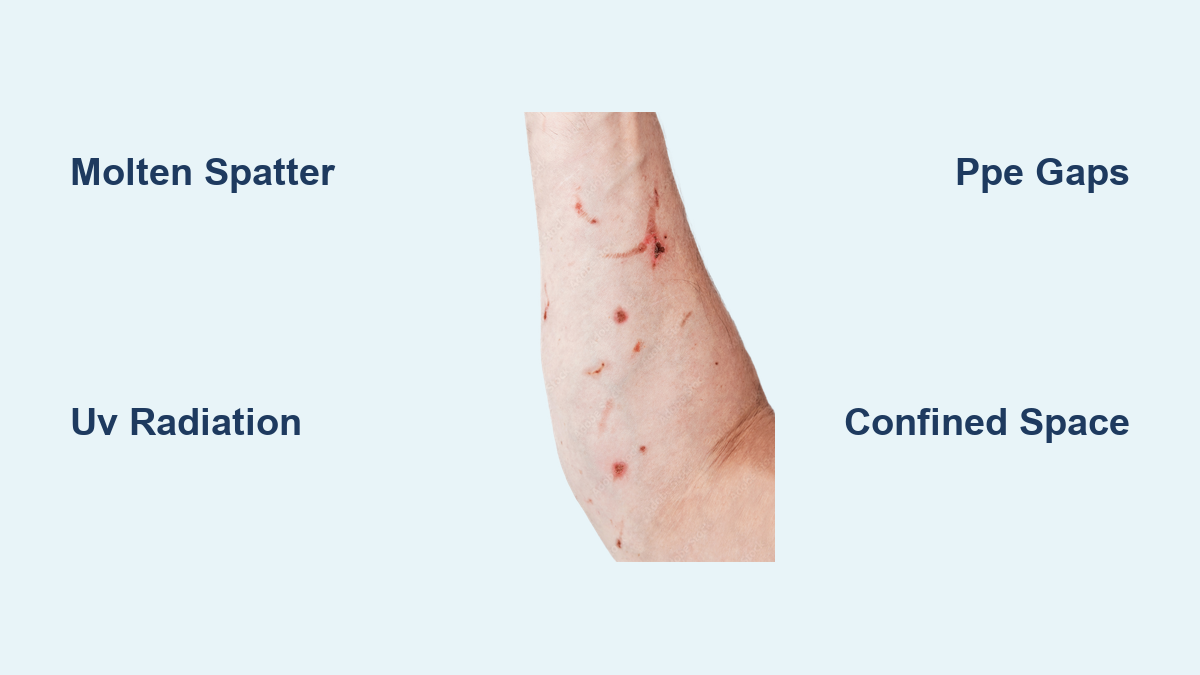
Welding burns strike unexpectedly even among experienced professionals, with thermal and radiation injuries representing the most frequent occupational hazards in metal fabrication. How do burns usually occur in welding? The answer lies in the extreme temperatures exceeding 6,500°F generated by the welding arc combined with ultraviolet radiation, flying sparks, and molten metal particles that penetrate protective gaps. Research shows welding-related eye injuries alone account for approximately 109,127 emergency department visits annually in the United States, with flash burns from UV radiation causing over 60% of these cases. Understanding these specific burn mechanisms isn’t just theoretical knowledge—it’s essential for implementing targeted prevention that keeps you working rather than sidelined by avoidable injuries.
The danger intensifies because many welding burns develop without immediate warning. Molten metal spatter can penetrate clothing gaps and continue burning beneath fabric, while UV radiation damage to your eyes often manifests hours after exposure with painful symptoms that appear suddenly. This delayed reaction creates a false sense of security that leads many welders to skip proper protection during brief welding tasks. By examining exactly how burns usually occur in welding, you’ll recognize the specific hazards in your work environment and implement prevention strategies that address your unique risk factors rather than relying on generic safety advice that may miss critical vulnerabilities.
Why Molten Metal Spatter Causes 70% of Welding Skin Burns (And How to Stop It)
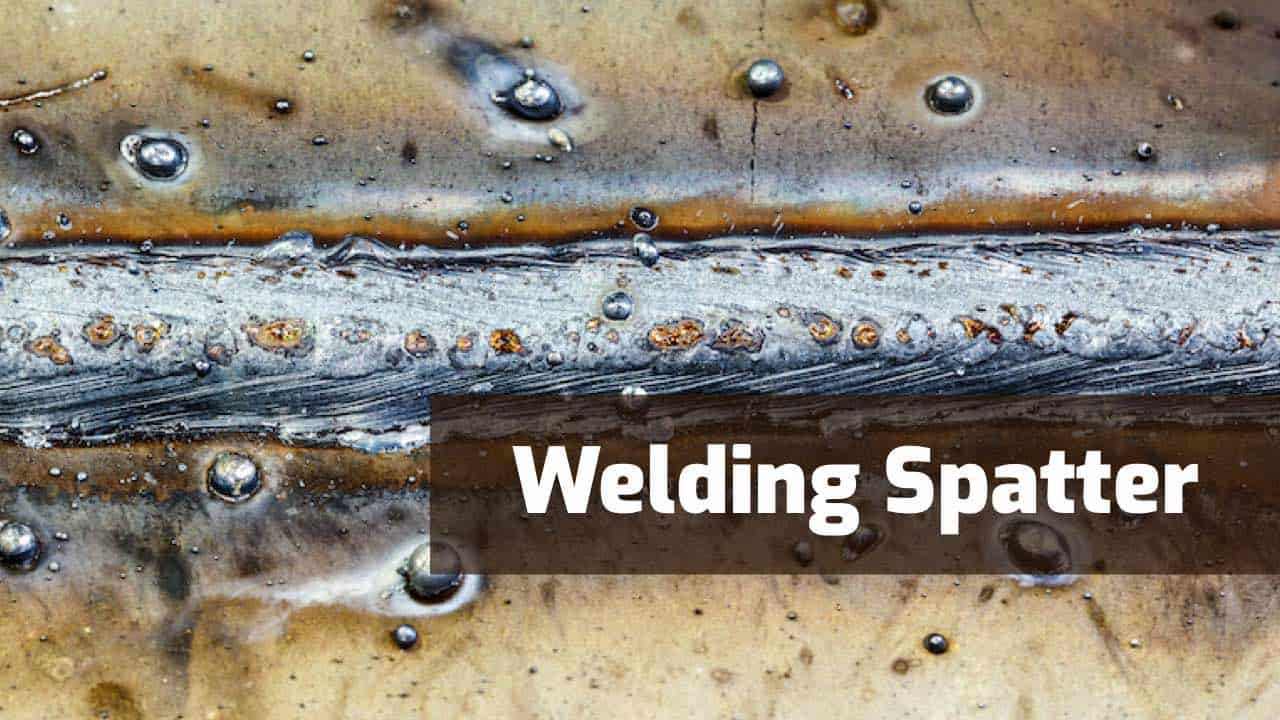
Molten metal droplets ejected during welding travel at high speeds and penetrate clothing gaps you might not even notice, creating the majority of thermal burns welders experience. Shielded metal arc welding, MIG, and flux-cored processes generate significant spatter that can travel several feet from your work area, landing on exposed skin or working through small openings in your protective gear. These metal particles remain hot enough to cause second-degree burns even after cooling slightly in flight, with the adhesive properties of molten steel or aluminum ensuring prolonged contact that deepens tissue damage beyond what brief flame exposure would cause.
How Your Clothing Gaps Become Hidden Burn Pathways
The most dangerous spatter burns occur through seemingly minor gaps in your protective coverage that you might overlook during routine work. A rolled-up sleeve cuff, an unbuttoned collar, or even the space between your gloves and jacket sleeve creates an entry point where molten particles can land directly on skin. These gaps become especially problematic during overhead welding positions when gravity pulls spatter downward toward vulnerable areas. Test your coverage by having a colleague observe you during simulated welding motions—many welders discover unexpected gaps when their posture changes from standing to bending or reaching.
Why Rural Welders Face Higher Spatter Injury Rates
Welders in agricultural and rural settings experience burn injuries at rates five times higher than urban counterparts due to environmental factors that increase spatter risk. Working outdoors exposes you to wind currents that redirect spatter toward unprotected areas, while welding in barns or farm shops often involves positioning near reflective metal surfaces that bounce hot particles back toward your body. The lack of dedicated welding booths in these environments means you’re more likely to work near flammable materials that can ignite from stray sparks, creating secondary burn hazards beyond direct spatter contact.
Why Your Eyes Burn Hours After Welding (The UV Radiation Trap)
Welder’s flash—radiation burns to your cornea—typically develops 6-12 hours after UV exposure, creating a dangerous misconception that brief welding without eye protection is safe. The welding arc produces intense ultraviolet radiation equivalent to staring directly at the sun, with exposure as short as 15 seconds sufficient to damage corneal tissue. Unlike thermal burns that cause immediate pain, UV radiation damage progresses silently until symptoms like intense eye pain, sensitivity to light, and the sensation of sand in your eyes suddenly appear hours later, often while you’re trying to sleep.
How Auto-Darkening Helmets Fail Without Proper Maintenance
Your auto-darkening welding helmet provides critical protection against flash burns only when properly maintained and correctly adjusted. Many welders unknowingly compromise their eye safety by using helmets with scratched lenses that scatter UV radiation, or failing to set the correct shade number for their specific amperage settings. Shade 10 might work for low-amperage TIG welding, but MIG operations at higher currents require shade 12 or 13 to block sufficient radiation. Test your helmet’s response time monthly—delays longer than 1/20,000th of a second allow damaging UV exposure during arc initiation.
Why Bystanders Get Flash Burns from Reflected Radiation
You don’t need to be the person welding to suffer radiation burns—reflected UV radiation from walls, machinery, or even light-colored work surfaces can cause flash burns to nearby workers. This explains why 30% of welding-related eye injuries occur to assistants, inspectors, or other personnel working within 10 feet of welding operations. Establish protective barriers around your welding area using UV-absorbing curtains, and require all personnel within 25 feet to wear safety glasses with UV protection (ANSI Z87.1+ rating), not just standard clear lenses that provide zero radiation defense.
How Faulty PPE Creates Hidden Burn Vulnerabilities

Damaged or improperly worn protective equipment accounts for nearly half of all preventable welding burns, with compromised gear providing false security that leads to increased risk-taking. A single hole in your welding glove or a small tear in your jacket sleeve creates a vulnerability where molten metal can contact skin directly. Leather gloves lose protective value when saturated with sweat or oil, while cotton underlayers beneath flame-resistant clothing can ignite and continue burning when exposed to sparks—contrary to the common misconception that inner layers provide additional protection.
The 3 Most Common Helmet Mistakes That Cause Facial Burns
Your welding helmet protects against more than eye damage—it’s your primary defense against facial burns from spatter and radiation. Yet three critical errors undermine this protection: raising the helmet too soon after arc termination (exposing your face to lingering radiation), improper head positioning that creates gaps between helmet and jacket collar, and using helmets with damaged side windows that allow peripheral radiation exposure. Always lower your helmet before striking the arc and keep it in position for at least 10 seconds after welding stops to avoid these preventable facial burns.
Why Standard Work Boots Increase Foot Burn Risk
Regular work boots with synthetic materials or exposed laces create significant burn hazards that many welders overlook. Molten spatter penetrates fabric laces and melts synthetic uppers, trapping hot particles against your skin. Opt for leather boots with high tops that tuck inside your pant legs, and avoid boots with exposed stitching that can catch and hold sparks. Check your footwear after each welding session for spatter accumulation—what looks like harmless ash may still contain particles hot enough to burn through fabric when disturbed later.
Why Working in Confined Spaces Doubles Your Burn Risk
Confined spaces like tanks, pipes, or enclosed structures multiply burn hazards through three dangerous mechanisms: restricted movement that limits quick withdrawal from hazards, reflective surfaces that intensify radiation exposure from multiple angles, and heat accumulation that raises ambient temperatures beyond safe levels. Welders in confined spaces face up to twice the burn injury rate compared to open-area welding due to these compounding factors that transform routine tasks into high-risk operations.
How Heat Buildup Creates Unexpected Burn Pathways
The enclosed nature of confined spaces traps heat that would normally dissipate in open areas, raising surface temperatures on surrounding metal to levels that can cause contact burns through protective clothing. What begins as a safe 200°F surface in open air can exceed 400°F in a confined space within minutes of welding, hot enough to damage synthetic fibers in your protective gear and transfer heat to your skin. Monitor ambient temperature with a handheld infrared thermometer before starting work, and implement forced-air ventilation to maintain surface temperatures below 140°F—the threshold where contact burns become likely through clothing.
The Critical Gap Between Torch Handling and Protective Gear
Your arm movement while welding in tight spaces often pulls protective sleeves away from your gloves, creating temporary gaps where spatter can enter. This happens most frequently when welding overhead positions in confined areas, as gravity works against maintaining proper coverage. Use gauntlet-style welding gloves that extend over your jacket sleeves, and secure the overlap with flame-resistant tape during confined space work. Perform a “reach test” before starting—bend and reach as you would during welding to ensure continuous coverage throughout your full range of motion.
How to Treat Welding Burns Within the Critical First 20 Minutes
Immediate response to welding burns determines whether minor injuries heal quickly or develop into serious complications requiring medical intervention. For thermal burns, cool running water applied within the first 3 minutes reduces tissue damage by 40% compared to delayed treatment, but water temperature matters—use cool (60-70°F) water for 15-20 minutes rather than ice-cold water that can cause additional tissue damage through vasoconstriction. Never apply butter, oil, or home remedies that trap heat and increase infection risk.
Why Rubbing Flash Burns Makes Eye Damage Permanent
The instinct to rub burning eyes after UV exposure worsens welder’s flash by scratching the already damaged corneal surface. Instead, immediately remove yourself from the welding area and apply preservative-free artificial tears every 5 minutes while waiting for medical care. Place a clean, cool compress over closed eyes without pressure—never rub or apply pressure that could dislodge damaged epithelial cells. Seek emergency eye care within 4 hours, as delayed treatment increases the risk of permanent corneal scarring that affects vision long-term.
The Burn Severity Checklist That Determines Medical Response
Not all welding burns require emergency care, but knowing which do could prevent long-term damage. First-degree burns (red, painful skin without blisters) typically heal in 3-6 days with basic first aid. Second-degree burns (blisters, intense pain, swelling) covering less than 3 inches require medical evaluation within 24 hours. Third-degree burns (white or charred skin, possible lack of pain due to nerve damage) or any burn involving eyes, hands, feet, or major joints needs immediate emergency care. When in doubt, seek professional evaluation—welding burns often appear less severe initially than they actually are.
Essential Burn Prevention Checklist for Every Welding Job
Preventing welding burns requires specific actions tailored to your current task rather than generic safety routines. Before striking an arc, verify your protective equipment matches the specific hazards of your welding process: shade 10 for low-amperage TIG (under 100A), shade 12 for MIG at medium currents, and shade 13+ for high-amperage operations. Check all protective gear for holes, thinning material, or compromised seams—replace items showing any wear rather than risking exposure. Ensure complete coverage by performing the “gap test”: have a colleague shine a flashlight around your silhouette to identify any unprotected areas where light penetrates.
The Shade Number Formula for Your Exact Welding Process
Your helmet’s shade number must match both your welding process and amperage range to provide adequate protection. Use this formula: for Stick welding, shade = (amperage ÷ 100) + 8; for MIG, shade = (amperage ÷ 100) + 9; for TIG, shade = (amperage ÷ 100) + 7. A 150-amp MIG operation requires shade 10.5 [(150 ÷ 100) + 9 = 10.5], so select the next highest standard shade (11). Incorrect shade selection—either too light (inadequate protection) or too dark (reduced visibility leading to errors)—creates unnecessary risk that could result in flash burns or thermal injuries.
The 3-Second Coverage Verification Test Before Every Weld
Before starting any welding task, perform this quick verification: assume your welding position and have a colleague check for gaps in your protective coverage using a bright light. Pay special attention to wrist-cuff junctions, neck openings, and ankle areas where spatter commonly penetrates. The test should take no more than 3 seconds—if you need to adjust your gear during this check, you’re not ready to weld. This simple routine catches 90% of coverage issues that lead to preventable burns, especially important when switching between welding positions that alter how your protective gear fits during the task.
Understanding how burns usually occur in welding transforms safety from a theoretical concern into actionable protection that keeps you working. By recognizing the specific mechanisms—molten metal spatter penetration, delayed UV radiation damage, PPE failures, and confined space hazards—you can implement targeted prevention that addresses your actual risk factors rather than relying on generic safety advice. Always verify your protective coverage before welding, match your equipment to the specific task requirements, and respond immediately to any burn incident using proper first aid protocols. These evidence-based practices reduce your risk of the most common welding injuries and ensure you maintain both your health and productivity on the job.
Leave a Reply