
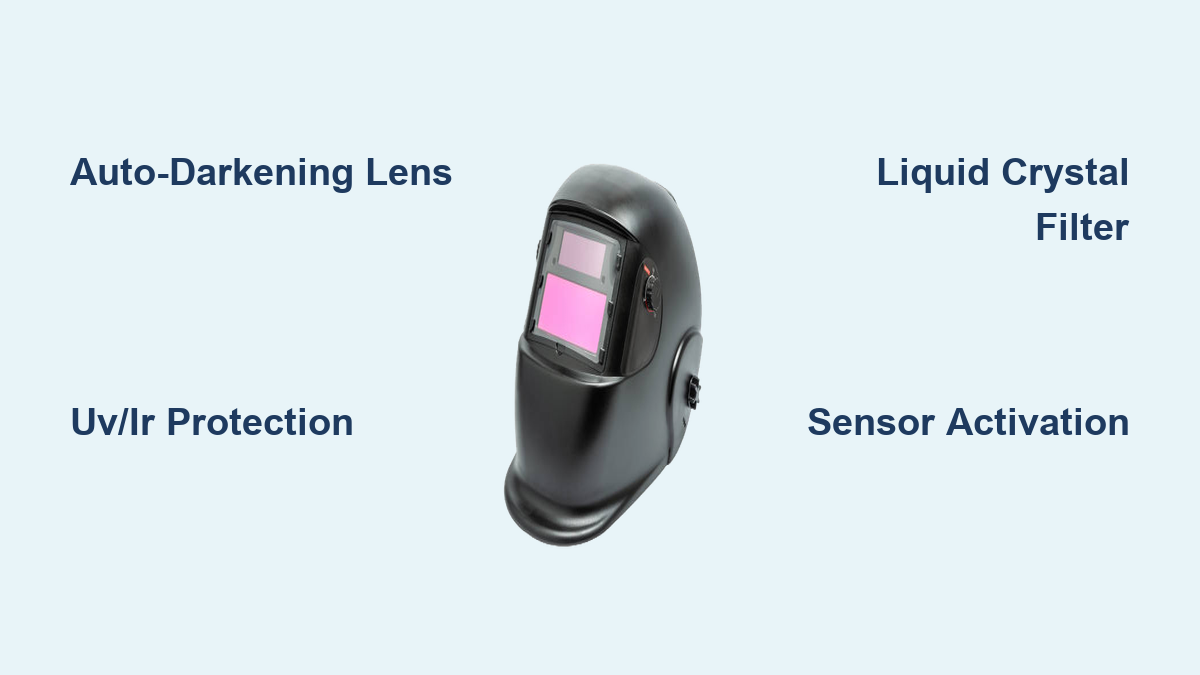
Welding produces some of the most intense artificial light known to industry, with arc brightness that can exceed 10,000 lumens at its source. Without adequate protection, this extraordinary light output—combined with significant ultraviolet and infrared radiation—can cause permanent eye damage in fractions of a second. How do welding masks work to prevent this? They combine carefully engineered optical filters with sophisticated electronic systems that respond instantaneously to changing light conditions, creating a protective barrier between the welder’s eyes and hazardous radiation. Understanding how these devices function isn’t just technical curiosity—it’s essential for selecting the right equipment and ensuring your vision remains protected throughout your welding career.
The evolution from simple fixed-darkness glass to today’s auto-darkening helmets represents a remarkable journey in protective technology. Traditional passive masks rely on permanently darkened glass that absorbs radiation across the full light spectrum, while modern electronic helmets use liquid crystal displays that can transition from nearly transparent to deeply shaded within milliseconds. Both approaches achieve the same fundamental goal—blocking harmful radiation while allowing sufficient visible light for weld positioning—but they differ dramatically in implementation, convenience, and protection flexibility. This guide examines the physics behind welding hazards, the technical mechanisms that counteract them, and the practical considerations that determine how effectively your welding mask protects you.
What Makes Welding Light Dangerous to Your Eyes
Ultraviolet Radiation Threats
Ultraviolet radiation poses the most acute danger to unprotected welders, with wavelengths between 100 and 400 nanometers carrying enough energy to damage biological tissues at the molecular level. UV-C and UV-B wavelengths are largely absorbed by the cornea and conjunctiva, causing inflammation that results in the intensely painful condition known as arc eye or photokeratitis. Even brief exposure—measured in seconds rather than minutes—can produce corneal burns severe enough to disable you for days. UV-A wavelengths penetrate more deeply, reaching the lens of the eye where they contribute to long-term cataract formation, meaning that cumulative exposure over your welding career can produce lasting vision damage even when individual exposures are too brief to cause immediate symptoms.
Infrared and Visible Light Hazards
Infrared radiation, extending from 700 nanometers into the far-infrared range, carries significant thermal energy that heats ocular tissues gradually over extended exposure periods. Unlike the immediate pain response triggered by UV damage to corneal nerves, IR exposure produces cumulative effects that may not manifest until years of exposure have accumulated. The lens of the eye is particularly susceptible to IR-induced opacification, and thermal burns to facial skin can occur during prolonged welding sessions without adequate protection. This thermal component operates silently alongside the more immediately dangerous UV radiation, making consistent protection essential for long-term eye health. Visible light from the welding arc appears brilliantly bright because its intensity rivals or exceeds that of direct sunlight, overwhelming the retina’s sensory capabilities and causing temporary blindness, persistent afterimages, and visual fatigue that impairs both safety and weld quality.
Traditional Passive Welding Masks: Fixed Protection Limitations
Fixed Shade Lens Construction
Passive welding helmets contain permanently darkened glass or polymer lenses that provide constant protection regardless of ambient light conditions or welding state. These traditional designs utilize one or more layers of specialized optical material that absorbs or reflects harmful radiation across the full spectrum, from UV through visible light to IR. The outermost layer is typically a cover plate made from tempered glass or polycarbonate that protects the inner filter from physical damage, molten metal spatter, and scratches that could compromise optical clarity. Beneath the cover plate sits the actual filter element, containing light-absorbing compounds that give the lens its characteristic dark appearance.
Filter glass traditionally incorporates metal oxides—particularly iron, chromium, cobalt, and rare earth elements—that absorb specific wavelengths of radiation. These metallic compounds are either suspended within the glass matrix during manufacturing or applied as surface coatings, with the concentration and combination determining the filter’s spectral response, shade number, and color balance. The resulting glass blocks harmful radiation while transmitting a portion of the visible spectrum, allowing you to see the weld pool and surrounding metal.
Limitations of Fixed-Darkness Designs
Passive welding masks require you to physically raise and lower the helmet between weld operations, creating several significant drawbacks. When you lift the helmet to position yourself for the next weld, your eyes are suddenly exposed to the bright arc, triggering a startle reflex that can cause missed welds, poor weld starts, or flinching that produces inconsistent results. This constant lifting and lowering also creates ergonomic strain on your neck and shoulder muscles, contributing to fatigue during extended welding sessions that can affect both productivity and safety over the workday.
Color distortion represents another meaningful limitation of traditional dark glass filters. The metallic compounds used to absorb radiation typically produce a greenish or amber tint that alters color perception in the weld pool and surrounding metal. This color shift makes it difficult for you to distinguish between different metal temperatures, identify weld penetration patterns, or detect porosity and other defects that depend on subtle color variations. The inability to see colors accurately can affect weld quality in applications where temperature indication or material identification matters.
Auto-Darkening Welding Helmets: Complete Technical Analysis

Liquid Crystal Technology in Action
Auto-darkening helmets employ liquid crystal display technology that enables the lens to transition between light and dark states within milliseconds of detecting arc ignition. The liquid crystal layer within these filters contains nematic or twisted nematic liquid crystal molecules that have the unique property of being able to rotate the plane of polarized light when an electric field is applied. In their relaxed state with no voltage applied, these molecules form a twisted helical structure that allows light polarized in a specific direction to pass through and have its polarization rotated by 90 degrees, enabling it to pass through a second orthogonal polarizer. When voltage is applied, the molecules align with the electric field, eliminating the twisting effect and preventing light from passing through the crossed polarizers.
Modern auto-darkening helmets typically employ two or more liquid crystal layers operating in series to achieve higher contrast ratios and faster switching times. Each layer can be controlled independently, allowing for more precise modulation of light transmission and improved optical clarity. The space between liquid crystal layers is filled with a polymer matrix that maintains uniform cell spacing while providing structural stability against physical shock and temperature variations. Response time is the critical performance specification for liquid crystal-based auto-darkening filters, with high-quality helmets achieving switching speeds of 1/20,000 to 1/30,000 of a second. This near-instantaneous response ensures that no detectable arc light reaches your eyes.
Sensor Systems and Control Circuitry
Auto-darkening helmets employ arrays of photodetectors that continuously monitor ambient light levels and trigger the darkening response when arc light is detected. These sensors are typically positioned around the viewing area—in corners, along edges, or behind the filter glass itself—and are designed to detect the characteristic spectral signature of welding arcs rather than simply responding to general brightness increases. High-quality helmets incorporate four or more sensors positioned to ensure detection regardless of the arc’s position relative to your line of sight.
The control electronics within auto-darkening helmets manage sensor signal processing, filter activation, shade adjustment, and delay timing functions. Power for electronic systems typically comes from replaceable batteries, usually lithium or alkaline cells providing 3 to 6 volts depending on helmet design. Some helmets incorporate solar cells that can extend battery life by providing supplemental charging during operation or maintaining charge during storage. Power consumption of modern auto-dimming helmets is relatively low, with quality batteries typically lasting 1,500 to 3,000 hours of active welding before requiring replacement.
Essential Components That Make Your Welding Mask Effective

Viewing Window Design and Optical Assembly
The viewing window determines your field of view and directly impacts productivity and safety, with standard sizes ranging from approximately 3.5 by 5 inches to larger formats exceeding 6 by 4 inches. The size of the viewing area affects how much of the weld pool and surrounding metal you can see without head movement, with larger windows generally providing better visibility and reduced neck fatigue during extended welding sessions. The geometry of the viewing window influences optical characteristics, with curved surfaces providing better optical quality than flat designs by reducing reflections and improving peripheral vision.
The filter assembly within an auto-darkening helmet consists of multiple functional layers laminated together. From front to back, these layers typically include an outer cover plate with anti-reflective coating, the first polarizer film, the first liquid crystal cell layer, a spacer or second polarizer, the second liquid crystal cell layer, the rear polarizer, and an inner cover plate. Each layer must be precisely manufactured and assembled to ensure optical clarity and consistent performance across the viewing area.
Headgear and Ergonomic Features
The headgear system distributes the helmet’s weight across your head and provides adjustment mechanisms for fit and positioning. Quality headgear incorporates multiple adjustment points including crown height, pivot angle, head circumference, and distance from face. These adjustments allow you to customize the helmet fit for your individual head shape and size, as well as accommodate varying work positions and preferences.
Suspension systems in modern helmets typically feature ratchet-style or smooth-adjustment headbands that allow one-handed operation. Some designs incorporate spring-loaded or pneumatic systems that counterbalance the helmet’s weight, reducing neck strain during prolonged use. Chin cups and neck covers provide additional protection and help seal the helmet against spatter and UV leakage. These components are typically made from heat-resistant materials such as Nomex or similar aramid fibers that can withstand high temperatures and repeated exposure to molten metal spatter without degrading.
Standards, Certifications, and Safety Compliance

ANSI Z87.1 Requirements for Welding Helmets
The American National Standards Institute Z87.1 standard establishes requirements for occupational and educational eye and face protection, including welding helmets and face shields. Helmets meeting ANSI Z87.1 must pass rigorous testing for optical quality, impact resistance, coverage area, and light transmission characteristics. This certification ensures that protective equipment meets minimum safety requirements for use in industrial environments.
Optical quality requirements under ANSI Z87.1 include limits on refractive power, prism deviation, and optical distortion to ensure that you can see clearly through the filter without eye strain or visual distortion. Filters must maintain their optical properties across the entire viewing area, not just at the center point. Impact resistance testing requires that helmets withstand impacts from a steel ball dropped from specified heights without the filter fragmenting or allowing objects to penetrate.
EN 379 European Standard for Automatic Filters
The European Standard EN 379 specifies requirements for automatic welding filters, including optical class defining quality grades for optical clarity, shade number accuracy, and switching characteristics. Filters are classified by optical class with Class 1 representing the highest optical quality and Class 3 representing acceptable minimum quality for industrial use.
The EN 379 optical classification system rates filters on four parameters: optical power (refractive error), prism deviation, variations in optical power across the viewing area, and variations in shade number across the viewing area. Each parameter receives a class rating of 1, 2, or 3, with Class 1 being best. High-quality welding helmets typically achieve Class 1 ratings across all parameters, indicating superior optical performance throughout the viewing area.
Maintenance and Troubleshooting for Reliable Protection
Essential Maintenance Procedures
Welding helmets should be inspected before each use for signs of damage, wear, or contamination that could compromise protection or visibility. The outer cover plate should be examined for scratches, cracks, pitting from spatter, or discoloration that could reduce visibility or optical clarity. Any damage to the cover plate may require replacement to maintain optimal protection and visibility.
Battery replacement intervals depend on usage patterns and battery type, but most auto-darkening helmets provide thousands of hours of operation on a single set of batteries. Low battery indicators, typically visible as flashing LEDs or dimming indicators, alert you when battery replacement is needed before power becomes insufficient for proper filter operation. Some helmets incorporate rechargeable battery systems or solar-assisted charging that can significantly extend battery life.
Common Troubleshooting Scenarios
When an auto-darkening helmet fails to darken upon arc ignition, the most common causes include depleted batteries, obstructed or damaged sensors, or electronic failure. Begin troubleshooting by replacing the batteries with fresh cells of the correct type. If the problem persists, inspect the sensor windows for contamination, damage, or obstruction that might prevent arc detection.
Slow switching response can result from low battery voltage, extreme temperature conditions affecting liquid crystal response time, or electronic component degradation. Cold temperatures significantly increase liquid crystal response time, and some helmets include temperature compensation circuits to mitigate this effect. Flickering during welding may result from sensor placement that causes partial arc detection, electrical interference affecting control circuits, or marginal battery voltage.
Understanding How Your Welding Mask Protects You
Welding masks work through a sophisticated combination of optical filtration, electronic sensing, and responsive filter technology that protects you from the intense light and radiation generated during welding processes. Traditional passive masks rely on permanently darkened glass or polymer filters that absorb harmful radiation across the visible, ultraviolet, and infrared spectrum, while modern auto-darkening helmets employ liquid crystal technology that can transition from transparent to dark states within fractions of a millisecond. The liquid crystal layers sandwiched between polarizers align in response to electrical voltage, blocking light transmission when arc light is detected by photoelectric sensors.
This electronic system enables dynamic protection that adjusts to actual welding conditions, providing optimal visibility for setup and positioning while ensuring complete protection during active welding. Understanding how your welding mask works enables informed selection, proper usage, and effective maintenance of this essential protective equipment. Regular inspection, proper maintenance, and timely replacement of worn components ensure that your welding mask continues providing the reliable protection that prevents the serious eye injuries that welding light can cause. Whether you’re using a simple passive helmet or a sophisticated auto-darkening model, knowing how it protects your vision is crucial for maintaining safety throughout your welding career.
Leave a Reply