
Cold welding stands apart from every other metal joining technique you might know. Unlike the blazing heat of arc welding or the molten pools of torch welding, this remarkable process bonds metals without any heating at all. Two pieces of metal fuse together in their solid state, with atoms from each surface crossing the boundary to form a seamless join. The phenomenon even caught NASA off guard when spacecraft components started unexpectedly bonding in the vacuum of space. Understanding how cold welding works reveals fascinating insights about atomic behavior, material science, and the hidden challenges of operating in outer space.
This guide walks you through the atomic mechanisms that make cold welding possible, the precise conditions required for success, and the practical applications where this unusual technique provides advantages that conventional welding simply cannot match. Whether you’re an engineer exploring joining options, a student curious about materials science, or someone who encountered the term in the context of spacecraft failures, you’ll find clear answers here.
Why Metal Atoms Bond Without Heat: The Atomic Secret
Cold welding happens because metal atoms can’t distinguish between themselves when clean surfaces make contact. When two pieces of identical metal touch under perfect conditions, the atoms lose awareness of the boundary separating them. This phenomenon explains how cold welding works at the most fundamental level.
The electron “sea” in metals allows atoms to share electrons freely across what was once a boundary. When clean metal surfaces meet, their electron clouds overlap seamlessly, creating metallic bonds as if the metal were never separated. Your kitchen aluminum foil doesn’t weld to itself because surface oxides and oils prevent this atomic connection.
This atomic-level explanation might sound theoretical, but it describes a real physical process observed in laboratory settings. The key is achieving conditions where atoms can make direct contact without interference from contaminants that would otherwise provide “information” about which piece they belong to.
How Surface Contamination Blocks Atomic Bonding
Surface oxides form almost instantly on most metals exposed to air. Aluminum develops an oxide layer within seconds, while steel forms rust when moisture is present. These layers act as impenetrable barriers preventing atomic contact.
Even microscopic amounts of oil, grease, or atmospheric contaminants stop cold welding from occurring. Your hands leave oils that would prevent bonding, which is why technicians wear gloves during surface preparation. In normal environments, these contamination layers are why cold welding doesn’t happen spontaneously between metal objects.
The Critical Role of Identical Metal Composition
Cold welding works best between identical metals because their atomic structures match perfectly. Copper bonds readily with copper, aluminum with aluminum, and gold with gold. The matching crystal structures allow atoms to interlock seamlessly across the interface.
Dissimilar metals present challenges due to mismatched atomic sizes and crystal structures. While some combinations like gold to silver can cold weld under controlled conditions, the resulting joints typically show lower strength than similar-metal welds.
Required Pressure Levels for Different Metals: Copper vs Aluminum vs Steel

Pressure serves as the mechanical force that drives cold welding by forcing surfaces into intimate contact. The amount of pressure needed varies dramatically based on the metal’s properties.
Softer metals like copper require relatively modest pressures—typically 30-50% of their yield strength. Aluminum needs slightly higher pressures due to its natural oxide layer, while steel demands significantly more force because of its hardness and stable oxides. Gold and silver, being extremely ductile, can cold weld with minimal pressure when surfaces are perfectly clean.
How Pressure Overcomes Surface Imperfections
All metal surfaces have microscopic peaks and valleys, even when they appear smooth. Applied pressure deforms these asperities, increasing the actual contact area between surfaces. This deformation breaks through any remaining ultra-thin contaminant films that cleaning might have missed.
The relationship between pressure and contact area follows a predictable pattern: higher pressure creates more bonding sites. However, excessive pressure can cause unwanted deformation or damage surrounding material, so finding the optimal pressure range is crucial for quality welds.
Time-Pressure Relationship for Strong Bonds
Cold welding doesn’t always happen instantly. Some joints form strong bonds almost immediately under proper pressure, while others benefit from a brief holding period that allows atomic diffusion to strengthen the connection.
For copper wire connections, holding pressure for just 1-2 seconds often creates reliable bonds. Aluminum may require 3-5 seconds due to its oxide layer, while steel connections might need longer dwell times. The optimal time depends on material properties and the specific application requirements.
Why Cold Welding Happens in Space But Not on Earth
The vacuum of space provides the perfect environment for cold welding by eliminating atmospheric contamination. Without oxygen and moisture, freshly cleaned metal surfaces remain pristine for extended periods rather than forming immediate oxide layers.
This discovery explained puzzling satellite failures where components that should have moved freely instead seized permanently. The Galileo spacecraft high-gain antenna anomaly from 1991 resulted from cold welding in space—a mission-critical mechanism became permanently bonded due to the vacuum environment.
How Spacecraft Engineers Prevent Unwanted Cold Welding
Modern spacecraft designers employ multiple strategies to prevent accidental cold welding. They select materials less prone to bonding, apply special surface treatments like gold plating or lubricants, and design mechanisms with controlled clearances that prevent metal-to-metal contact.
Space agencies now test components under simulated space conditions to identify potential cold welding risks before launch. Designers carefully consider sliding interfaces, bearing surfaces, and any moving parts that might experience metal-to-metal contact during operation.
Earth-Based Applications of Vacuum Cold Welding
While space provides natural vacuum conditions, manufacturers create artificial vacuum environments for controlled cold welding applications. These specialized chambers allow technicians to join sensitive materials that would oxidize too quickly in normal air.
Electronics manufacturers use vacuum cold welding for high-reliability connections where even trace oxidation would compromise performance. The process creates pure metal-to-metal bonds without introducing solder or other materials that could degrade over time.
5 Metals That Cold Weld Perfectly (And 3 That Fail)
Ductile metals with face-centered cubic crystal structures cold weld most effectively. Understanding which metals work best helps you determine if cold welding suits your application.
Top performers:
– Copper: Excellent conductivity and softness make it ideal for electrical connections
– Aluminum: Despite its oxide layer, proper preparation yields strong bonds
– Gold: Noble metal properties resist oxidation, requiring less aggressive cleaning
– Silver: Similar benefits to gold with slightly different electrical properties
– Platinum: High ductility and corrosion resistance enable reliable cold welding
Problem metals:
– Steel: Stable oxides and high hardness require extreme surface preparation
– Titanium: Forms tenacious oxide layers that are difficult to remove completely
– Magnesium: Highly reactive and prone to fire hazards during preparation
Copper Cold Welding: The Gold Standard for Electrical Connections
Copper stands out as the most practical metal for cold welding applications, particularly in electrical systems. The process creates connections with superior conductivity compared to soldered joints since no foreign material interrupts the electron flow.
Wire manufacturers use cold welding extensively to join copper strands without introducing resistance points. Insulation-displacement connectors simultaneously cut through wire insulation and create cold-welded connections to copper conductors—eliminating the need for pre-stripping wires.
Aluminum Challenges: Overcoming the Oxide Layer
Aluminum’s natural oxide layer presents the biggest hurdle for cold welding. This layer forms within seconds of exposure to air and is relatively hard compared to the underlying metal.
Successful aluminum cold welding requires aggressive surface preparation: chemical etching to remove oxides followed by immediate mechanical abrasion to expose fresh metal. The process must happen rapidly or within a protective atmosphere to prevent re-oxidation before bonding occurs.
Cold Welding vs Arc Welding: 4 Critical Differences You Need to Know
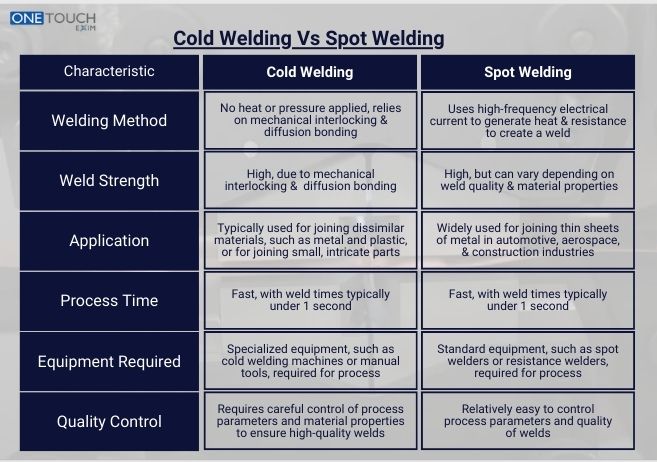
Cold welding fundamentally differs from fusion welding processes in ways that dramatically affect joint properties and applications.
No heat-affected zone: Cold welding preserves the original metal microstructure throughout the part, while arc welding creates a heat-affected zone with altered properties surrounding the joint. This difference makes cold welding ideal for thin materials that would warp or burn through with conventional welding.
Pure metal-to-metal bond: Cold-welded joints contain no filler material, maintaining the base metal’s original properties. Arc welding introduces filler that may have different characteristics, potentially creating weak points or corrosion risks.
No visible weld seam: Unlike arc welding’s distinctive bead, cold welding creates an invisible bond that appears as if the metal was never separated. This characteristic provides both advantages (clean appearance) and challenges (difficult quality verification).
Different failure modes: Cold-welded joints typically fail in the base metal rather than at the interface when properly made, while arc welds often fail at the fusion boundary or in the heat-affected zone.
3 Industries Using Cold Welding for Stronger Electrical Connections
Electrical manufacturing represents the most significant practical application of cold welding technology today. The process creates connections with superior conductivity and reliability compared to traditional soldering methods.
Telecommunications companies rely on cold welding principles in insulation-displacement connectors that form reliable connections without pre-stripping wires. These connectors simultaneously cut through insulation and create cold-welded bonds to copper conductors—doubling production speeds while improving connection reliability.
Aerospace wiring systems use cold-welded connections for critical systems where vibration resistance and long-term reliability are paramount. Unlike solder joints that can fatigue under vibration, properly made cold welds actually strengthen over time through continued atomic bonding.
Wire Wrap Connections: The Forgotten Cold Welding Technique
Before surface-mount technology dominated electronics manufacturing, wire wrap connections provided reliable cold-welded joints for circuit boards. Technicians wrapped insulated wire around square posts under tension, creating pressure that formed cold welds over time.
These connections proved exceptionally reliable in military and aerospace applications where vibration resistance was critical. The cold-welded joints maintained electrical continuity even when insulation eventually degraded—a testament to the durability of properly formed cold welds.
Surface Prep Failures: Why 90% of DIY Cold Welds Fail
The most common reason cold welding attempts fail is inadequate surface preparation. Achieving and maintaining the required cleanliness demands careful attention to cleaning methods, handling procedures, and timing.
Successful surface preparation requires multiple steps: chemical cleaning to remove oils and greases, mechanical abrasion to remove oxides, and immediate welding before recontamination occurs. Even fingerprints can introduce enough oil to prevent bonding.
Critical surface prep mistakes to avoid:
– Using improper solvents that leave residue
– Touching cleaned surfaces with bare hands
– Waiting too long between cleaning and welding
– Using contaminated abrasives that embed particles
– Ignoring humidity effects on re-oxidation rates
How to Verify Surface Cleanliness Before Welding
Technicians use several methods to confirm surfaces are ready for cold welding. Water break tests show whether a surface is hydrophobic (contaminated) or hydrophilic (clean). X-ray photoelectron spectroscopy provides detailed surface composition analysis but requires specialized equipment.
For practical applications, visual inspection under high magnification reveals surface contaminants. A properly cleaned metal surface appears uniformly bright with no discoloration, streaks, or visible particles. Any inconsistency indicates the need for additional cleaning.
Future of Cold Welding: From Nanotech to Spacecraft Design
Nanoscale research has revealed extraordinary cold welding properties that differ significantly from macro-scale processes. Scientists discovered that gold nanowires thinner than 10 nanometers can cold-weld together through simple mechanical contact with remarkably low pressure.
These nanoscale welds approach perfection, maintaining identical crystal orientation and exhibiting the same strength and electrical conductivity as the original nanowire. This discovery suggests cold welding could enable new manufacturing techniques for nanoelectronics and other miniature devices.
As manufacturing continues pushing toward smaller dimensions and higher precision, techniques that work without heating may become increasingly valuable. The atomic-level bonding that makes cold welding possible today may underpin tomorrow’s manufacturing innovations in fields from quantum computing to advanced materials science.
Leave a Reply