
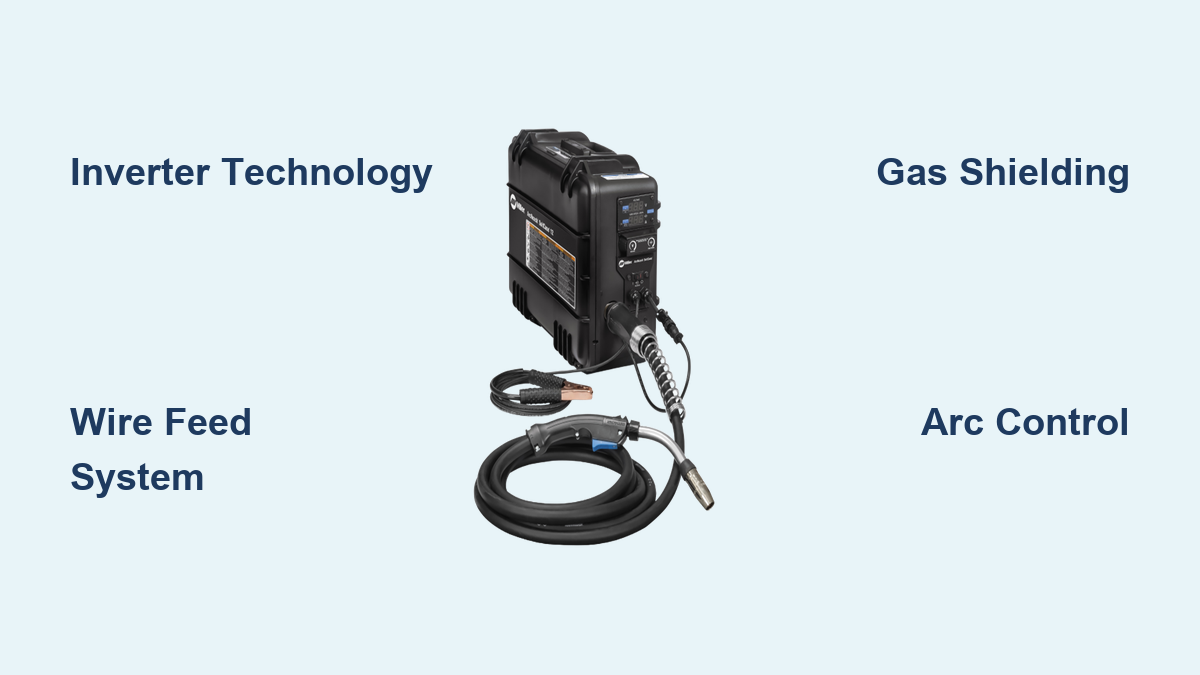
When your tractor breaks down in the middle of harvest season or a critical fence post snaps during a storm, waiting to haul equipment back to the shop isn’t an option. That’s where suitcase welders transform field repairs from impossible to immediate—delivering professional welding capability in a portable package you can carry to the problem. But how does this compact powerhouse actually work when most welding equipment requires dedicated shop space? Understanding the engineering inside these portable units helps you maximize their potential and choose the right model for your specific needs. Whether you’re a farmer, mechanic, or DIY enthusiast, knowing how does a suitcase welder work reveals why this technology has become indispensable for on-site metal repairs.
Unlike traditional welding machines that weigh hundreds of pounds and require dedicated circuits, suitcase welders pack all essential components into a single portable unit weighing 25-45 pounds. The secret lies in sophisticated electronics that convert standard electrical power into the precise welding arc needed for strong, clean joints. Despite their modest size—typically fitting within a 20×10-inch footprint—these machines contain advanced power conversion systems that rival industrial equipment. This guide breaks down the exact mechanisms that make portable welding possible, so you can operate your unit with confidence and understand its capabilities and limitations.
Inverter Technology: The Heart of Portable Power Conversion
Why Traditional Transformers Won’t Fit in Your Tool Bag
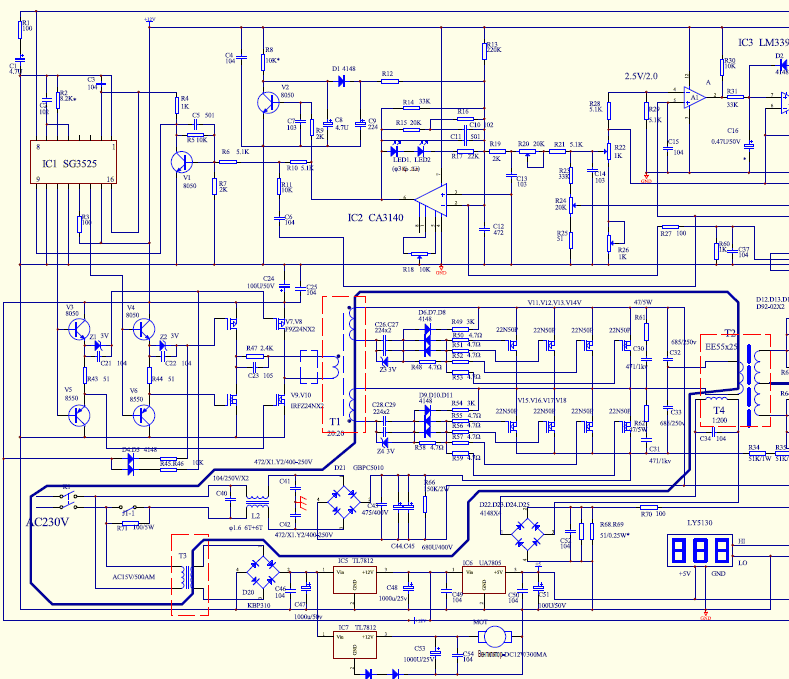
Older welding machines relied on heavy copper-wound transformers that required massive iron cores to handle welding currents, making true portability impossible. Suitcase welders solve this through inverter technology that replaces bulky transformers with high-frequency electronics. When you plug in your unit, it first converts incoming AC power to DC, then rapidly switches this DC on and off at frequencies between 20,000-100,000 Hz—thousands of times faster than standard 60 Hz household current. This high-frequency AC passes through a miniature transformer that steps down the voltage while increasing current, then converts back to DC for the welding arc.
Voltage Flexibility for Any Job Site Power Source
Most suitcase welders offer dual-voltage capability that adapts to available power sources. When running on standard 110V household current, expect output around 90-120 amps—enough to weld steel up to 1/8 inch thick but insufficient for heavy fabrication. Flip the switch to 220V operation, and output jumps to 140-200 amps, handling materials up to 3/8 inch thick. Advanced models automatically detect input voltage, while others require manual adjustment. For generator-powered operation in remote locations, ensure your generator delivers at least 30% more wattage than the welder’s input requirement to handle startup surges without tripping breakers.
Continuous Wire Feed System: Your Metal Delivery Mechanism

Inside the Wire Drive Assembly
Unlike stick welding that requires frequent electrode changes, suitcase welders use continuous wire feed systems housed within the unit. The wire spool (typically 4-8 pounds) mounts on an internal hub with adjustable friction control to prevent unwinding. Drive rolls—two grooved wheels that grip the wire—pull material through a PTFE-lined conduit to the welding gun. An electric motor controls feed speed, directly determining deposition rate: faster speeds build larger weld beads while slower speeds suit thin materials. Proper tension adjustment proves critical—too loose causes erratic feeding, while too tight deforms wire and creates “bird nests” inside the machine.
Troubleshooting Common Wire Feed Issues
Irregular wire feeding typically stems from three causes: improper drive roll tension, liner obstructions, or worn contact tips. If wire jerks during feeding, first check tension settings against the manufacturer’s chart for your wire diameter. Next, inspect the liner for kinks or debris buildup—replace if damaged. Finally, examine the contact tip for erosion; worn tips cause arcing that damages wire and creates inconsistent arcs. Quality suitcase welders include clear tension adjustment markings and often feature quick-release mechanisms for rapid liner replacement in the field.
Shielding Protection: Gas vs. Flux-Core Solutions
MIG Welding’s Gas Shielding System
When using solid wire for MIG welding, suitcase welders integrate gas delivery directly into their portable design. Shielding gas flows from a cylinder mounted on the unit’s frame through a regulator that controls pressure and a flowmeter that sets delivery rate (typically 20-30 CFH). Common gas blends include 75% argon/25% CO2 for steel welding, though specialized mixes exist for stainless or aluminum. The gas travels through a hose to the welding gun, exiting through a diffuser that creates a protective cloud around the arc to prevent atmospheric contamination that causes porous, weak welds.
Flux-Core Wire: Gas-Free Welding for Maximum Portability
For truly gas-free operation, many suitcase welders support flux-core wire that contains flux compounds in its center. When burned, this flux generates its own shielding gas and forms a slag layer over the weld, eliminating the need for external gas cylinders. This configuration maximizes portability for remote work but trades off increased spatter and post-weld cleanup requirements. Flux-core wire also costs more per pound than solid wire. Savvy users often carry both options—using gas-shielded MIG for shop-quality welds when possible and switching to flux-core for emergency field repairs where gas transport proves impractical.
Arc Control Systems: Precision in Your Palm
Voltage and Amperage Relationship Explained
The welding arc forms when current jumps from the wire electrode to the workpiece, reaching temperatures near 10,000°F—hot enough to melt both wire and base metal simultaneously. Voltage controls arc length (higher voltage = longer arc), while amperage determines heat input and wire melt-off rate. Modern suitcase welders manage this relationship through internal circuitry that maintains stable arcs despite minor variations in technique. More advanced units offer multiple welding modes: standard MIG for general work, pulsed MIG for thinner materials that reduces heat input while maintaining penetration, and specialized settings for stainless steel or aluminum.
Preset Programs for Foolproof Operation
Most quality suitcase welders include preset programs that automatically match voltage and wire speed to common applications. Instead of manually adjusting multiple parameters, simply select “1/8-inch steel with 0.030 ER70S-6 wire” and the machine configures optimal settings. These presets prove invaluable for intermittent users who may not remember ideal parameters, while maintaining consistency across multiple welders on production jobs. Digital displays show actual output values during welding, allowing you to fine-tune settings based on real-time performance rather than theoretical charts.
Thermal Management: Keeping Cool Under Pressure
Overload Protection Mechanisms
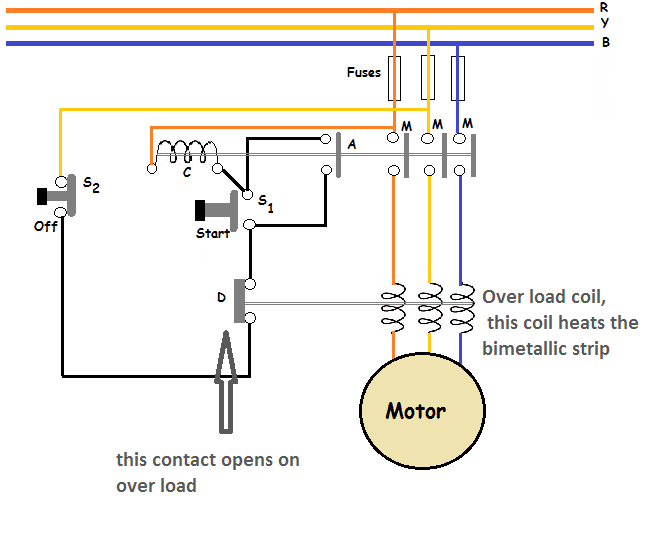
The compact design of suitcase welders creates thermal challenges that larger industrial machines don’t face. All quality units include thermal overload protection that monitors internal temperatures and automatically reduces output or shuts down when components approach safe limits. This protection prevents damage to expensive power electronics but may interrupt long weld passes on thick materials. Some units provide diagnostic indicators showing when thermal shutdown occurs, helping distinguish between normal protection cycles and actual malfunctions.
Duty Cycle Realities for Portable Units
Duty cycle—the percentage of 10 minutes a welder can operate at maximum output without overheating—proves more critical in suitcase models than industrial machines. While shop units may offer 60-100% duty cycles at full power, portable models typically deliver 20-30% at maximum output. This means a 150-amp suitcase welder may only sustain that output for 2-3 minutes before requiring a cooldown period. Smart operators learn to match output to duty cycle requirements—using lower settings for longer continuous work or taking strategic breaks during high-amperage welding.
Maintenance Essentials for Long-Term Reliability
Consumable Replacement Schedule
Regular maintenance focuses primarily on consumable parts that wear with use. Contact tips should be replaced whenever wire feeding becomes erratic or you notice excessive spatter. Diffusers and nozzles require cleaning after each use to prevent spatter buildup that restricts gas flow. Drive rolls need inspection for wear grooves every 5-10 wire spool changes—replace immediately if grooves exceed wire diameter. Keeping spare consumables in your kit prevents job delays when components wear out during critical repairs.
Internal Cleaning Protocol
Metal particles and dust accumulate inside the case over time, potentially causing electrical shorts. Perform internal cleaning every 50-100 operating hours using compressed air (with the unit unplugged). Focus on cooling vents, fan blades, and power components—clogged airflow passages trigger premature thermal shutdowns. For units used in dusty environments like farms or construction sites, increase cleaning frequency to maintain optimal performance. Never use vacuum cleaners for internal cleaning, as static electricity can damage sensitive electronics.
Maximizing Your Suitcase Welder’s Capabilities
Matching Settings to Material Thickness
Understanding how does a suitcase welder work reveals why proper parameter selection matters. For 18-gauge steel, try 15-18 volts with 250-300 inches-per-minute wire speed using 0.023-inch wire. When welding 1/4-inch material, increase to 22-24 volts with 350-400 IPM using 0.035-inch wire. Always perform test welds on scrap material first—listen for the ideal “sizzling bacon” sound indicating proper settings. A harsh buzzing suggests excessive voltage, while popping sounds indicate insufficient voltage causing unstable arcs.
Emergency Field Repair Techniques
When facing critical repairs with limited resources, suitcase welders enable solutions impossible with traditional equipment. For broken implements in remote locations, use flux-core wire without gas for immediate fixes. If power sources prove unreliable, run the welder at reduced output to match generator capacity—most units function at 70-80% output on marginal power sources. Keep a 10-foot grounding cable in your kit to establish solid workpiece connections when welding on painted or rusty surfaces that resist standard ground clamp attachment.
The engineering inside suitcase welders represents a triumph of modern electronics—packing professional welding capability into a package you carry to the job rather than hauling the job to your shop. By understanding how these systems interact, you transform from a button-pusher to a knowledgeable operator who can troubleshoot issues, optimize settings for specific materials, and maximize the machine’s lifespan through proper maintenance. Whether you’re repairing farm equipment in the field, fixing automotive components in your garage, or making structural connections on a construction site, this knowledge ensures your portable welder delivers reliable performance whenever and wherever metal needs joining.
Leave a Reply