
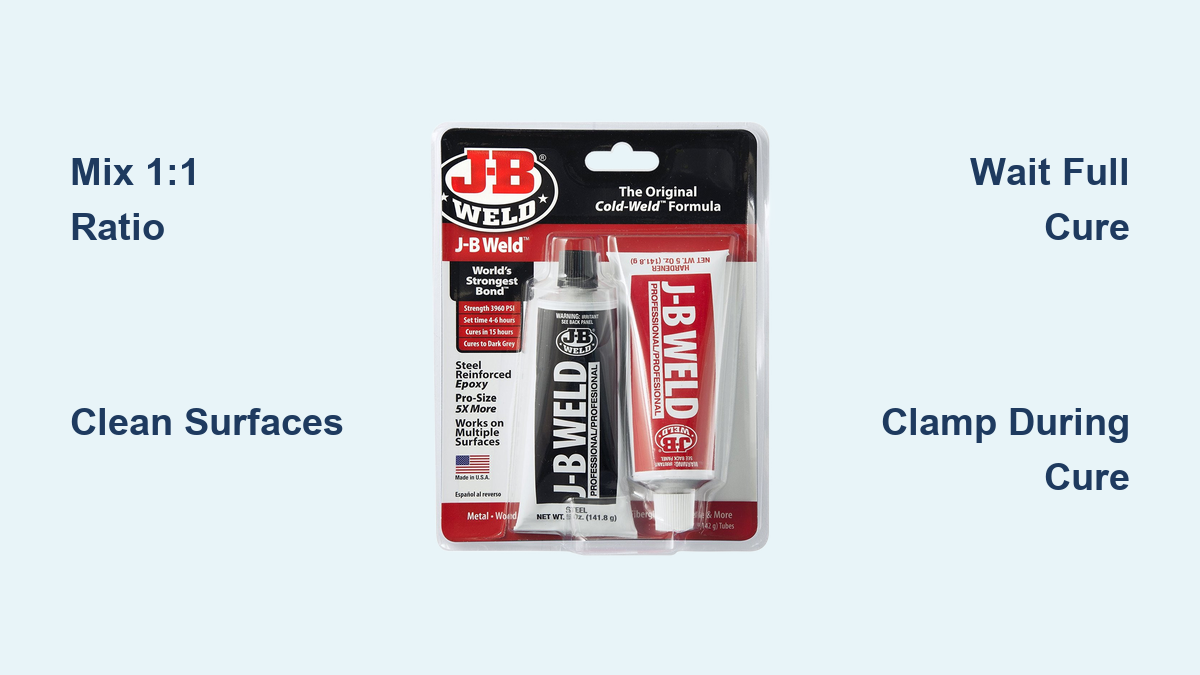
When your car’s radiator cracks or a cast iron pipe springs a leak, reaching for JB Weld often feels like pulling out a superhero from your toolbox. But how does JB Weld work its magic where ordinary adhesives fail completely? The answer lies not in marketing hype but in precise polymer chemistry that transforms two separate compounds into a single, incredibly strong bond capable of withstanding extreme heat, pressure, and vibration. Understanding the science behind this transformation isn’t just academic—it directly impacts your repair success rate, helping you avoid common mistakes that weaken bonds before they even cure. Whether you’re fixing a cracked engine block or repairing a broken tool handle, knowing exactly how JB Weld works at the molecular level will help you prepare surfaces correctly, mix proportions precisely, and achieve maximum bond strength that lasts for years instead of days.
The secret to JB Weld’s legendary strength begins with its two-part formulation—a resin component and a hardener component that must combine in exact proportions to trigger a chemical metamorphosis. Unlike ordinary glues that simply dry out, JB Weld undergoes thermosetting polymerization, a process where the mixed components chemically react to form an entirely new material with superior properties. When you squeeze equal parts from those distinctive black and red tubes, you’re not just making paste—you’re initiating a complex molecular dance where resin molecules link with hardener molecules to create a rigid, cross-linked structure that bonds at the molecular level rather than just sticking to surfaces.
The Chemical Reaction That Creates Super Strength
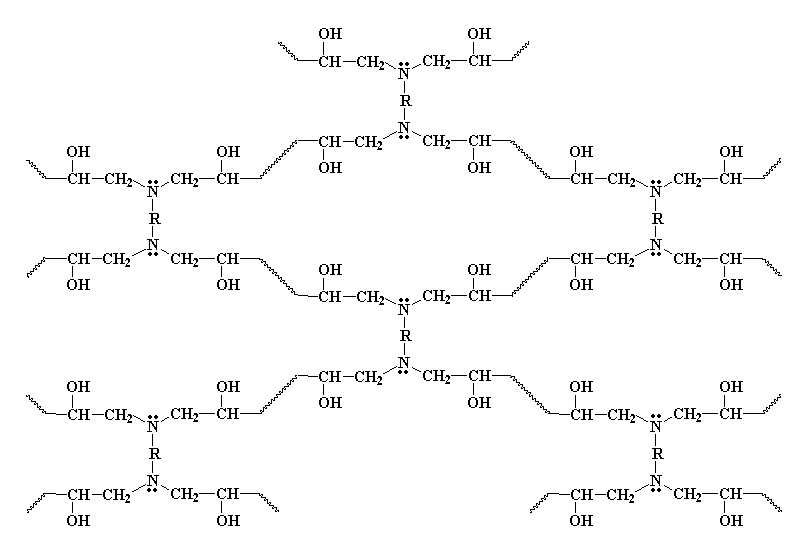
JB Weld’s power comes from the specific chemical marriage between its bisphenol-A epoxy resin and modified amine hardener. When these components mix, the amine groups in the hardener attack the epoxide rings in the resin, opening them up and forming new covalent bonds that link molecules together in long, interconnected chains. This ring-opening polymerization creates a three-dimensional network far stronger than the simple linear chains found in most plastics. As more bonds form, the mixture transitions from a workable paste to an incredibly dense molecular matrix that resists deformation under stress.
This reaction generates heat as it progresses—a characteristic exothermic process you can feel when the mixture warms in your hands during mixing. The heat actually accelerates the reaction, creating a feedback loop where more bonds form faster as temperature rises. At room temperature (70°F), this process sets JB Weld within 15-25 minutes, but the chemical transformation continues for hours as the network becomes increasingly dense and interconnected. Understanding this timeline prevents the common mistake of handling a “set” joint too soon—what feels solid at one hour hasn’t yet developed the full 5,000 PSI tensile strength that makes JB Weld famous.
Why Setting Time Isn’t Cure Time (And Why It Matters)
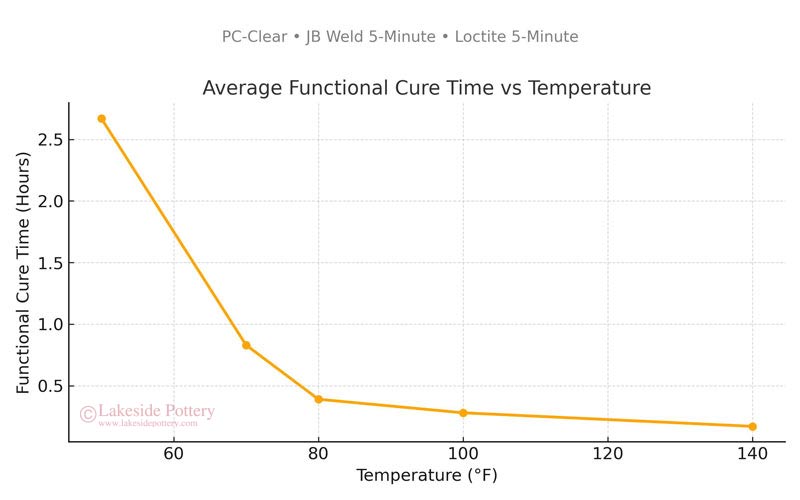
Most JB Weld failures happen because users mistake setting time for cure time. When the mixture stops flowing and holds its shape (setting time), only about 20% of the chemical reaction has completed. The material feels solid to the touch but lacks structural integrity because the molecular network remains incomplete. True cure time—the period needed for maximum strength development—continues for 8-15 hours at room temperature as the chemical bonds fully develop and interconnect.
This distinction has real-world consequences: a water pump repaired with JB Weld might hold water pressure after one hour but fail catastrophically when engine heat and vibration stress the incomplete bond. For critical repairs, waiting the full cure time (or even 24 hours for maximum security) prevents premature failure. Temperature dramatically affects this timeline—working in a 50°F garage might double cure times, while a warm 85°F workshop could cut them by nearly half. Smart DIYers use this knowledge to their advantage, applying gentle heat (never exceeding 150°F) to accelerate curing for time-sensitive repairs.
How to Test If JB Weld Has Fully Cured
You can check cure progress without damaging your repair by pressing a fingernail into an inconspicuous area—fully cured JB Weld will resist indentation completely. Another method involves tapping the repair with a small screwdriver handle; a dull thud indicates incomplete cure while a sharp “ping” suggests full hardness. For critical applications, wait the full manufacturer-recommended time regardless of surface hardness tests.
Surface Prep Secrets That Make or Break Bonds

Even perfect mixing won’t save a repair with poor surface preparation, because JB Weld bonds through both mechanical interlocking and chemical adhesion. Oil, grease, rust, or paint creates barriers that prevent the epoxy from penetrating microscopic surface irregularities where mechanical bonding occurs. On metal surfaces, this means cleaning with acetone followed by aggressive sanding with 80-120 grit paper to create a “tooth” for the epoxy to grip.
Critical Surface Prep Steps for Different Materials
- Metal: Remove all rust/paint, clean with acetone, then rough-sand
- Plastic: Lightly sand with 120 grit, clean with isopropyl alcohol
- Ceramic: Scuff surface with coarse sandpaper, remove dust thoroughly
- Concrete: Remove loose particles, clean with wire brush, ensure dryness
Skipping proper preparation might yield a bond that holds initially but fails prematurely as contaminants gradually weaken the interface. The extra 10 minutes spent prepping surfaces often determines whether your repair lasts months or years.
Temperature’s Dramatic Effect on Performance
Working below 60°F dramatically slows JB Weld’s chemical reaction, potentially extending cure time to 24 hours or more. Conversely, temperatures above 90°F accelerate curing but risk creating internal stresses as the outer layers cure faster than the interior. The ideal application temperature range is 65-85°F—warm enough for proper curing but cool enough to allow adequate working time.
Once cured, JB Weld’s heat resistance becomes legendary, with standard formulations handling continuous exposure up to 300°F and brief spikes to 600°F. This exceptional performance stems from the dense cross-linking that prevents thermal softening. However, sustained exposure near maximum temperatures gradually degrades the bond, so engine repairs near exhaust manifolds benefit from specialized high-heat JB Weld variants.
The 1:1 Ratio Myth and Mixing Reality
While JB Weld recommends a 1:1 mixing ratio, achieving true molecular balance requires more precision than equal visual portions provide. Too much hardener creates a brittle, weak bond; too much resin leaves uncured sticky patches. The solution? Mix thoroughly for a full 60-90 seconds on a non-porous surface, scraping the mixing tool repeatedly to ensure complete blending. Properly mixed JB Weld shows absolutely uniform gray color with no streaks of either component visible.
Why JB Weld Bonds Outperform Mechanical Fasteners
The molecular structure of cured JB Weld distributes stress across thousands of connection points rather than concentrating force at discrete fastener points. This continuous bonding creates superior resistance to shear forces and vibration—explaining why JB Weld often outperforms bolts or welds in high-vibration applications like automotive repairs. The material’s compressive strength (3,900 PSI) actually exceeds its tensile strength, making it ideal for filling gaps and cracks where crushing forces dominate.
Critical Applications Where JB Weld Excels (And Where It Fails)
JB Weld creates permanent bonds on steel, iron, aluminum, copper, wood, concrete, and many plastics, but fails completely on flexible materials or certain plastics like polyethylene. It excels at repairing cracked engine blocks, transmission cases, and exhaust components but shouldn’t be used on constantly flexing joints or food-contact surfaces. For underwater repairs, the original JB Weld formulation requires dry application before submersion—marine-specific variants work better for wet conditions.
Three Common JB Weld Mistakes That Cause Repair Failure
- Inadequate surface cleaning – Oil or grease prevents proper adhesion
- Rushing the cure process – Handling before full chemical cure
- Poor mixing technique – Incomplete blending creates weak spots
Pro Tips for Maximum Bond Strength
Clamp repaired parts whenever possible during curing—this maintains intimate contact between surfaces and prevents microscopic movement that creates weak interfaces. For deep cracks, apply JB Weld in thin layers rather than one thick application to prevent heat buildup that can cause uneven curing. When sanding cured epoxy, wear proper respiratory protection as the dust contains silica particles. Finally, paint over outdoor repairs to protect against UV degradation, which gradually weakens epoxy bonds exposed to direct sunlight.
Understanding how JB Weld works transforms it from a mysterious repair miracle into a predictable engineering solution. By respecting the chemistry behind the cure, preparing surfaces meticulously, mixing precisely, and allowing proper cure time, you’ll achieve repair results that rival professional welding—without the expensive equipment. The next time you reach for that familiar black-and-red tube, remember: you’re not just applying glue, you’re conducting polymer chemistry that, when done correctly, creates bonds stronger than the materials themselves.
Leave a Reply