
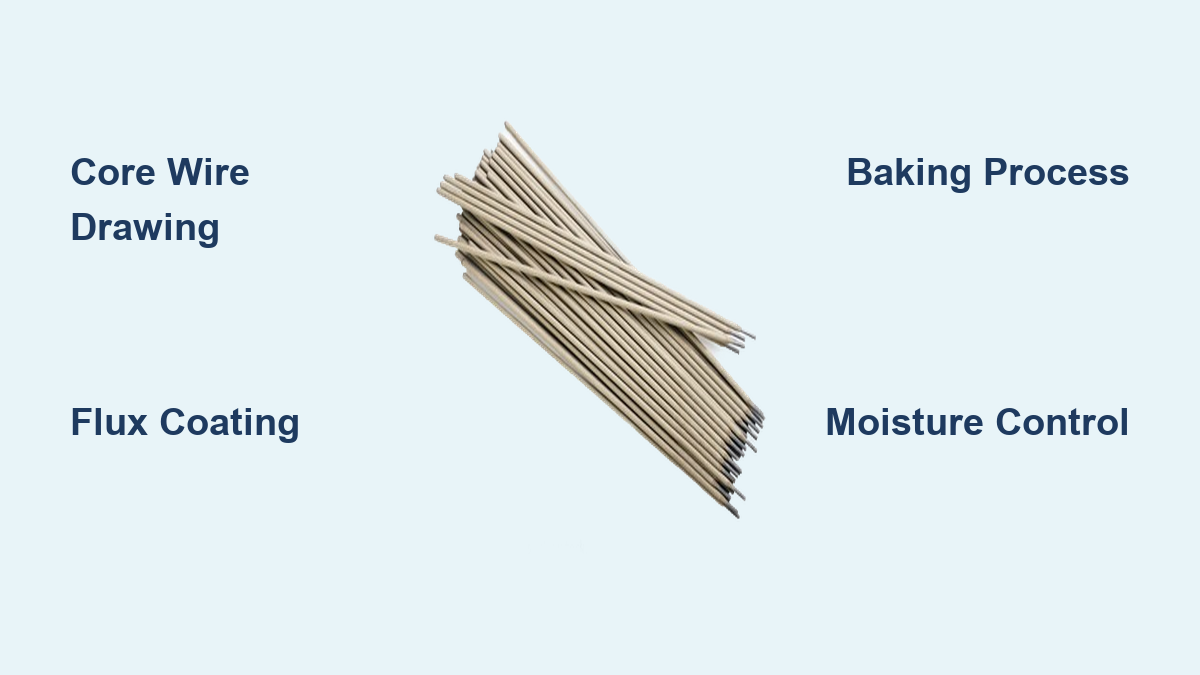
Ever grabbed a welding rod only to wonder what goes into creating that seemingly simple stick? When moisture ruins your electrodes or inconsistent arcs disrupt your workflow, understanding how welding rod is made becomes critical. Most welders know these consumables are essential for shielded metal arc welding (SMAW), but few realize the precision engineering behind each rod. This guide pulls back the curtain on electrode manufacturing—from raw ore to your workshop shelf. You’ll discover why certain rods perform better in damp conditions, how coating composition affects arc stability, and what separates premium electrodes from bargain-bin failures. Whether you’re troubleshooting porosity issues or selecting rods for critical projects, this breakdown of the welding rod production pipeline will transform how you choose and use these indispensable tools.
Raw Material Sourcing and Core Wire Production
The journey of how welding rod is made begins long before the flux coating is applied. High-purity iron ore undergoes smelting to create low-carbon steel specifically formulated for electrode cores. Manufacturers carefully control carbon content (typically 0.05-0.15%) to prevent brittleness while maintaining weld strength. This molten steel is cast into billets and hot-rolled into wire rods at temperatures exceeding 1,000°C.
Precision Wire Drawing Process

The real magic happens during wire drawing, where rod diameter consistency makes or breaks electrode performance:
– Steel rods pass through progressively smaller diamond or tungsten carbide dies
– Each draw reduces diameter by 10-15% while increasing tensile strength
– Critical diameter tolerances: ±0.02mm for 3.2mm electrodes
– Lubrication with borax-based compounds prevents galling
– Intermediate annealing at 650°C relieves internal stresses
Pro tip: Inconsistent wire diameter causes erratic arc behavior—premium manufacturers use laser micrometers to monitor every meter of wire during production.
Surface Cleaning for Optimal Adhesion
Before flux coating, wire surfaces undergo rigorous preparation:
1. Alkaline degreasing removes drawing compounds
2. Acid pickling (10-15% hydrochloric acid) eliminates scale
3. Electrolytic cleaning provides final surface activation
4. Immediate water rinsing prevents flash rusting
Visual cue: Properly cleaned wire should reflect light evenly without streaks or discoloration—any residue causes flux delamination during baking.
Flux Coating Formulation and Application
The flux coating—comprising 25-45% of the electrode’s weight—determines its welding characteristics. How welding rod is made hinges on precise flux chemistry tailored to specific applications. Rutile-based electrodes (E6013) use 25-40% titanium dioxide for easy starts, while low-hydrogen types (E7018) rely on calcium carbonate and fluorite to minimize moisture absorption.
Mixing Critical Flux Ingredients
Manufacturers blend 8-12 components in computer-controlled mixers:
– Arc stabilizers: Potassium silicate (3-8%) for smooth arc transfer
– Slag formers: Silica and aluminum oxide (15-25%) for protective coverage
– Deoxidizers: Manganese and silicon (2-5%) to prevent porosity
– Gas formers: Cellulose (1-3%) generating CO/CO₂ shielding
– Alloying agents: Nickel or chromium powders for specialized rods
Common mistake: Overlooking humidity control during mixing—flux powders must stay below 0.5% moisture content or electrodes become unusable.
Coating Application Techniques
Two primary methods apply flux to the core wire:
Dip-Extrusion Process (Most Common)
– Wire passes through coating slurry at 15-30m/min
– Precision dies control coating thickness within 0.1mm
– Multiple passes build up required coating mass
– Immediate infrared pre-drying prevents slumping
Press-Coating Method (Specialty Electrodes)
– Dry flux powder compressed around wire under 50-100 tons pressure
– Used for stainless steel and hardfacing electrodes
– Requires exact powder particle size distribution
– Eliminates moisture-related baking issues
Time estimate: Coating adds 8-12 seconds per electrode but determines 70% of welding performance characteristics.
Critical Drying and Baking Stages
Moisture control separates functional electrodes from hydrogen-induced cracking hazards. How welding rod is made demands meticulous thermal processing—this stage causes most manufacturing failures when rushed.
Initial Moisture Removal (Drying Ovens)
Freshly coated electrodes enter conveyor ovens at 80-120°C for 2-4 hours:
– Removes surface moisture from liquid binders
– Prevents blistering during high-temp baking
– Target residual moisture: <0.5% for rutile rods
– Low-hydrogen types require <0.15% moisture
Warning: Skipping this step causes “sweating” during baking—moisture turns to steam and cracks the coating.
High-Temperature Baking (The Make-or-Break Stage)
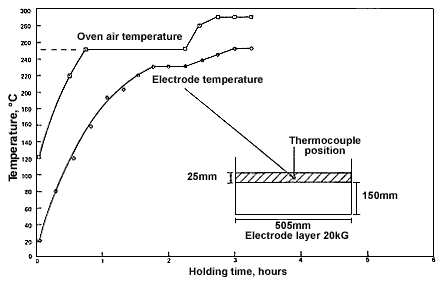
Final curing occurs in multi-zone kilns reaching 300-450°C:
| Electrode Type | Baking Temperature | Duration | Critical Purpose |
|—————-|———————|———-|——————|
| E6013 (Rutile) | 250-300°C | 1-2 hours | Sets potassium silicate binder |
| E7018 (Low-H) | 350-450°C | 2-3 hours | Decomposes carbonates to absorb moisture |
| Stainless | 200-250°C | 1.5 hours | Prevents chromium oxidation |
Expert insight: Baking profiles are proprietary—over-baking makes coatings brittle, while under-baking leaves dangerous moisture. Top manufacturers use moisture analyzers at exit points.
Quality Control and Packaging Protocols
How welding rod is made culminates in rigorous testing where manufacturers separate reliable products from hazardous failures. Each batch undergoes 7 critical checks before leaving the factory.
Electrical Performance Verification
https://www.alibaba.com/product-detail/High-Precision-Arc-Stability-Testing-Machine-Welding_1600600058202.html
- Arc stability testing: Electrodes welded in vertical position at 120% rated current
- Re-ignition capability: Measured after 500ms arc interruption
- Spatter analysis: High-speed cameras quantify metal transfer efficiency
- Failure threshold: >15% spatter rate rejects entire batch
Mechanical Property Validation
Destructive testing of weld deposits includes:
1. Tensile strength verification (min. 485 MPa for E7018)
2. Charpy impact testing at -20°C for critical applications
3. Bend tests to 180° without cracks
4. Macro-etch analysis for internal defects
Pro tip: Reputable brands publish certified test reports—avoid electrodes without traceable QC documentation.
Moisture Content Critical Check
Low-hydrogen electrodes undergo Karl Fischer titration:
– Acceptable limit: 0.4ml H₂O per 100g electrode
– Field test: Submerge in acetone—cloudiness indicates moisture
– Consequence: Just 0.05% excess moisture can cause hydrogen cracking in thick steel
Moisture-Proof Packaging and Storage
The final step in how welding rod is made determines shelf life. Premium electrodes use triple-barrier packaging:
1. Vacuum-sealed inner foil pouch (0.1mm thick)
2. Desiccant-filled cardboard tube
3. Hermetically sealed outer plastic container
Storage reality check: Once opened, low-hydrogen rods last only 4 hours in humid conditions before requiring re-baking at 350°C for 1 hour. Always store electrodes in climate-controlled cabinets maintaining <50% humidity.
Why Manufacturing Quality Matters in Your Welds
Understanding how welding rod is made explains real-world performance differences. That $30/kg premium electrode outperforms bargain alternatives because:
– Consistent core wire diameter prevents arc wandering
– Precisely formulated flux minimizes porosity in damp conditions
– Proper baking prevents hydrogen-induced cracking in critical joints
– Rigorous QC catches coating defects invisible to the naked eye
Maintenance tip: Never skip re-baking low-hydrogen rods after opening—invest in a 400°C electrode oven for shop use. Store all rods in sealed containers with humidity indicators.
Troubleshooting Common Electrode Failures
When welds show porosity or inconsistent arcs, trace issues to manufacturing stages:
Problem: Excessive Spatter
- Likely cause: Inconsistent flux coating thickness
- Check: Measure coating diameter at 3 points along rod
- Fix: Switch to manufacturer with tighter coating tolerances
Problem: Sticky Arc (Poor Re-ignition)
- Likely cause: Incorrect potassium silicate ratio
- Check: Compare arc behavior with new vs. old batch
- Fix: Use E6013 for maintenance work; E7018 requires steady hands
Problem: Hydrogen Cracking in Thick Steel
- Likely cause: Moisture contamination during baking/packaging
- Check: Test with opened 24-hour-old rods
- Fix: Always re-bake low-hydrogen rods; verify packaging integrity
Final Note: The next time you strike an arc, remember the metallurgical precision behind that welding rod. Proper manufacturing transforms basic steel wire into a sophisticated chemical delivery system that stabilizes arcs, shields molten metal, and deposits quality welds. When selecting electrodes, prioritize manufacturers who publish their baking profiles and QC data—this transparency proves they’ve mastered how welding rod is made. For critical projects, always test new batches on scrap material first, and never compromise on storage conditions. Your weld integrity depends on it.
Leave a Reply