
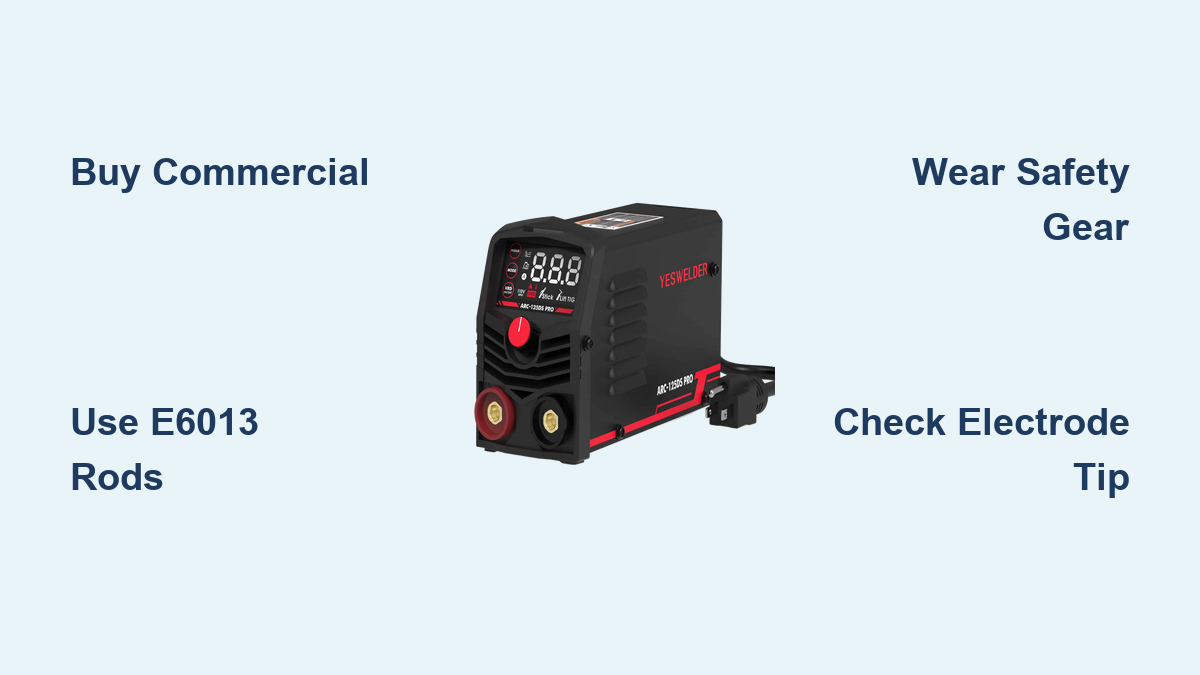
Your search for reliable arc welding capability starts with a critical decision: purchasing a commercial unit or attempting a DIY build. Whether you need occasional repairs for farm equipment or regular fabrication work, the wrong approach can mean wasted money, safety hazards, or frustrating performance issues. Commercial arc welders dominate the market for good reason—they arrive pre-engineered with verified safety features, consistent output, and manufacturer warranties that protect your investment. The ARC-125DS-PRO exemplifies why most buyers choose this route: a compact 110V unit delivering 20 to 125 amps with automatic hot start and lift TIG capability in a 4.4-pound package. While DIY construction using salvaged microwave transformers remains theoretically possible, the safety risks and performance limitations make this path suitable only for experienced builders with advanced electrical knowledge. This guide cuts through the confusion to help you determine exactly how to get arc welder that matches your skill level, budget, and intended applications.
Buy Commercial Arc Welder Instead of DIY
Purchasing a manufactured arc welder represents the practical choice for nearly every user, combining safety assurance with predictable performance that homemade units cannot match.
Commercial Units Provide Verified Safety Features
Commercial arc welders arrive with proper insulation, thermal management systems, and overcurrent protection that eliminate the significant electrocution and fire risks inherent in DIY construction. Manufacturers engineer these units for consistent output characteristics across various electrode types and material thicknesses. Modern machines include features like automatic hot start functionality that boosts current during startup, enabling easy arc initiation without requiring operator mastery of strike techniques. Adaptive arc force controls minimize electrode sticking without compromising stability or increasing spatter—critical advantages for beginners.
The market spans from budget-friendly hobbyist models under $100 to industrial machines costing several thousand dollars. Your selection should center on input power requirements (110V versus 220V), amperage output range, duty cycle ratings, portability needs, and specific applications. Most users should evaluate whether a stick-only machine meets requirements or if dual-function capability (stick/TIG combination) would provide greater versatility.
Why Beginners Should Avoid DIY Arc Welder Projects
Attempting to build an arc welder from microwave transformers creates extreme danger due to high voltage present even when unplugged—these components can retain lethal charges in their capacitors. The consensus among experienced welders strongly favors commercial purchase for beginners; the risks significantly outweigh cost savings when budget-friendly commercial units now match or exceed most homemade capabilities. If you lack comprehensive understanding of electrical systems including Ohm’s law, current flow, and grounding principles, skip the DIY approach entirely.
ARC-125DS-PRO: Best Budget-Friendly Stick Welder for Beginners
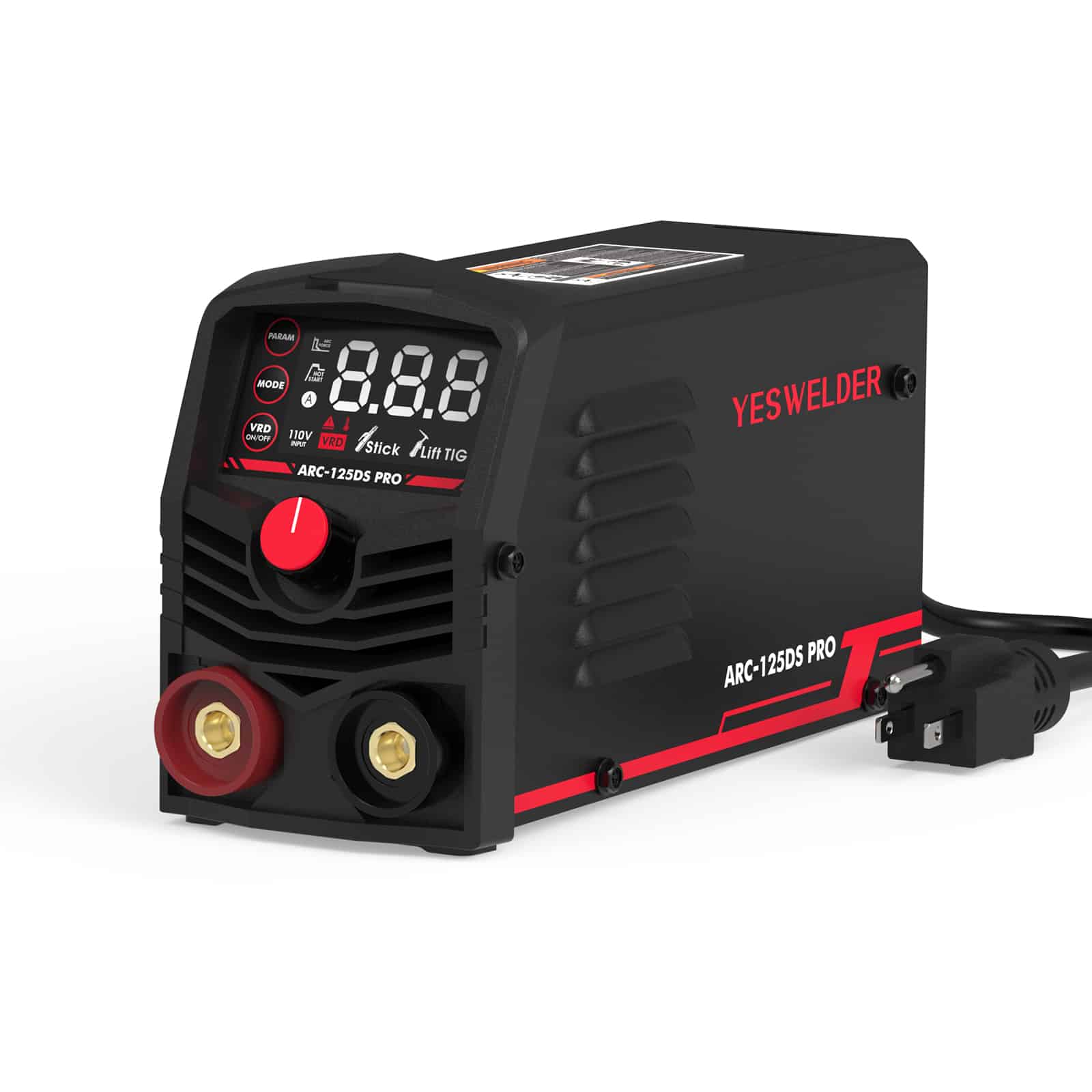
The ARC-125DS-PRO stands as a popular choice in the mini portable stick welder category, delivering robust capabilities in a compact form factor suitable for home workshops and occasional professional use.
Key Specifications and Performance Capabilities
| Specification | Details |
|---|---|
| Rated Input Voltage | AC 110V, 50/60Hz |
| Input Current | 40A |
| Output Current Range | 20–125A |
| Duty Cycle | 60% @125A, 100% @97A |
| Weight | 4.4 lbs (2 kg) |
| Dimensions | 9.3 × 3.7 × 5.1 inches |
This 110V unit handles thin materials through moderate-thickness applications, with users successfully welding from paper-thin metal to 3/16-inch steel with good penetration. The machine offers dual functionality with both stick and lift TIG capabilities, handling 6010, 6011, 6013, and 7018 electrodes across stainless steel and mild steel. The intelligent LED display provides clear visibility of current settings, electrode diameter, function mode, and welding mode for precise adjustments during operation.
What Users Say About Real-World Performance
Verified purchasers consistently report surprising performance relative to the unit’s compact size. A retired master field mechanic with 42 years of experience noted he wished he had known about this welder years earlier, stating it would have been “an excellent addition to his service truck.” Hobbyists appreciate the straightforward operation—even one user who admitted they had “no idea what I’m doing” was still able to weld successfully with this machine. The ARC-125DS-PRO proves particularly popular among users who weld only a few times annually but require reliable performance when needed.
Choose Right Electrodes for Successful Arc Welding
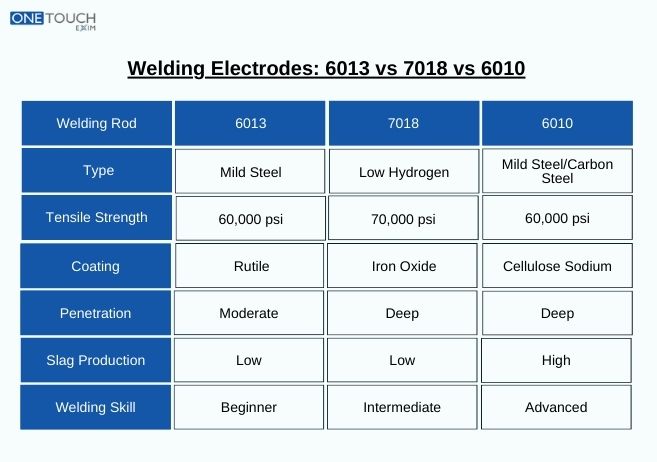
Selecting appropriate electrodes significantly impacts welding success, particularly for users developing their skills. Different electrode classifications offer distinct characteristics suited to specific applications and experience levels.
E6013 Electrodes for Beginner Success
E6013 electrodes rank among the most versatile and beginner-friendly options. These rods feature a rutile coating promoting easy arc initiation and restriking, stable arc characteristics, and relatively spatter-free operation. They perform well on dirty or slightly rusted metal, tolerate a wider range of amperage settings without failing, and produce attractive weld beads requiring minimal post-weld cleanup.
Pro Tip: When your electrode starts sticking during use, the core wire often burns back into the flux coating. Break or scrape off the excess flux to expose fresh metal for reliable striking—no need to waste the entire rod.
E7018 Electrodes for Quality Critical Welds
E7018 electrodes feature a low-hydrogen coating producing high-quality welds with excellent mechanical properties and minimal porosity. These rods provide deeper penetration and stronger welds than E6013, making them suitable for critical structural applications. However, they require more skill to use effectively and demand stricter storage conditions to prevent moisture absorption.
Low-hydrogen electrodes typically require filing or grinding at the tip to initiate the arc reliably, especially when restriking on partially used rods. They perform best on clean, properly prepared metal and require attention to polarity (typically DC+ for optimal results).
Master Essential Arc Welder Safety Requirements
Welding generates multiple hazards requiring comprehensive protection and environmental controls that no operator should ignore.
Wear Complete Protective Gear Every Time
You must wear proper protection even for “just a quick weld”—the arc produces intense visible light, ultraviolet radiation, and infrared radiation causing severe eye damage and skin burns within seconds of exposure. Proper welding helmets with appropriate shade lenses (typically shade 10-14 for stick welding) provide essential face and eye protection. Auto-darkening helmets offer convenience by automatically adjusting to arc intensity.
Leather welding gloves protect hands from heat, sparks, and molten metal spatter. Welding jackets or leather aprons protect your body, particularly important when welding in positions where molten metal can fall onto you. Never skip safety glasses worn under the helmet—they protect during non-welding activities like grinding and preparing materials.
Control Your Welding Environment
Adequate ventilation removes welding fumes that can cause respiratory irritation and long-term health effects. Natural ventilation may suffice for occasional outdoor welding, but enclosed spaces require local exhaust ventilation. Clear the welding area of combustible materials and have fire extinguishing equipment readily available—sparks can travel significant distances.
Critical electrical safety tip: GFCI protection on welding circuits provides essential shock protection, particularly when operating in damp conditions. Wet environments, damaged cables, and inadequate grounding create electrocution hazards that have caused fatalities among inexperienced builders.
Troubleshoot Common Arc Welder Starting Problems
Even properly functioning arc welders can present operational challenges, particularly for new users learning the technique.
Fix Difficult Arc Initiation in 4 Steps
- Check electrode condition: When the metal core burns away during use, the surrounding flux coating can extend beyond the exposed metal. Break or scrape off excess flux to expose the core metal.
- Verify machine settings: Higher amperage settings generally make starting easier but increase burn-through risk on thin materials. Match settings to your material thickness.
- Clean the workpiece: Rust, paint, and oil interfere with electrical contact. The welding area and ground clamp connection point must be clean and secure.
- Adjust your strike technique: Aggressive striking—jabbing the electrode firmly into the workpiece—often works better than gentle tapping. Scraping the electrode along the workpiece (like striking a match) frequently proves most effective.
Prevent Electrode Sticking During Welding
Sticking typically occurs when the arc gap becomes too small or current settings are too low. Maintain proper arc length (approximately equal to the electrode diameter) to prevent most sticking issues. When sticking happens, quickly break the electrode free with a rocking or twisting motion—pulling straight away while energized can damage your equipment.
Time-saving shortcut: Use run-on plates—small pieces of scrap metal tacked to the beginning of your joint—to establish a stable arc before moving onto your actual workpiece. Similarly, run-off plates at the weld termination point prevent difficult finishing techniques that often result in sticking.
Find Quality Arc Welders at Best Price Points
Determining where to get arc welder requires understanding the value proposition across different price ranges and purchasing channels.
Match Your Budget to Realistic Expectations
- Under $200: Primarily includes imported mini-welders and basic transformer-style machines. Set realistic expectations—these work for light duty but quality varies significantly.
- $200-500: Substantial improvement in quality and capability. This sweet spot offers machines suitable for regular hobbyist and light professional use.
- Above $500: Professional-grade equipment with maximum capability, durability, and features for demanding applications.
Critical buying tip: Welding supply stores provide expert guidance and after-sales support (though prices may be higher). Online retailers offer competitive pricing but require more self-reliance for setup. Test used equipment before purchase when possible—used units need careful inspection for damage and electrical issues.
Develop Arc Welding Skills Through Targeted Practice
Arc welding requires substantial practice to develop proficiency, with experienced welders emphasizing that mastering basic equipment builds skills transferable to any machine.
Accelerate Learning With Deliberate Practice
Practicing on scrap metal of various thicknesses develops sensitivity to machine settings, travel speed, and arc length. Focus on specific techniques rather than simply completing welds—this builds competence more effectively than volume welding without reflection. Record practice sessions and review your performance to identify areas for improvement.
Community resources including welding forums, local maker spaces, and experienced mentors provide valuable support. Even experienced welders continue learning and encountering new challenges—normalizing the learning process helps beginners persist through initial difficulties.
Key Takeaways for How to Get Arc Welder:
– Commercial units like the ARC-125DS-PRO provide the safest, most reliable path for most users
– DIY construction carries significant safety risks—only attempt if you have advanced electrical knowledge
– E6013 electrodes offer the best starting point for beginners developing their skills
– Proper safety gear is non-negotiable—never skip protection even for quick welds
– Practice deliberately on scrap metal before attempting important projects
Regardless of how you get arc welder, developing competent welding skills requires consistent practice, proper technique development, and ongoing learning. The investment in quality equipment, appropriate safety gear, and skill development produces reliable, satisfying results that enable a wide range of fabrication, repair, and creative projects. For most users, purchasing a commercial unit like the ARC-125DS-PRO represents the smartest path to successful welding capability without unnecessary risk.
Leave a Reply