
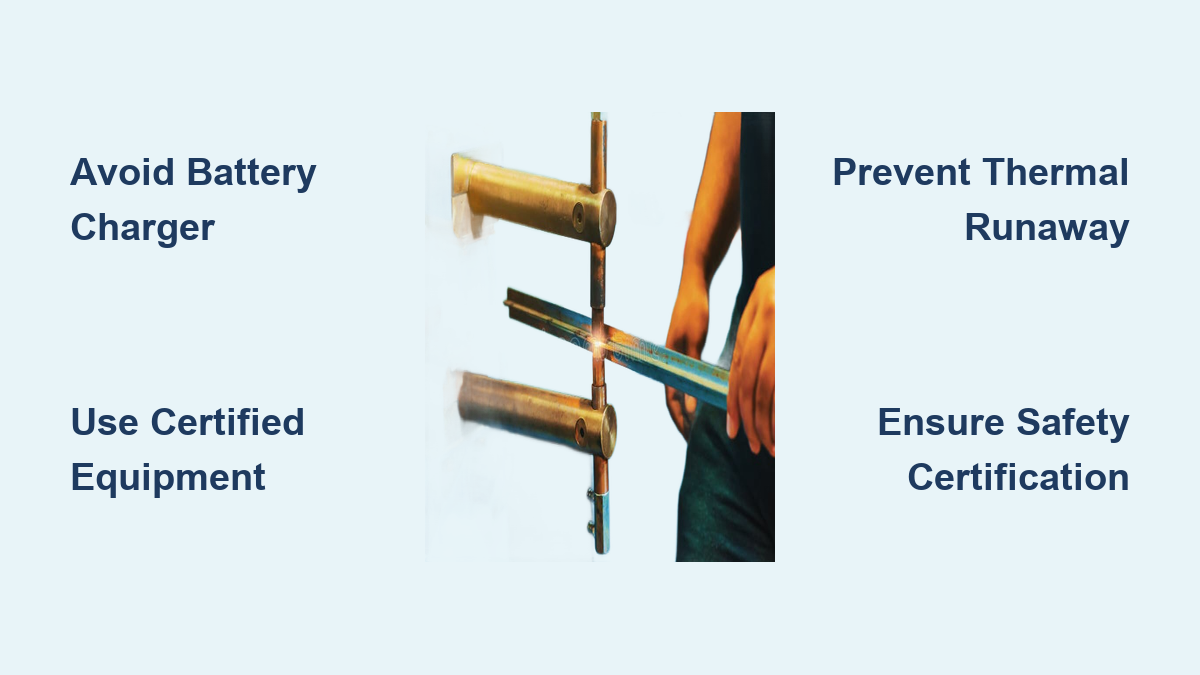
You’ve seen the online tutorials promising a cheap spot welder built from a scrap battery charger. Maybe you need to repair a broken battery pack or fabricate small metal parts. The allure of saving $200+ on professional equipment is strong—until you realize making a spot welder from a battery charger carries extreme fire and electrocution risks with no safe DIY method. Electrical safety experts universally warn against this conversion because battery chargers lack critical safety features for spot welding’s massive current demands. In this article, you’ll discover why this dangerous myth persists, the specific hazards that make it unsafe, and three legitimate alternatives that won’t risk your home or health. Forget viral “hacks”—real solutions prioritize your safety over shortcuts.
Critical Electrical Hazards That Make This Conversion Deadly

Battery chargers deliver controlled 2-10A currents for safe battery recharging. Spot welding requires instantaneous 500-3000A bursts to fuse metal—current levels chargers physically can’t produce without catastrophic failure. When modified incorrectly (as all DIY guides are), these systems bypass critical safety circuits, creating multiple lethal threats:
- Thermal runaway fires: Uncontrolled current melts wiring insulation within seconds, igniting nearby materials.
- Explosive component failure: Capacitors or transformers can rupture violently when overloaded, spraying shrapnel.
- Lethal electrocution risk: Exposed high-current terminals carry enough power to stop your heart instantly.
Unlike purpose-built spot welders with insulated electrodes and timed current cutoffs, modified chargers lack any protection against accidental contact. One slip of a gloved hand near exposed terminals could be fatal. Electrical safety standards like NFPA 70E explicitly prohibit modifying equipment beyond its certified design parameters—which includes all battery charger repurposing attempts.
Why No “Safe” DIY Method Exists for Home Users
⚠️ Critical Reality Check: If a $30 battery charger could safely produce 2000A spot welds, manufacturers would sell $50 spot welders instead of $200+ professional units. Physics and safety regulations make this impossible.
Three non-negotiable barriers prevent safe conversion:
1. Insufficient copper mass: Charger cables use thin-gauge wire that vaporizes under spot-welding currents
2. No duty cycle control: Chargers overheat in seconds when forced into continuous high-current mode
3. Missing arc suppression: Uncontrolled arcing melts electrodes and sprays molten metal
Professional spot welders solve these with heavy copper busbars, magnetic blowouts, and microsecond-precision timing—components impossible to retrofit safely onto consumer chargers. Every documented DIY failure (from garage fires to ER visits) traces back to ignoring these fundamental mismatches.
How Viral “Tutorials” Mislead Users Into Danger
Online videos often show successful first welds using modified chargers, creating false confidence. These demonstrations hide critical context that leads to disaster during real-world use:
The Hidden Failure Timeline Most Videos Ignore
| Phase | What Happens | Why It’s Dangerous |
|---|---|---|
| 0-30 sec | Initial welds appear successful | Thin cables handle brief current spikes |
| 30-90 sec | Wiring insulation melts, exposing copper | Risk of accidental contact with live parts |
| 90-180 sec | Components overheat, causing voltage drops | Weak welds tempt users to “force” more current |
| 180+ sec | Thermal runaway ignites nearby materials | Fire spreads before user reacts |
These videos never show the inevitable endpoint: all unmodified chargers fail catastrophically within minutes of actual welding use. The “success” you see is merely the calm before component explosion. Even if you avoid immediate injury, degraded insulation creates hidden shock risks that persist long after the project ends.
Three Deadly Mistakes DIYers Always Make
- Ignoring cable gauge requirements: Using 12-14AWG charger cables instead of minimum 2/0AWG welding cables
- Bypassing overcurrent protection: Disabling fuses or thermal cutoffs to “get stronger welds”
- Assuming car batteries are safe: Connecting external batteries creates uncontrolled current sources with no shutoff
Each “fix” amplifies risks exponentially. That moment you decide to “just weld one more tab” after noticing melting insulation? That’s when fires start.
Documented Consequences: When DIY Spot Welders Fail
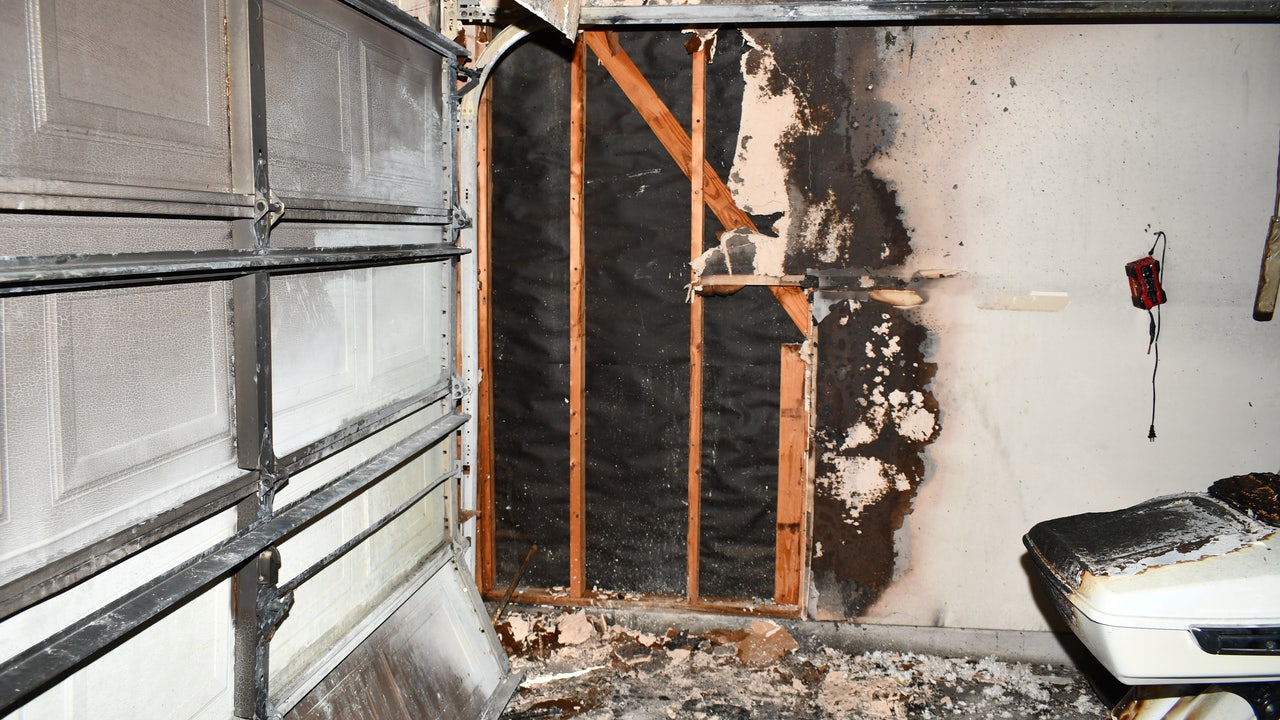
Real-world incidents prove why professionals condemn this practice:
- 2022 California garage fire: A modified charger ignited lithium-ion battery debris during an e-bike repair, destroying the home. Investigators found melted 10AWG cables attempting to handle 1500A.
- 2023 ER case study: A hobbyist suffered third-degree burns when a capacitor exploded after 45 seconds of welding, spraying electrolyte and shrapnel.
- OSHA violation report: An auto shop employee lost two fingers when a jury-rigged charger welder arced unexpectedly during battery terminal repair.
These aren’t isolated incidents—they represent predictable outcomes when physics confronts wishful thinking. The Consumer Product Safety Commission notes a 300% rise in welding-related ER visits since 2020, directly correlating with viral DIY tutorials. No legitimate welding organization endorses charger conversions; all emphasize certified equipment only.
Three Safe, Affordable Alternatives That Won’t Risk Your Life

Stop gambling with lethal currents. These proven solutions deliver real spot welding capability without compromising safety:
Invest in Purpose-Built Entry Equipment
Modern hobbyist spot welders solve the exact problems DIYers face:
– $150-$300 units (like SaldSpot Mini or Hump Max) include:
– 1000-2000A output with precise timing controls
– Insulated copper electrodes with automatic shutoff
– UL/CE safety certifications
– Key advantage: Built-in current monitoring prevents thermal runaway before hazards develop
Unlike jury-rigged chargers, these units won’t melt your workbench after three welds. The $100 premium over a “free” charger pays for decades of safe operation—and peace of mind.
Learn Professional Techniques Through Certified Training
Many community colleges and makerspaces offer affordable spot welding courses:
– $50-$150 workshops teach:
– Electrode maintenance and alignment
– Material-specific current settings
– Emergency shutdown procedures
– Bonus: Access to industrial-grade equipment during training
You’ll weld better in your first class than after months of dangerous DIY experimentation. The American Welding Society maintains a free directory of certified programs nationwide—no risky modifications required.
Use Professional Repair Services for Critical Jobs
For lithium-ion battery repairs or safety-critical components:
– Local battery rebuild shops charge $20-$50 for spot welding services
– Mobile technicians bring certified equipment to your location
– Guaranteed safety: No liability for DIY-caused fires or explosions
This isn’t “giving up”—it’s prioritizing what matters most: your life and property. That $50 service call is cheaper than a rebuilt garage or medical bills.
Essential Safety Checklist Before Any Welding Project
Never operate any welding equipment without verifying these non-negotiables:
– ✅ Certification labels: UL, CE, or ETL marks confirming safety testing
– ✅ Automatic shutoff: Current cutoff within 0.01 seconds of trigger release
– ✅ Insulated electrodes: No exposed metal within 6 inches of contact point
– ✅ Adequate cable gauge: Minimum 4/0 AWG for 1000A+ applications
If your setup lacks any of these, stop immediately. No welding job is worth your safety. Keep a Class C fire extinguisher within arm’s reach during all welding operations—lithium fires require specialized suppression.
Why Your Safety Outweighs “Saving” $200
That viral video showing a successful DIY spot welder didn’t capture the aftermath: the charred remains of a garage, the hospital bills, or the family left unprotected by preventable negligence. Battery chargers weren’t engineered for spot welding’s extreme demands—and no YouTube tutorial can rewrite physics. Professional welders spend years mastering safe techniques with certified equipment for good reason.
Your welding projects deserve proper tools, not death traps disguised as shortcuts. Invest in a purpose-built spot welder, take certified training, or use professional services. The moment you prioritize safety over viral hacks is the moment you become a true craftsman. Your life—and your loved ones’ safety—depends on this choice. Stop searching for dangerous conversions; start building with confidence using equipment designed to protect you.
Leave a Reply