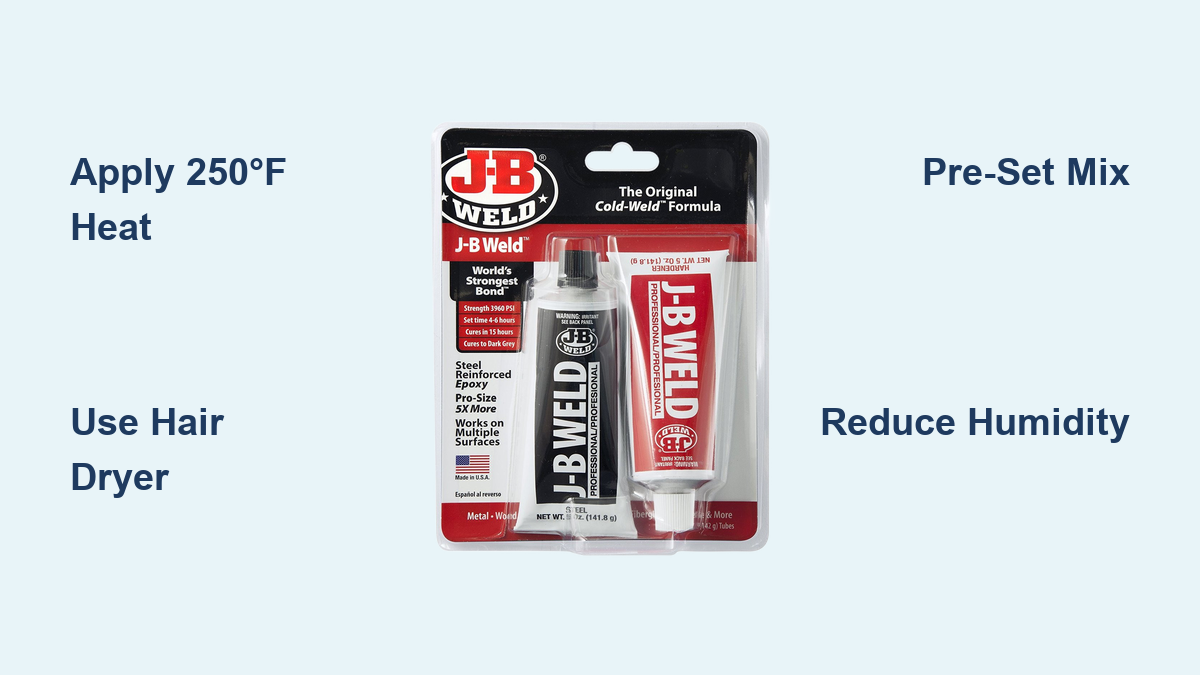
That broken engine part won’t wait 24 hours for JB Weld to cure—neither will your leaky pipe or cracked bumper. When you need repairs done yesterday, understanding how to make JB Weld dry faster transforms frustrating downtime into immediate solutions. The legendary epoxy’s standard 24-hour cure time feels like an eternity when you’re holding pieces together, yet its remarkable 3960 psi tensile strength makes it worth the wait. The good news is you don’t have to sacrifice strength for speed. Multiple proven techniques exist to accelerate JB Weld drying while maintaining the bond integrity that makes it the professional’s choice for critical repairs. Whether you’re fixing household items or automotive components, these methods cut cure time dramatically without compromising durability.
Apply Heat at 250°F for 1-2 Hour JB Weld Curing
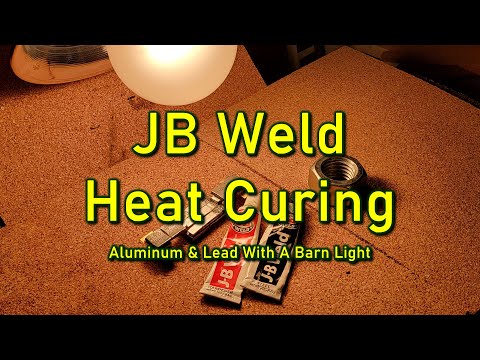
Heat application delivers the most dramatic acceleration of JB Weld drying time by boosting molecular activity in the epoxy’s chemical reaction. When you expose curing JB Weld to temperatures between 250°F and 300°F, the standard 4-6 hour initial set compresses to just 1-2 hours while maintaining full bond strength. An ordinary household oven preheated to 250°F provides the most consistent heat source for oven-safe repairs. Place your item on the middle rack, set a timer for 1-2 hours, and you’ll achieve results impossible at room temperature.
For non-oven-safe items, maintain steady heat using alternative methods. Position a heat lamp 12-18 inches from the repair site, monitoring with an infrared thermometer to prevent hot spots. The key is consistent temperature—not maximum heat—as uneven heating creates weak points in the cured epoxy. Never exceed 300°F, as temperatures approaching 400°F begin breaking down the epoxy’s molecular structure. This heat acceleration technique works because JB Weld’s curing process is exothermic—it generates its own heat—so external warmth simply amplifies the natural reaction already occurring.
How to Use a Hair Dryer to Halve JB Weld Drying Time
When you need to make JB Weld dry faster immediately, your hair dryer becomes the most accessible acceleration tool. Set it to maximum heat and hold it 6-8 inches from the repair, moving continuously to distribute warmth evenly. This technique typically cuts standard cure time by 50%, transforming a 4-hour set into just 2 hours. Focus particularly on vertical surfaces where gravity fights against your repair—directed heat creates a skin layer that prevents running while the interior continues curing.
For best results, work in 5-minute intervals with 2-minute cooling periods to prevent overheating. Critical mistake to avoid: holding the dryer too close or too long in one spot, which can cause bubbling or uneven curing. This method shines for automotive repairs where disassembly isn’t practical—direct heat to exhaust manifolds or engine blocks without removing components. The hair dryer’s airflow also helps evaporate surface moisture that might otherwise slow curing, providing dual acceleration benefits you won’t get from stationary heat sources.
JB Kwik vs. JB Quik: When to Choose Fast-Setting Alternatives
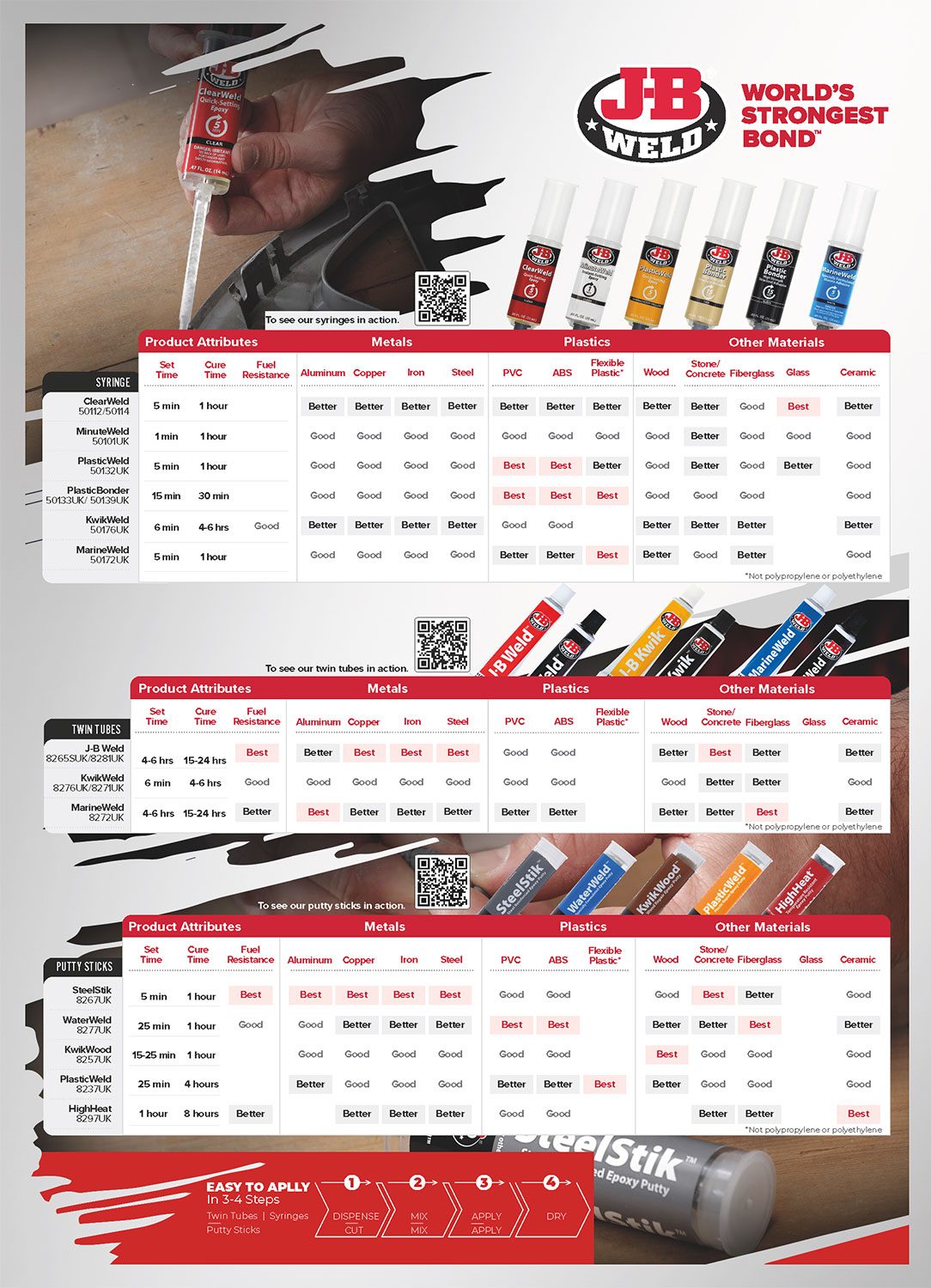
When waiting hours isn’t an option, JB Weld’s fast-setting variants deliver dramatically quicker results—but understanding their limitations prevents future failures. JB Kwik begins setting in just 5 minutes with a full cure in 4-6 hours, while JB Quik dries within minutes, making it ideal for vertical surface repairs where standard JB Weld runs before setting. These quick-set formulas solve immediate time constraints but come with significant trade-offs.
Strength comparison:
– Original JB Weld: 3960 psi tensile strength
– JB Kwik: 2424 psi (about 60% of original)
– JB Quik: Slightly less than JB Kwik
More critically, heat resistance plummets in fast-setting variants—they begin softening above 200°F and fail around 400°F, compared to the original formula’s 500°F tolerance. Use quick-set formulas only for repairs that won’t face high stress or heat exposure. For engine components or exhaust systems, accelerate the original JB Weld with heat rather than sacrificing heat resistance for speed.
Pre-Set Your JB Weld Mix for Vertical Surface Repairs
Stop fighting gravity on vertical surfaces by pre-setting your JB Weld mix before application. Mix the 2:1 ratio of resin to hardener on cardboard or plastic, then wait 1-2 hours until it thickens to a tacky, putty-like consistency. This pre-cured material grips vertical surfaces immediately rather than sliding downward during the critical initial set phase. The technique effectively gives your repair a 2-hour head start on curing while solving the most frustrating aspect of vertical repairs.
This method works particularly well when combined with heat acceleration—pre-set the epoxy, apply it to your surface, then use a hair dryer to finish curing in just 1-2 hours total. Pro tip: For deep cracks, apply pre-set JB Weld in thin layers with 30-minute intervals between applications. This prevents air pockets while allowing each layer to bond properly, creating a stronger repair than single thick applications.
Stop JB Weld From Running on Cracks With This Tape Trick

Vertical crack repairs become manageable with this simple mechanical reinforcement technique that also accelerates effective drying. First, clean and dry the repair area thoroughly—any moisture significantly slows curing. Next, apply masking tape along both sides of the crack to create a dam that contains the epoxy. For deeper reinforcement, press a small piece of window screen into the uncured JB Weld before applying the final layer.
The screen acts like rebar in concrete, providing structural support while the epoxy cures around it. After applying JB Weld within your taped boundaries, use a hair dryer on low heat to accelerate surface setting—within 15 minutes, the epoxy will form a skin that prevents further running. Leave the tape in place for at least 2 hours to ensure complete surface cure before removal. This combined approach solves both the running problem and accelerates usable strength development for time-sensitive repairs.
Why Humidity Slows JB Weld Curing (And How to Fix It)
High humidity sabotages your efforts to make JB Weld dry faster by interfering with the epoxy’s chemical reaction. Moisture in the air competes with the curing process, extending both initial set and full cure times significantly. In extremely humid conditions, standard 24-hour cure times can stretch to 48 hours or more, negating your acceleration efforts.
Counteract humidity with these practical solutions:
– Work in air-conditioned spaces where humidity stays below 50%
– Use a dehumidifier in your workshop for critical repairs
– Apply a small fan to circulate air around the repair (not directly on it)
– Pre-heat metal surfaces with a heat gun to drive off surface moisture
Critical insight: Cold metal surfaces naturally condense moisture from humid air, so always warm repair surfaces to at least 70°F before applying JB Weld. This preparation step alone can shave hours off cure time in humid environments while creating stronger bonds.
Avoid These 3 Mistakes When Speeding Up JB Weld Drying
Rushing JB Weld curing often backfires when these common mistakes undermine your efforts. First, applying excessive heat too quickly creates a hardened outer shell while the interior remains uncured—a time bomb waiting to fail under stress. Always apply heat gradually, starting with lower temperatures and increasing slowly.
Second, moving or stressing the repair before it reaches handling strength (typically 4-6 hours even with acceleration) compromises bond integrity. Even when the surface feels solid, the molecular bonding continues beneath the surface. Critical rule: Wait at least 4 hours before light handling, 8 hours before moderate stress, and 24 hours for maximum strength—even with heat acceleration.
Third, using quick-set formulas on high-heat applications guarantees failure. JB Kwik and JB Quik soften above 200°F, making them disastrous choices for engine repairs. For high-heat applications, accelerate the original JB Weld formula instead of sacrificing heat resistance for speed.
Combine Methods for 4-Hour JB Weld Repairs With Full Strength
The fastest path to reliable repairs combines multiple acceleration techniques strategically. For critical repairs requiring full 3960 psi strength, follow this proven sequence:
- Thoroughly clean surfaces with brake cleaner (dry surfaces cure 30% faster)
- Mix small batches of original JB Weld (larger batches cure slower)
- Pre-set the mix for 60-90 minutes until tacky
- Apply to prepared surface and reinforce with window screen if needed
- Apply consistent heat at 250°F using a heat lamp for 2-3 hours
This method delivers 90% of full strength in just 4 hours—compared to 24 hours at room temperature—while maintaining the original formula’s heat resistance. For non-critical repairs where speed trumps maximum strength, substitute JB Kwik and reduce total time to 2 hours with heat application.
Remember that proper surface preparation contributes more to successful acceleration than any single technique. Clean, dry, slightly roughened surfaces bond faster and stronger, making every acceleration method more effective. When time matters but reliability is non-negotiable, this combined approach gives you the best of both worlds—speed without sacrifice.
Leave a Reply