
Tired of struggling with unreliable solder joints when building battery packs? Learning how to make spot welder with capacitor solves this problem by delivering precise, high-current pulses that weld nickel strips to lithium cells without damaging sensitive internals. This DIY approach costs a fraction of commercial units while giving you complete control over welding parameters. In just 20 milliseconds, your capacitor-based spot welder stores energy and releases it precisely where needed—creating strong bonds while keeping heat away from battery components that could fail from excessive temperature exposure. You’ll discover exactly which components to use, how to assemble them safely, and the critical adjustments needed for consistent, professional-quality welds on 0.15mm to 0.3mm nickel strips.
Capacitor spot welders outperform transformer-based alternatives for battery work because their brief energy bursts prevent heat conduction into cell internals. When you build your own spot welder with capacitor bank, you gain the ability to tailor energy output specifically for your projects—whether assembling 18650 battery packs or repairing small electronics. This guide walks through every step of constructing a reliable unit using affordable, readily available components. By the end, you’ll understand how to select the right capacitors, implement safe switching technology, and operate your new tool with confidence for flawless battery tab welding every time.
Selecting Your Capacitor Bank Components
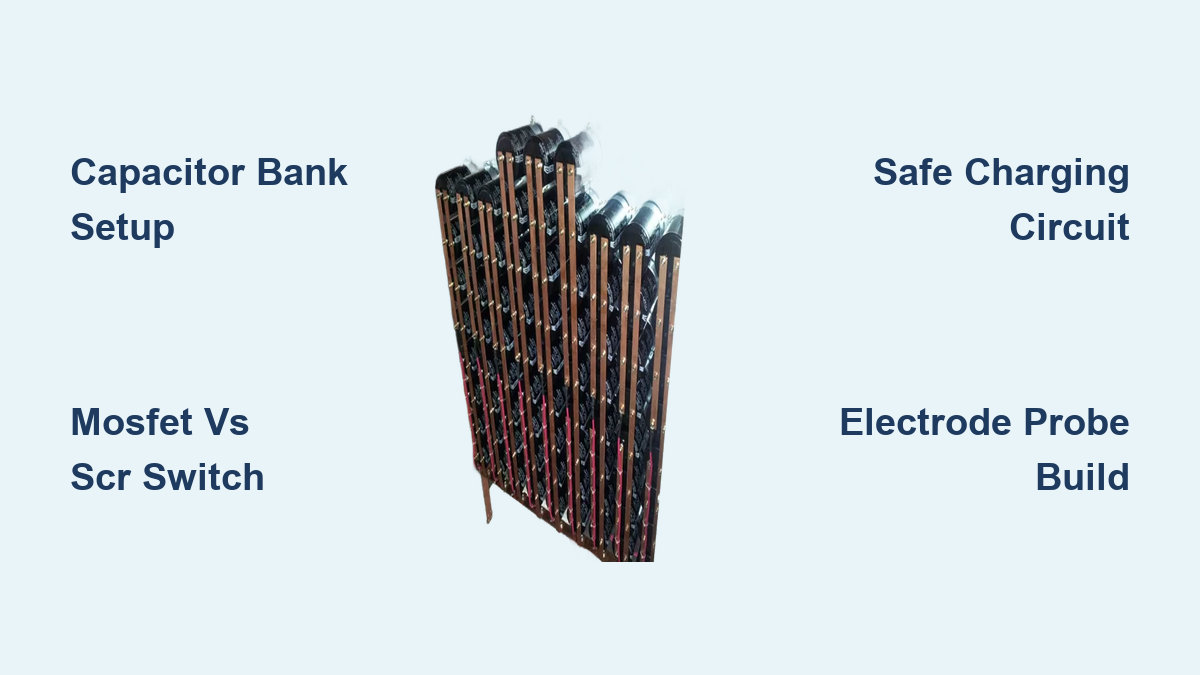
Building an effective capacitor spot welder starts with choosing the right energy storage components. For reliable battery tab welding, you need a bank that delivers 60-85 joules with extremely low resistance. A practical configuration uses 30 capacitors rated at 16V and 47mF each, creating 1.4 farads total capacitance with just 0.46 milliohms equivalent series resistance. This setup stores 84 joules when charged to 16V—perfect for welding 0.15mm nickel strips without damaging lithium cells.
Critical capacitor specifications to verify before purchasing:
– Voltage rating must exceed your operating voltage by 50% (use 25V+ caps for 16V systems)
– Low equivalent series resistance (under 20 milliohms per capacitor)
– Radial lead or snap-in terminal types for easier mounting
– Temperature rating of 105°C for longer lifespan
Avoid supercapacitors for your first build—they require complex balancing circuits due to their low 2.7V cell ratings. Traditional electrolytic capacitors offer simpler parallel configuration and better pulse current handling for spot welding applications. When you make spot welder with capacitor bank, ensure all units come from the same manufacturing batch to guarantee matched characteristics and prevent uneven current sharing.
Assemble Your Capacitor Bank in 4 Critical Steps
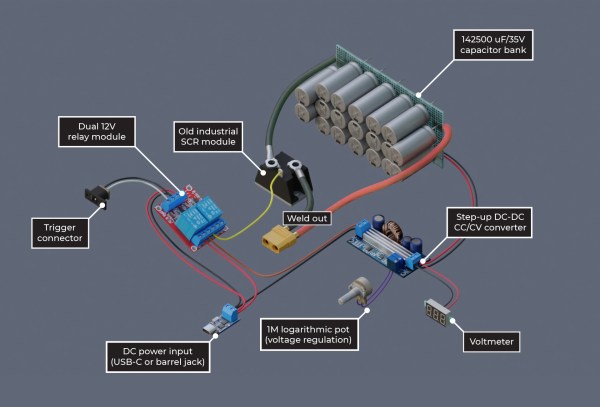
Constructing your capacitor bank requires precision to handle the 2,000+ ampere discharges safely. Start with a double-sided perfboard that provides solid mechanical support and electrical isolation between components. The following sequence ensures reliable connections that won’t overheat during operation:
- Insert capacitors evenly spaced through perfboard holes with positive terminals aligned
- Create low-resistance connections by pushing copper wick through holes around each lead, bending over, and soldering thoroughly
- Install bleeder resistors (100k-1M ohm) across the bank to safely discharge stored energy when powered off
- Verify connections with a multimeter in continuity mode, checking for shorts between positive and negative rails
Warning: Never skip the bleeder resistor installation—capacitors retain dangerous charge levels even after power disconnection. A single 1M ohm resistor across your bank provides safe discharge within 10-15 minutes while consuming minimal standby power.
MOSFET vs SCR: Choosing Your Switching Technology
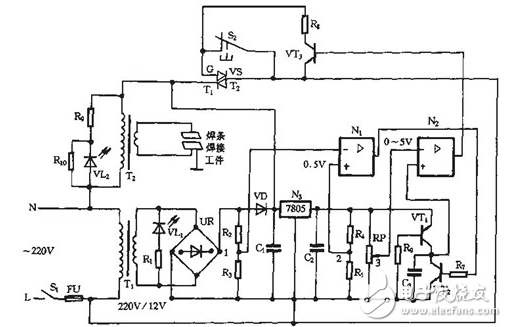
Your capacitor spot welder’s switching component determines reliability and control precision. Two technologies dominate DIY builds, each with distinct advantages:
MOSFET-based systems offer superior control for beginners:
– Use 10+ parallel MOSFETs rated at 30V+ with ≤2.5 milliohms on-resistance
– Provide microsecond switching for precise 10-20ms weld pulses
– Require gate driver circuits but allow easy adjustment of pulse duration
– Best for USB-C powered portable designs where fine control matters
SCR (thyristor) systems suit those prioritizing simplicity:
– Industrial modules like T90RIA120 handle 1,000+ ampere peaks effortlessly
– Latch closed with brief gate pulse then automatically turn off as capacitors discharge
– Eliminate complex gate driving requirements of MOSFETs
– Ideal for fixed-energy applications where pulse timing is less critical
When you make spot welder with capacitor bank, match your switch to your skill level—MOSFETs offer more control but require careful current balancing, while SCRs provide “set and forget” reliability once properly triggered.
Build a Reliable Charging System in Minutes
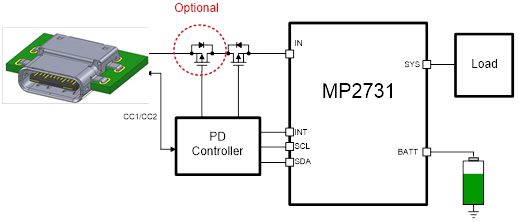
Your capacitor spot welder requires proper charging circuitry to prevent component damage and ensure consistent welds. USB-C power delivery offers the most versatile solution for DIY builds, but requires specific implementation:
- Use a CC/CV DC-DC converter between your power source and capacitor bank
- Set constant current mode to limit inrush (3A works for most 1.4F banks)
- Configure voltage limit 10% below capacitor rating (14.4V for 16V caps)
- Monitor charging with panel voltmeter connected directly across capacitor terminals
A 12V/3A USB-C power source fully charges a 1.4F bank in approximately 4 seconds—fast enough for production work but slow enough to prevent triggering source protection circuits. Never connect capacitors directly to power sources without current limiting; the initial inrush current can exceed 500 amperes, damaging connectors and power supplies.
Construct Professional Welding Probes Yourself
Your spot welder’s electrodes determine weld quality and longevity. Create precision probes using these specifications:
- Material: 12.7mm (0.5″) diameter oxygen-free copper rod
- Tip shape: Taper to 3-5mm diameter over 15-20mm length
- Length: 100-150mm for comfortable handling
- Connection: Solder 10 AWG silicone-insulated wire to copper base
Mount probes in insulated holders made from heat-resistant materials like fiberglass or high-temperature 3D printed resin. Apply firm, consistent pressure during welding—approximately 5-10 pounds force—to ensure good contact without deforming thin nickel strips. Connect probes to your capacitor bank using XT90 connectors for reliable, high-current connections that won’t overheat during repeated use.
Critical Safety Practices for Safe Operation
Capacitor spot welders store dangerous energy levels—follow these non-negotiable safety rules:
Before every use:
– Verify bleeder resistors are functioning with multimeter
– Inspect all high-current connections for signs of heating
– Confirm no metal objects are bridging capacitor terminals
During welding:
– Always wear ANSI-approved safety goggles
– Never touch probes during or immediately after welding
– Keep hands clear of electrode contact points
After use:
– Wait 5 minutes before handling internal components
– Manually discharge capacitors using 100-ohm/5W resistor
– Store in location away from flammable materials
Warning: The electromagnetic pulse from discharge can damage nearby electronics—keep phones, computers, and credit cards at least 3 feet away during operation. This critical precaution prevents data corruption from your how to make spot welder with capacitor project.
Troubleshoot Common Issues in Minutes

Keep your capacitor spot welder performing reliably with these quick fixes:
Weak or inconsistent welds?
→ Clean copper electrodes with brass brush
→ Verify consistent 5-10 pound probe pressure
→ Check capacitor bank voltage (must be ≥95% of target)
Double triggering (multiple pulses)?
→ Add 100nF capacitor across trigger switch terminals
→ Implement software debounce if using microcontroller
→ Replace mechanical switch with higher-quality alternative
No discharge when triggering?
→ Confirm capacitors are charged using voltmeter
→ Check switch continuity with multimeter
→ Test MOSFETs/SCRs for proper operation
Regular maintenance prevents most failures—inspect all high-current connections monthly for discoloration indicating overheating, and replace any capacitors showing bulging or leakage immediately. When you make spot welder with capacitor bank, component health directly determines welding consistency.
Enhance Your Spot Welder for Professional Results
Once your basic unit works reliably, implement these upgrades:
- Add dual-pulse capability with LTC6993 timer circuit for oxide-penetrating first pulse
- Install digital voltage display to monitor capacitor charge consistency
- Upgrade to 8 AWG silicone wire for probe connections, reducing resistance by 40%
- Create interchangeable tips for different thickness materials
For USB-C powered models, adding a 5V buck converter powers control circuitry directly from the input source—eliminating separate batteries. These enhancements transform your how to make spot welder with capacitor project from functional to professional-grade, handling everything from delicate 0.1mm nickel strips to thicker 0.3mm interconnects with equal precision.
Building your own capacitor spot welder delivers immediate value for battery builders while teaching valuable power electronics skills. Start with a basic MOSFET-switched design using the component specifications outlined here, then refine your unit as your confidence grows. Within hours of completing your how to make spot welder with capacitor project, you’ll produce battery pack welds that rival commercial equipment—saving hundreds while gaining complete control over your fabrication process. Remember to prioritize safety at every stage, and your DIY spot welder will deliver reliable service for years of battery building projects.
Leave a Reply