
Cast iron repair presents unique challenges that test even experienced welders. When your cast iron component develops a crack or break, you might instinctively reach for your TIG welder, but this material demands special attention. Unlike steel or aluminum, cast iron’s high carbon content creates significant hurdles during the welding process. The distinctive gray color you see in cast iron comes from graphite flakes that make it brittle and prone to cracking when heated improperly. Many DIY enthusiasts and even some professionals have struggled with failed cast iron welds that cracked immediately or shortly after completion. The good news is that with proper techniques and precautions, successful TIG welding of cast iron is achievable. In this guide, you’ll learn the critical factors that determine whether your cast iron repair will hold or fail, why temperature control makes all the difference, and how to approach this challenging material with confidence.
Why Cast Iron Welding Requires Special Techniques
Cast iron’s composition creates unique welding challenges that don’t exist with other metals. The high carbon content (2-4%) transforms into graphite during cooling, which creates stress points where cracks can form. When you apply heat from welding, the localized heating causes expansion, and during cooling, the rapid contraction creates tension that exceeds cast iron’s low tensile strength. This explains why so many cast iron welds crack either during the welding process or shortly after. The material’s poor thermal conductivity means heat doesn’t dissipate evenly, creating hot spots that intensify these stresses. Understanding these fundamental properties is crucial before attempting any cast iron repair.
How Cast Iron’s Structure Affects Weld Integrity
The graphite structure in cast iron behaves differently than the crystalline structure of steel during heating and cooling cycles. As the weld area cools, the graphite flakes can’t accommodate the contraction stresses, leading to cracks that follow the graphite pattern. This is why successful cast iron welding requires managing the thermal cycle carefully. The key isn’t just in the welding technique itself but in controlling how the entire piece heats and cools. Without proper heat management, even a perfectly executed weld bead will fail as the surrounding material cracks.
Critical Temperature Thresholds for Cast Iron Welding
Temperature control represents the most critical factor in successful cast iron welding. The material becomes significantly more vulnerable to cracking when it passes through the critical temperature range of 1,100-1,600°F during both heating and cooling. When cast iron cools through this range too quickly, the thermal stresses exceed the material’s strength. Professional welders emphasize that maintaining proper pre-heat temperatures and controlling the cooling rate are often more important than the welding technique itself. This explains why many failed welds occur not from poor welding execution but from inadequate temperature management.
Essential Preparation Steps Before Welding

Proper preparation determines 80% of your cast iron welding success before you even strike an arc. Rushing through preparation is the most common mistake that leads to failed repairs. The extensive preparation required for cast iron might seem excessive compared to other materials, but each step addresses specific challenges inherent to this material.
Cleaning and Preparing the Weld Area
Thorough cleaning represents the non-negotiable first step in cast iron repair. Oil, grease, or paint contamination will cause porosity and weakness in your weld. Use a wire brush specifically designated for cast iron (to prevent carbon steel contamination), followed by solvent cleaning. For deep cracks, you’ll need to grind or chip out the entire fracture to create a proper V-groove that allows complete penetration. The groove should be wide enough to access the root without excessive heat input. Remember that any contaminants trapped in the weld zone will compromise integrity, so invest significant time in this preparation phase.
Pre-Heating Cast Iron Properly
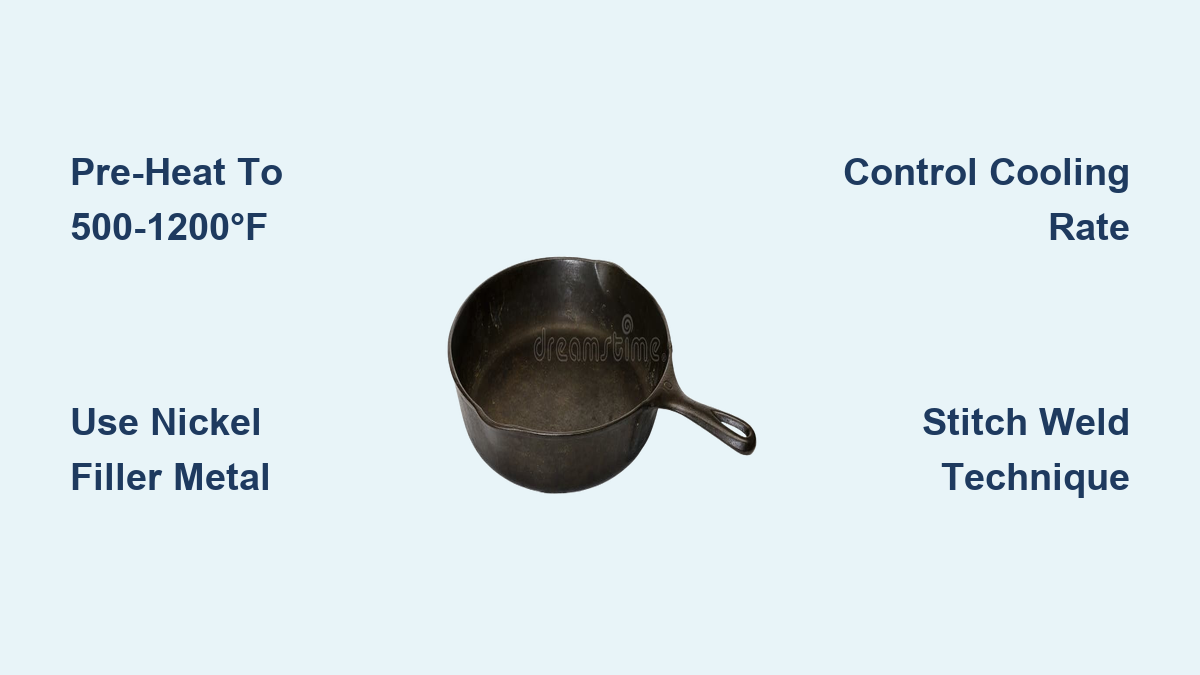
Pre-heating serves multiple critical functions in cast iron welding. It reduces the temperature differential between the weld zone and the base metal, minimizes thermal shock, and slows the cooling rate through the critical temperature range. Most professionals recommend pre-heating to 500-1,200°F depending on the casting’s size and complexity. Larger castings require higher pre-heat temperatures to maintain thermal stability during welding. Use temperature-indicating crayons or an infrared thermometer to verify temperatures at multiple points. Never apply direct flame to the weld area itself—heat the surrounding area evenly to avoid creating new stress points.
TIG Welding Technique for Cast Iron Success
The actual welding process for cast iron differs significantly from standard TIG procedures. Your approach to amperage settings, travel speed, and weld placement all require adjustment to accommodate cast iron’s unique properties.
Optimal Welding Parameters for Cast Iron
When TIG welding cast iron, use lower amperage settings than you would for steel of similar thickness. Typically, 70-120 amps works well for most repairs, depending on material thickness. The key is maintaining a small, controlled weld pool that minimizes the heat-affected zone. Use short arc length and avoid excessive puddle agitation. Cast iron doesn’t flow like steel, so don’t expect the same puddle characteristics. Keep your travel speed slightly faster than normal to prevent overheating any single area. The goal is to deposit enough material to fill the joint without creating a large heat sink that will cause cracking during cooling.
Strategic Weld Placement and Sequence
The sequence in which you place weld beads dramatically affects the final result. For longer cracks, use a “stitch welding” technique—weld short segments (1-2 inches) with cool-down periods between them. Always weld toward the direction of existing cracks rather than away from them. Start at one end of a crack and weld toward the other end in short increments. This technique helps push potential cracking away from your completed weld rather than into it. For round components, weld in a circular pattern, working toward the center. These strategic approaches help manage stress distribution throughout the casting.
Post-Weld Heat Treatment for Maximum Strength

What happens after you complete the weld determines whether your repair will last or fail prematurely. Many welders focus entirely on the welding process itself but neglect the equally critical post-weld treatment phase.
Controlled Cooling Methods
Rapid cooling guarantees failure in cast iron welds. The proper cooling process requires maintaining the entire casting at elevated temperatures (typically 900-1,000°F) for several hours before allowing slow cooling. Professional shops use temperature-controlled ovens, but for field repairs, you can create a makeshift oven using firebricks and insulating blankets. The cooling rate should not exceed 75°F per hour through the critical temperature range. This slow cooling allows the graphite structure to stabilize without creating excessive stresses. Skipping this step is the most common reason for delayed weld failures that occur hours or days after apparently successful welding.
Stress Relief Techniques
For critical applications, additional stress relief beyond controlled cooling may be necessary. This involves reheating the entire casting to 1,100-1,200°F and holding it at that temperature for one hour per inch of thickness before controlled cooling. This process helps redistribute residual stresses throughout the casting rather than concentrating them at the weld zone. While not always necessary for small repairs, it’s essential for structural components that will experience significant loads.
Common Cast Iron Welding Mistakes to Avoid

Even experienced welders make critical errors when working with cast iron. Recognizing these common pitfalls can save you from frustrating failures.
Why Using the Wrong Filler Metal Guarantees Failure
Many welders mistakenly use standard steel filler rods for cast iron repairs. This approach almost always fails because the different expansion rates between steel and cast iron create immense stress at the fusion line. Nickel-based filler metals (ENi-1) work best for most gray cast iron repairs because they have expansion characteristics closer to cast iron and remain ductile enough to absorb stresses. For high-strength applications, nickel-iron alloys (ENiFe-1) provide better matching properties. Using the wrong filler material creates an inherent weakness regardless of perfect welding technique.
The Danger of Insufficient Pre-Heating
One of the most frequent mistakes is inadequate pre-heating. Some welders skip pre-heating entirely or only warm the immediate weld area. Cast iron requires thorough, uniform heating of the entire casting to be effective. Without proper pre-heat, the thermal shock of welding creates immediate micro-cracks that may not be visible but will lead to premature failure. The size of the casting determines how much area needs pre-heating—larger castings require heating a wider area surrounding the weld zone.
When to Consider Alternative Repair Methods
TIG welding isn’t always the best solution for cast iron repairs. Certain situations call for different approaches that might yield better results.
Brazing vs. Welding for Cast Iron
For thin castings or applications where strength requirements aren’t extreme, brazing often produces more reliable results than welding. Brazing uses lower temperatures (below cast iron’s melting point), reducing thermal stress. The brass or bronze filler metal flows into the joint without melting the base metal, creating a bond that’s more forgiving of cast iron’s brittleness. While not as strong as a proper weld, brazed joints often outperform poorly executed welds on cast iron components.
Cold Metal Stitching for Critical Repairs
For high-value or safety-critical cast iron components, cold metal stitching provides a reliable alternative to welding. This mechanical repair method involves drilling and tapping a series of holes along the crack, then inserting special locking pins that draw the crack closed. The process creates no heat whatsoever, eliminating thermal stress concerns entirely. While more labor-intensive, cold stitching often produces the most durable repairs for valuable cast iron components like engine blocks or machinery bases.
Essential Safety Considerations for Cast Iron Welding
Welding cast iron introduces specific safety hazards beyond standard welding precautions. The high pre-heat temperatures create significant burn risks, and cast iron can release zinc fumes if it contains galvanized coatings. Always wear full protective gear including heat-resistant gloves and aprons when handling pre-heated castings. Work in a well-ventilated area, preferably with fume extraction, as cast iron welding can produce hazardous particulates. Never attempt to quench a hot casting with water—this guarantees immediate cracking and creates dangerous steam explosions. Allow all components to cool completely in a safe, designated area away from flammable materials.
Successful cast iron welding demands respect for the material’s unique properties and strict adherence to proper procedures. While challenging, mastering these techniques allows you to repair valuable components that might otherwise be scrapped. Remember that patience and proper temperature management make the difference between a lasting repair and frustrating failure. For critical applications or when in doubt, consult a welding professional with specific cast iron experience—your safety and the component’s integrity depend on it.
Leave a Reply