
Your chromoly roll cage or bicycle frame demands welds that won’t fail under stress—but one wrong move with the torch can create invisible cracks that compromise the entire structure. Chromoly steel (typically 4130 grade) offers exceptional strength-to-weight ratio for racing frames, aircraft components, and high-performance builds, yet its unique composition requires specialized welding approaches. Unlike mild steel, chromoly’s chromium and molybdenum content makes it heat-sensitive, with improper technique leading to brittle welds that crack under pressure. This guide delivers the exact methods professional fabricators use to weld chromoly successfully—covering process selection, surface prep, filler metals, heat management, and critical mistakes to avoid. Follow these steps precisely, and you’ll create chromoly welds that maintain structural integrity while maximizing the material’s legendary strength.
Why Chromoly 4130 Steel Requires Special Welding Techniques
Chromoly’s reputation as a “welder’s metal” comes from its chromium (0.8-1.1%) and molybdenum (0.15-0.25%) content that enhances strength while keeping carbon levels low. This composition allows you to use thinner tubing than mild steel for equivalent strength—critical for racing applications where every ounce counts. However, chromoly’s lower chromium content (under 1.1% versus stainless steel’s 10.5% minimum) means it lacks corrosion resistance but gains easier weldability compared to stainless.
The real challenge lies in chromoly’s heat sensitivity, particularly with thin-wall tubing (0.035″ to 0.120″). Excessive heat input causes three critical problems: burn-through on thin sections, distortion/warping from uneven heating, and a widened heat-affected zone (HAZ) that becomes brittle and prone to failure. Unlike modern high-strength steels like Docol that tolerate more heat, chromoly demands precise thermal control throughout the welding process. This is why most professional fabricators exclusively use TIG welding for chromoly structural applications—they need the superior heat management that only GTAW provides.
TIG vs. MIG for Chromoly: Which Process Delivers Stronger Welds?

Perfecting TIG Welding for Chromoly Tubing
TIG welding produces the cleanest, strongest chromoly welds when you follow these exact parameters. Start with a gas lens-equipped torch using 7/16″ ceramic cup and 1/16″ 2% thoriated tungsten with a sharp point—this configuration delivers optimal gas coverage on curved tube surfaces. Set your machine to DCEN polarity with pure argon at 15-25 CFH flow rate, and always use 6+ seconds of post-flow gas (1 second per 10 amps).
For standard 0.035″ wall chromoly tubing, run 20-40 amps at 9-12 volts with ER80S-D2 filler rod matching the base metal thickness. The critical technique? Maintain a tight arc length—keep your tungsten within 1/8″ of the workpiece to minimize heat input and prevent HAZ widening. When adding filler, dip the rod quickly into the puddle without breaking the gas shield, and move steadily to avoid overheating any single spot.
When MIG Welding Chromoly Makes Sense
While TIG delivers superior results, MIG welding chromoly works effectively if you follow these specific adjustments. Use 0.035″ ER70S-6 wire with 75% argon/25% CO2 shielding gas—this C25 blend improves wetting and reduces spatter compared to straight CO2. If your machine has inductance control, set it for stainless steel applications even though you’re welding chromoly; this counterintuitive setting improves puddle flow and edge tie-in.
The biggest mistake fabricators make with MIG is improper travel speed. Move too slowly, and you’ll burn through thin tubing; too fast, and you’ll get poor fusion. For 0.035″ chromoly, maintain a travel speed that produces a weld bead 1.5x the base metal thickness with smooth, consistent ripples. Always clean the joint thoroughly before MIG welding—chromoly’s mill scale causes porosity that MIG’s faster process won’t overcome like TIG can.
Critical Cleaning Steps Before Welding Chromoly (Don’t Skip #3)
Removing Mill Scale: The Non-Negotiable First Step
Chromoly arrives with a thin layer of mill scale that must be removed before welding—unlike some modern high-strength steels, chromoly won’t tolerate surface contaminants. Start by wiping the area with a clean rag to remove oils, then use a mild abrasive wheel or flap disc to grind 3 inches around the joint area. This mechanical cleaning removes the mill scale that causes porosity and poor fusion.
The Acetone Wipe: Your Final Defense Against Contamination
After mechanical cleaning, wipe the joint with acetone using a lint-free cloth—never skip this step. Any residual grinding dust or oils will cause weld defects that compromise structural integrity. Pay special attention to inside tube surfaces if welding closed sections; use a pipe brush dipped in acetone for thorough cleaning. Never use chlorinated solvents as they can cause porosity when exposed to welding heat.
ER80S-D2 vs. ER70S-6: Choosing the Right Filler for Chromoly
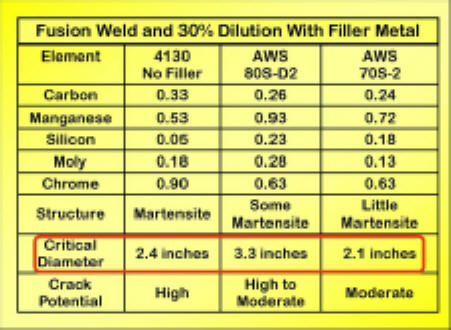
For structural chromoly applications like roll cages or bicycle frames, ER80S-D2 is the gold standard filler metal. It matches 4130 base material strength while providing excellent ductility—critical for applications that must absorb impact energy. ER70S-6 works as an alternative but produces slightly weaker welds; compensate by increasing weld size or using gussets in high-stress areas.
Never use 4130-specific filler for sporting applications—it creates brittle welds prone to cracking under impact. Similarly, avoid stainless steel fillers like 312 unless absolutely necessary; their higher strength lacks the elongation needed for flexible structures like motorcycle frames. For 0.035″ chromoly tubing, use 0.035″ diameter filler—thicker rods require excess heat that causes burn-through.
Pure Argon vs. C25: Best Shielding Gas for Chromoly Welds
When TIG welding chromoly, 100% argon is mandatory—helium blends add unnecessary heat that widens the HAZ. The cooler-running argon protects thin tubing from distortion while providing excellent arc stability. For MIG welding, 75% argon/25% CO2 (C25) delivers optimal results by improving wetting and reducing spatter compared to straight CO2.
Gas lens kits are essential for chromoly tubing—standard collet bodies don’t provide adequate coverage on curved surfaces. The multiple screens in a gas lens create laminar flow that prevents atmospheric contamination, eliminating the “rolling off” effect that causes oxidation on tube welds. This simple $20 upgrade prevents 90% of porosity issues in chromoly welds.
Avoiding Heat Damage in Chromoly: 4 Temperature Control Methods
Preheating Guidelines Based on Thickness
For chromoly under 0.120″ wall thickness, no preheat is required—just ensure material is at room temperature (70°F+). Thicker sections (0.120″+) need 300-400°F preheat to prevent rapid cooling cracks. Use temperature crayons to verify heating—never guess.
Heat Input Control Techniques That Prevent Distortion
Short arc length is your primary heat control tool—keep tungsten within 1/8″ of workpiece to minimize voltage and heat input. For long welds, use stitch welding (1″-2″ segments with 2″-3″ gaps) to allow heat dissipation between passes. Always weld toward existing heat rather than cold material to prevent cracking.
Post-Weld Cooling: Why Slow is Better
Never quench chromoly welds—rapid cooling causes cracking and lamellar tearing. Allow welds to cool slowly at room temperature; this gradual transition maintains ductility in the heat-affected zone. Thick sections (0.120″+) require stress relief at 1,100°F using an oxy/acetylene torch with neutral flame, weaved across the weld area to avoid hot spots.
Never Quench Chromoly: 3 Costly Welding Mistakes That Cause Cracks
Mistake #1: Using Stainless Steel Filler on Roll Cages
312 stainless steel filler creates catastrophic failures in roll cages—it’s stronger than 4130 tubing but lacks necessary elongation. During impact, the rigid weld concentrates stress rather than flexing, causing sudden structural failure. Use ER80S-D2 exclusively for safety-critical applications.
Mistake #2: Thick Filler Rod on Thin Material
1/16″ filler on 0.035″ chromoly requires excessive heat, leading to burn-through and distortion. Match filler diameter to base metal thickness—one size smaller for thin tubing. Thicker filler also creates wider HAZs that become brittle points under stress.
Mistake #3: Ignoring the X-Factor in Flux-Cored Welding
For flux-cored applications, X-factor must stay below 15 to prevent temper embrittlement. This formula measures resistance to toughness loss when cooling through 850°F-1,100°F. Exceeding this threshold creates welds that fail at low temperatures—critical for racing applications in cold climates.
Exact TIG Settings for 0.035″ Chromoly Tubing (Amps, Gas, Filler)
Follow this precise specification for professional-quality chromoly welds:
- Parent Material: 4130 chromoly, condition N
- Material Thickness: 0.035″ wall
- Filler Metal: ER80S-D2, 0.035″ diameter
- Joint Type: 90° tube-to-tube
- Joint Gap: 0.000-0.010″
- Current Type: DCEN
- Amperage: 20-40 amps
- Voltage: 9-12 volts
- Torch Configuration: Gas lens with 7/16″ ceramic cup
- Tungsten: 1/16″ 2% thoriated, pointed
- Shielding Gas: Pure argon, 15-25 CFH
- Post-Flow: 6+ seconds
- Tack Sequence: Minimum 4 places
Master these techniques, and you’ll consistently produce chromoly welds that maintain the material’s legendary strength-to-weight ratio. Remember the critical triad: perfect surface prep, precise heat control, and correct filler selection. For racing or aerospace applications, always choose TIG welding with ER80S-D2 filler and meticulous joint cleaning—your safety depends on it. With chromoly, there are no second chances; every weld must be perfect the first time.
Leave a Reply