
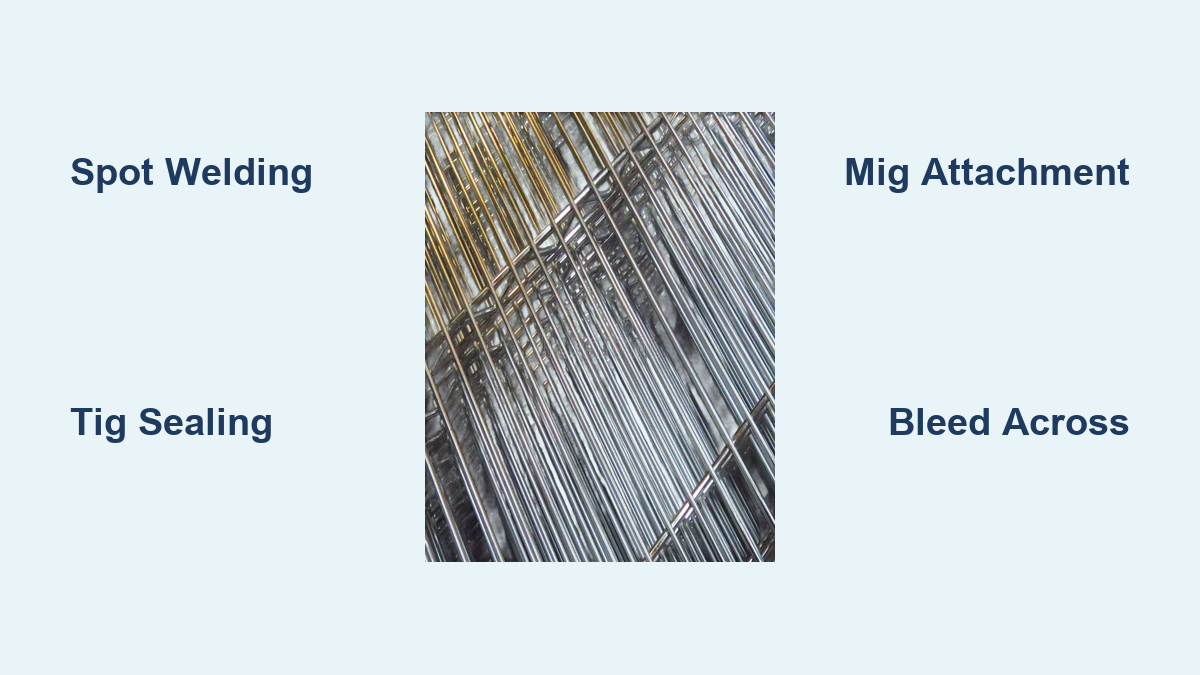
Welding mesh presents unique challenges that differ significantly from welding solid steel plates. The open structure of mesh, varying wire diameters, and thermal conductivity all influence how heat distributes during welding, requiring specialized techniques to achieve strong, durable bonds without damaging the delicate wire structure. If you’ve ever tried conventional welding methods on wire mesh only to end up with burned-through wires or weak joints, you’re not alone—this is one of the most common frustrations for fabricators working with filtration screens, security enclosures, or industrial guards.
Whether you’re repairing a damaged mesh panel or manufacturing new components, understanding the right welding method for your specific application determines the quality and longevity of your finished product. This guide covers the five primary welding techniques used for wire mesh applications, providing detailed instructions on when to use each method, how to execute proper technique, and which approach best suits your project requirements.
Spot Welding Mesh: Fast Production for Cylinder Profiles and Filter Elements
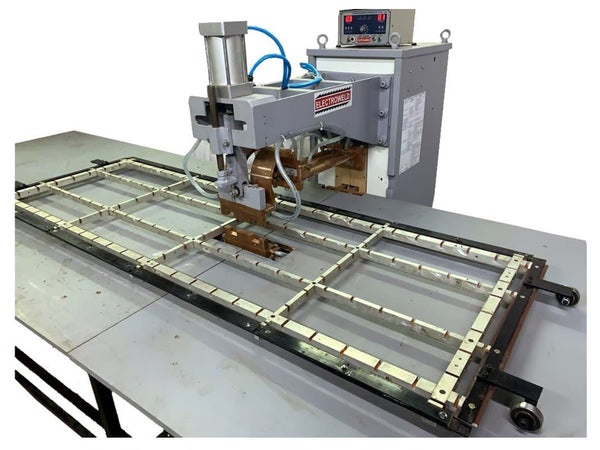
Spot welding (resistance welding) stands as the fastest method for joining wire mesh components, making it ideal for high-volume production of sock screen gaskets and filter elements. This technique uses electrical current to generate heat at contact points between wires, creating bonds through the resistance of the materials themselves without requiring additional filler material.
Why this method works best: Each spot weld takes only a fraction of a second to complete, allowing rapid progression through large mesh sections—critical for meeting tight production deadlines. The minimal heat affected zone preserves the mesh’s dimensional accuracy while creating strong bonds at wire intersections.
Avoiding Burn-Through: Critical Voltage Settings for Different Wire Diameters
The primary risk when spot welding mesh involves excessive voltage settings. When voltage is too high for your specific wire diameter, heat burns through the wire rather than creating a proper bond—wasting expensive mesh stock and slowing production.
Pro tip: Test settings on off-cut material before beginning your actual project. Thicker wires tolerate higher voltage, while fine wires require careful parameter adjustment. For stainless-steel mesh, increase voltage slightly compared to carbon steel due to higher electrical resistance.
Step-by-Step: Welding Mesh to Flat Surfaces Without Damage
- Position your mesh so it makes good electrical contact with the solid steel surface
- Start the weld on the solid material first, not directly on the mesh wire
- Allow the weld pool to “bleed across” onto the mesh wire
- Use a spot timer for consistent duration (0.1-0.3 seconds typical)
- Target intersection points where wires cross for better electrical contact
Warning: Never judge weld completion by eye alone—using a spot timer prevents variation that causes weak or burned-through joints.
TIG Welding for Leak-Free Mesh Applications (When Appearance Matters)
TIG welding creates the highest-quality, most visually appealing welds for wire mesh applications requiring complete sealing. This technique excels when working with multi-layer sintered mesh filters where leaks cannot be tolerated in high-pressure filtration systems or containment applications.
When to Choose TIG vs. Other Methods for Stainless Steel Mesh
TIG welding becomes your best option when:
– Final products will be visible to customers
– Complete leak prevention is mandatory
– Working with thicker mesh sections (16 gauge or thicker)
– Joining mesh to substantial supporting structures
Time estimate: TIG welding takes 3-5 times longer than spot welding, making it cost-prohibitive for non-critical applications.
Creating Perfect Seals for Multi-Layer Sintered Mesh Filters
For sintered mesh assemblies, TIG welding provides the robust bond needed to attach mesh securely to filter end pieces. The key is maintaining a stable weld pool while moving smoothly along the seam—too slow causes burn-through, too fast creates poor fusion.
Visual cue: Look for a clean, consistent bead with minimal spatter. Discoloration extending more than 1/8 inch from the weld indicates excessive heat input.
MIG Welding Mesh to Frames: The Speed Advantage for Security Enclosures

MIG welding offers the best balance of speed and quality for attaching mesh panels to supporting structures like trailer frames, security enclosures, and machine guards. The continuous wire feed allows longer, uninterrupted welds compared to other methods.
Proper Torch Angle and Travel Speed for Mesh Attachment
Hold your torch at a 10-15 degree angle in the direction of travel and maintain consistent speed—too slow burns through mesh wires, too fast creates weak joints. For stainless-steel mesh, use an argon/CO₂ shielding gas mix to maintain corrosion resistance.
Pro tip: MIG welding generally works better than stick welding for mesh attachment—the smoother arc characteristics provide better heat control, reducing tendency to melt through delicate wires.
Plasma Welding Cylindrical Mesh: Automated Precision for Oil & Gas Screens
Plasma welding excels when working with long, cylindrical components like sand control screens for oil and gas wells. The automated process controls torch movement, arc length, and welding speed with precision manual operation cannot match.
When Automated Plasma Welding Justifies the Setup Time
Invest in plasma welding when:
– Working with repetitive cylindrical shapes
– Production volume exceeds 50 units
– Leak integrity is critical for safety
– Consistency across long production runs matters more than setup time
Cost consideration: For small batches or one-off projects, setup time outweighs benefits—stick with TIG or MIG instead.
Mesh-to-Steel Welding: Avoiding the #1 Cause of Weak Mesh Attachments

The most common mistake when welding mesh to solid steel? Starting the weld directly on the mesh wire. This approach almost always causes burn-through because the mesh wire lacks sufficient mass to absorb the heat.
The “Bleed Across” Technique That Prevents Burn-Through
Experienced welders follow this sequence:
1. Begin welding on the solid steel material
2. Move smoothly toward the mesh wire
3. Briefly linger at the mesh wire to achieve fusion
4. Continue onto the next section of solid material
Visual cue: A successful weld shows slight discoloration on the mesh wire without breaking its structural integrity.
Troubleshooting Mesh Welding Failures: Burn-Through, Poor Fusion & Warping
Fixing Burn-Through Without Sacrificing Joint Strength
When mesh wires burn through during welding:
– Reduce welding current by 10-15%
– Increase travel speed slightly
– Ensure proper electrical contact between mesh and base material
– For resistance welding, reduce weld time by 0.05-second increments
Critical check: Poor electrical contact often causes burn-through despite proper settings—verify mesh makes full contact with underlying surface.
Solving Poor Fusion When Mesh Pulls Away From Solid Steel
Weak joints that separate under stress typically result from starting the weld directly on the mesh wire rather than bleeding from solid material. Proper technique ensures the solid material reaches sufficient temperature to form a proper bond with the mesh wire.
Quick fix: When re-welding, overlap the previous weak spot by 1/4 inch while starting on solid material.
Material-Specific Welding: Stainless Steel, Coppery-Coated Mesh & More
Adjusting Parameters for Galvanized Mesh vs. Bare Stainless Steel
When mesh has a coppery color, it typically indicates zinc galvanizing. This coating:
– Improves electrical contact for resistance welding
– Requires proper ventilation due to toxic fumes when heated
– May need removal at weld points for optimal results
Pro tip: For stainless-steel mesh, increase shielding gas flow rate by 20% compared to carbon steel applications.
Cost Analysis: Which Mesh Welding Technique Fits Your Budget?
When Spot Welding Saves 70% vs. TIG for Production Runs
For single-layer mesh projects:
– Spot welding costs approximately $0.02 per weld
– TIG welding costs approximately $0.07 per weld
– MIG welding falls in between at $0.04 per weld
Break-even point: Production runs exceeding 100 units typically justify automated plasma welding despite higher setup costs.
Selecting Your Mesh Welding Method: Final Recommendations
Choose your technique based on these factors:
– Spot welding: Best for high-volume production of simple mesh components
– TIG welding: Essential for critical applications requiring leak-proof seals
– MIG welding: Ideal for general-purpose mesh-to-frame applications
– Plasma welding: Justified for long cylindrical components in volume production
– Soldering: Only for delicate applications where heat damage must be minimized
Pro tip: Always practice on scrap material matching your actual project before starting the final work—this saves time and material in the long run. With proper technique selection and execution, you’ll create welded mesh assemblies that provide durable, reliable solutions for filtration, security, and industrial applications.
Leave a Reply