
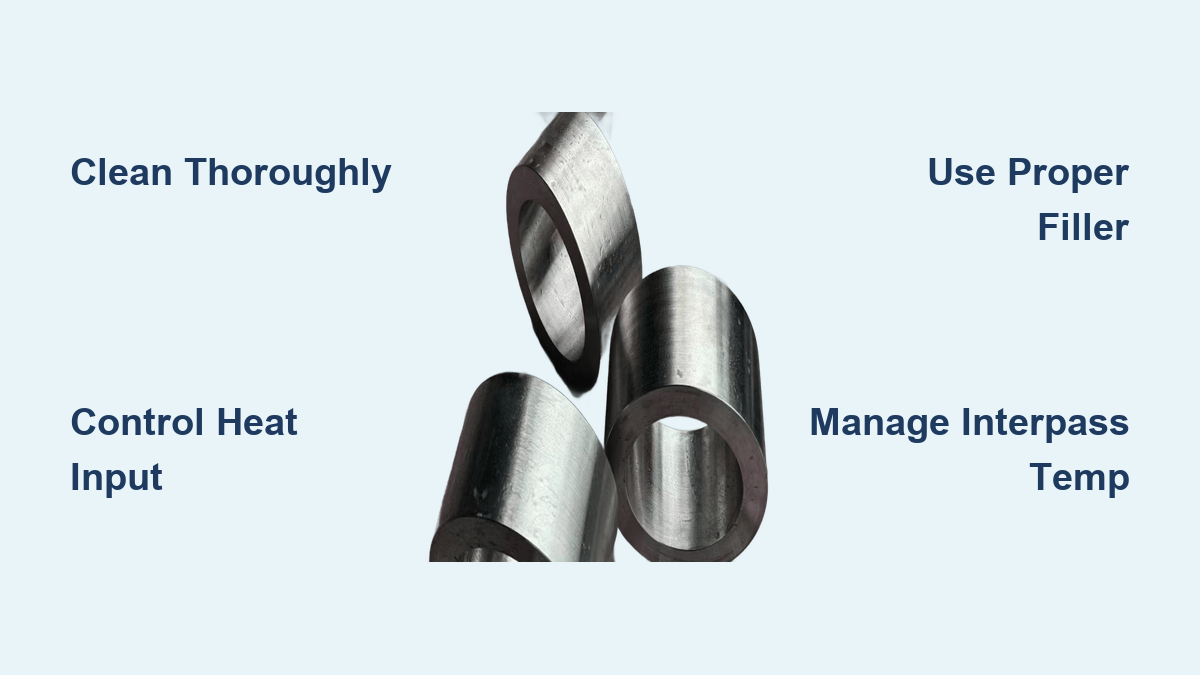
You’ve landed the perfect job welding Monel components for a marine project, but that confident feeling evaporates when you realize this nickel-copper alloy won’t behave like standard steel. Monel welding demands specialized techniques that differ significantly from carbon steel or even stainless steel work. This corrosion-resistant alloy, containing approximately 65% nickel and 30% copper, flows like liquid aluminum when molten yet requires precise heat control to prevent defects. Whether you’re working with Monel 400 for seawater applications or the precipitation-hardened Monel K500 for high-strength needs, mastering these specific techniques ensures welds that match the parent material’s legendary corrosion resistance. This guide delivers exactly what you need to produce flawless Monel welds on your first attempt.
Why Monel Welding Requires Specialized Techniques
Understand Monel’s Unique Material Properties
Monel’s exceptional corrosion resistance in marine environments comes with welding challenges you won’t encounter with common metals. Unlike carbon steel, Monel’s high nickel content creates a weld pool with extreme fluidity—similar to aluminum—that demands tighter parameter control within a narrower operational window. The alloy’s thermal conductivity varies significantly between CuNi variants (like 70/30 CuproNickel) and NiCu alloys (like Monel 400), directly affecting your heat input requirements.
Critical distinction: CuNi alloys require higher heat input due to greater thermal conductivity, while NiCu variants need less heat but still demand meticulous technique. Recognizing which variant you’re welding determines your torch angle, travel speed, and amperage settings. Monel K500 adds another layer of complexity with its aluminum and titanium additions for precipitation hardening, requiring modified temperature controls to prevent cracking.
Identify Your Specific Monel Variant
Before striking an arc, confirm whether you’re working with Monel 400 (UNS N04400) or Monel K500 (UNS N05500), as this decision impacts your entire welding procedure. Monel 400 offers excellent corrosion resistance with straightforward weldability, making it the most commonly welded variant for marine components. Monel K500 provides increased strength for demanding applications but requires careful attention to interpass temperatures to avoid heat-affected zone cracking.
Pro tip: Check for certification paperwork or perform a spark test—Monel produces short, reddish sparks without the bursting characteristics of carbon steel. Never assume you’re working with standard Monel; the wrong technique for K500 could cause catastrophic cracking in service.
Best Welding Processes for Monel Alloys
Gas Tungsten Arc Welding (TIG) for Precision Work
GTAW stands as the preferred method for Monel welding, especially on thin materials or critical applications requiring maximum control. This process delivers clean, high-integrity welds with minimal spatter when you follow these specific parameters:
- Shielding gas: Pure argon works for most applications, but add 25-50% helium when welding CuNi variants to compensate for their higher thermal conductivity
- Filler metal: Always use ERNiCu-7 to match Monel 400’s composition and maintain corrosion resistance
- Torch angle: Maintain 70-80 degrees from the workpiece (steeper than carbon steel) for better pool control
- Technique: Use stringer beads rather than weaving to minimize heat input and prevent grain growth
Common mistake: Using too long of an arc length increases oxidation and heat input. Keep your tungsten-to-work distance at 1/8 inch or less for optimal results.
Gas Metal Arc Welding (MIG) for Production Efficiency
When welding thicker Monel sections or working in production environments, GMAW provides higher deposition rates while maintaining quality. Follow these guidelines for successful Monel MIG welding:
- Wire feed speed: Set precisely to maintain consistent melt-off; erratic speeds cause porosity
- Stick-out length: Maintain 3/4 inch to ensure proper electrical contact and gas coverage
- Gas selection: Pure argon or argon with 5-10% CO2 (avoid higher CO2 percentages)
- Travel speed: Slower than carbon steel due to Monel’s sluggish flow characteristics
Troubleshooting tip: If you notice excessive spatter, reduce voltage slightly while maintaining wire feed speed—Monel’s high nickel content makes it sensitive to voltage fluctuations.
Proper Monel Joint Preparation Steps

Achieve Absolute Cleanliness Before Welding
Monel’s intolerance for contamination makes meticulous cleaning non-negotiable. Unlike steel, where minor oil residues might not cause issues, Monel will develop porosity from even microscopic contaminants. Follow this cleaning sequence:
- Mechanically remove oxides using a stainless steel brush dedicated solely to Monel work
- Solvent-wipe with acetone or isopropyl alcohol to eliminate oils and greases
- Extend cleaning at least two inches beyond the weld zone on both sides
- Clean filler wire with emery cloth followed by solvent wiping before use
Warning: Never use carbon steel brushes on Monel—they embed iron particles that create corrosion initiation points. Keep separate, clearly labeled tools for nickel alloys.
Optimize Joint Geometry for Monel
Standard joint designs for carbon steel won’t work for Monel’s unique flow characteristics. Modify your joint preparation with these specific adjustments:
- Gap width: Open to 3/16 inch (4.8 mm) for better root penetration
- Bevel angle: Increase to 35-40 degrees (wider than steel) for improved torch access
- Root face: Create a sharp feather edge rather than a blunt land
- Tack welds: Grind start/stop points extremely thin to prevent hidden defects
Visual cue: When properly prepared, the joint should provide clear visibility to the root without excessive torch manipulation.
Master Monel-Specific Welding Techniques
Perfect Your Filler Wire Manipulation
Monel’s fluid weld pool demands precise filler wire handling that differs significantly from steel welding:
- Hold the wire within the gas shield envelope at all times
- Apply slight forward pressure as you dip the wire into the pool
- Add filler only when you feel the wire “give”—indicating proper fusion
- Tip the wire upward slightly when tying into tack welds
Expert note: The “give” sensation occurs when the base metal reaches fusion temperature. Adding filler too early causes lack of fusion that won’t be visible until destructive testing.
Execute Proper Tie-Ins and Crater Management
Tie-in points and crater management represent critical failure points in Monel welding:
- Grind tack welds extremely thin before welding over them
- Hold the puddle at tie-in points longer to ensure complete fusion
- Withdraw the torch slowly from the crater to prevent hole pulling
- Use a back-step technique for crater filling on stop points
Time estimate: Allow 2-3 seconds of dwell time at each tie-in point—rushing this step causes hidden lack of fusion defects.
Critical Temperature Control for Monel
Manage Interpass Temperatures Strictly
Exceeding maximum interpass temperatures causes grain growth that compromises Monel’s corrosion resistance:
- Maximum temperature: Never exceed 250°F (121°C) between passes
- Cooling method: Use copper backing bars or forced air cooling if needed
- Monitoring: Check temperature at multiple points with a contact pyrometer
- Verification: Wait until weld area feels warm but not hot to the touch
Consequence: Excessive interpass temperatures create sensitized zones prone to intergranular corrosion in service environments.
Apply Limited Preheat Only When Necessary
Unlike carbon steel, Monel rarely requires preheat and often performs better without it:
- Standard practice: No preheat for sections under 1 inch thick
- Exception: Limited preheat (150-200°F) for thick sections or Monel K500
- Application: Heat uniformly using induction or torch with temperature monitoring
- Verification: Ensure temperature doesn’t exceed interpass limits
Common mistake: Applying carbon steel preheat practices to Monel causes excessive grain growth and reduced corrosion resistance.
Essential Safety Practices for Monel Welding
Control Nickel Fume Exposure
Welding Monel generates hazardous nickel fumes requiring specific safety measures:
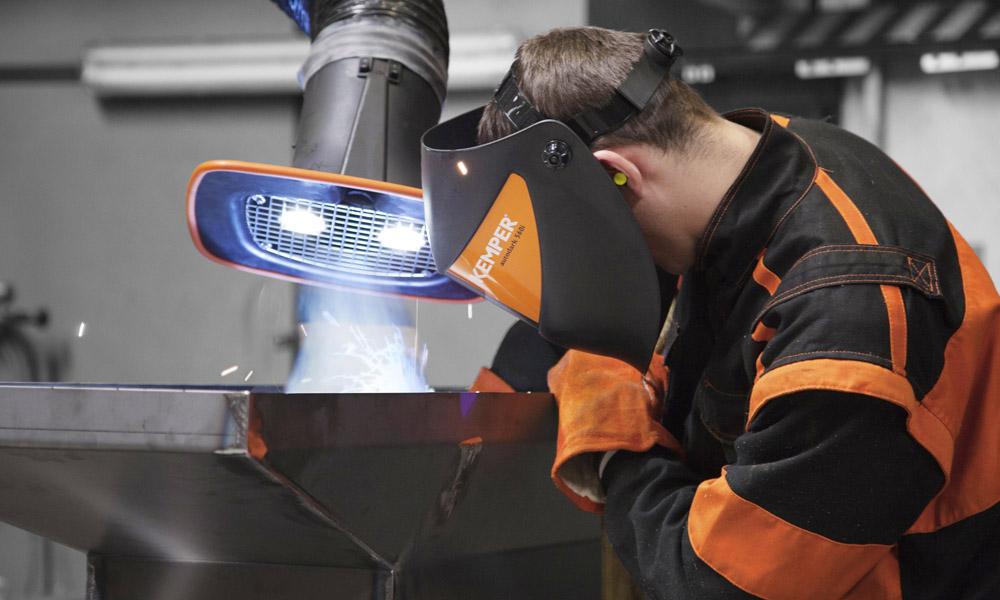
- Ventilation: Use local exhaust ventilation positioned within 6 inches of the arc
- Respiratory protection: P100 filters minimum when ventilation is insufficient
- Work practices: Position yourself upwind of fumes when possible
- Hygiene: Change clothes and shower after welding to prevent secondary exposure
Regulatory note: OSHA’s permissible exposure limit for nickel is 1 mg/m³ as an 8-hour TWA—exceeding this requires respiratory protection.
Proper Personal Protective Equipment
Standard welding PPE requires enhancements for Monel work:
- Gloves: Heavy-duty leather with additional heat protection
- Clothing: Flame-resistant cotton without polyester blends
- Eye protection: Auto-darkening helmet with #12-13 shade
- Footwear: Leather boots without exposed laces
Pro tip: Wear a welding cape for additional neck protection—Monel’s bright arc produces intense UV radiation.
Avoid These Common Monel Welding Defects
Prevent Porosity Through Contamination Control
Porosity remains the most common Monel welding defect, caused by:
- Inadequate base metal cleaning
- Moisture in shielding gas
- Contaminated filler wire
- Drafts disturbing gas coverage
Fix: Double-clean all surfaces, use dry gas from properly stored cylinders, and shield the weld area from drafts.
Eliminate Lack of Fusion with Proper Technique
Lack of fusion occurs when:
- Travel speed is too fast for Monel’s sluggish flow
- Amperage is too low for material thickness
- Torch angle directs heat away from fusion faces
- Contamination prevents proper wetting
Solution: Reduce travel speed, increase amperage slightly, use steeper torch angles, and maintain absolute cleanliness.
Final Steps for Monel Weld Success
Complete your Monel welding project with these finishing steps:
- Mechanically clean weld surface with stainless steel brush
- Perform non-destructive testing (dye penetrant for surface defects)
- Verify corrosion resistance with appropriate testing if critical
- Document parameters for future reference
Maintenance tip: Store completed Monel weldments in dry conditions—while the alloy resists corrosion, moisture can cause surface staining that requires additional cleaning before installation.
Mastering how to weld Monel comes down to respecting its unique characteristics rather than applying carbon steel techniques. By controlling heat input precisely, maintaining absolute cleanliness, and using Monel-specific joint designs, you’ll produce welds that match the parent material’s legendary corrosion resistance. Practice these techniques on test coupons before tackling critical work—Monel’s narrow parameter window demands familiarity that only comes with hands-on experience. When your Monel welds perform flawlessly in harsh marine environments, you’ll know you’ve mastered one of welding’s most demanding specialty alloys.
Leave a Reply