
Titanium pipe welding stands among the most challenging yet rewarding skills in metal fabrication. This remarkable metal delivers an exceptional strength-to-weight ratio—approximately 45% lighter than steel while maintaining comparable strength—making it indispensable for aerospace systems, chemical processing equipment, marine hardware, and power generation installations. However, titanium’s very properties that make it valuable also make it extraordinarily demanding to weld. The metal begins absorbing oxygen, nitrogen, and hydrogen once it exceeds temperatures between 500°F and 800°F, leading to embrittlement and catastrophic loss of corrosion resistance. A contaminated weld can render expensive titanium components completely useless, transforming what should be a precision fabrication project into an exercise in frustration and wasted material.
This comprehensive guide provides everything needed to successfully weld titanium pipe, covering preparation protocols, shielding gas systems, equipment selection, technique execution, and quality verification. Whether working with commercially pure titanium grades or titanium alloys like Ti6Al4V, mastering these fundamentals enables fabricators to produce welds that match titanium’s legendary strength and durability. The investment in learning proper titanium welding techniques pays dividends through decades of reliable service from properly welded components.
Achieve Absolute Cleanliness Before Welding Titanium Pipe
Before striking your first arc on titanium pipe, understand that contamination is your enemy—body oils, shop dust, cutting fluids, and residues from other metals can all compromise your weld integrity. Titanium’s reactivity means even microscopic contaminants can cause embrittlement, making your expensive material worthless. The moment you touch titanium with bare hands, you’ve introduced oils that will contaminate the weld zone before you even begin.
Implement Strict Handling Protocols for Titanium Pipe
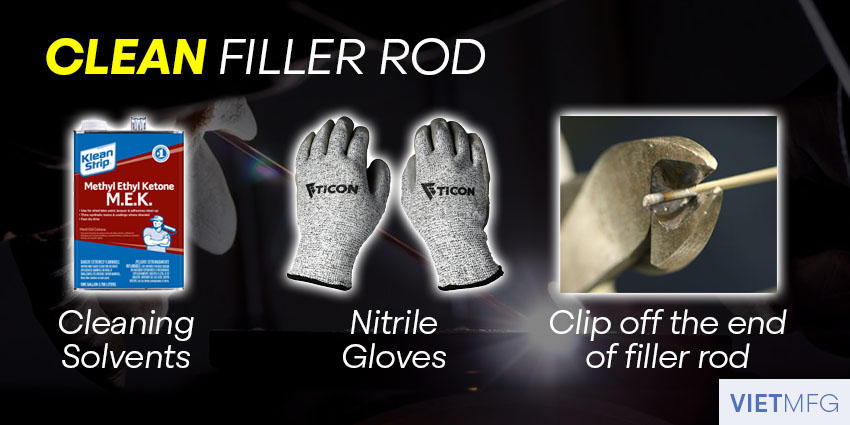
Never touch titanium pipe surfaces with bare hands—your skin’s natural oils contain contaminants that will transfer to the metal and cause weld failures. Instead, wear dedicated nitrile gloves (or other lint-free alternatives) throughout the entire preparation and welding process. These gloves should never be used when handling steel, aluminum, or other alloys that could transfer cross-contamination.
Establish a dedicated workstation exclusively for titanium work, away from other metal fabrication areas. This prevents airborne particles from other metals from settling on your titanium pipe. Keep your work area clean, well-lit, and free from drafts that could disrupt shielding gas coverage during welding.
Master Proper Cutting and Surface Preparation Techniques
Use high-speed circular saws rather than band saws for cleaner cuts with less material deformation. If you must use a band saw, carefully inspect cut surfaces and file away any smeared metal before proceeding. Critical warning: All cutting and grinding tools must be dedicated exclusively to titanium—soft grinding tools that may have embedded materials from previous work pose serious contamination risks.
Remove titanium’s protective oxide layer before welding, as it melts at a higher temperature than the base metal and can create inclusions in your weld. Using a die grinder with a dedicated carbide deburring tool (never used on other metals), grind both inner and outer surfaces extending approximately one inch back from the joint. Work slowly to minimize heat input that could cause oxidation or warping.
Execute the Titanium Pipe Cleaning Sequence
Follow this precise cleaning sequence for titanium pipe:
- Wearing nitrile gloves, apply acetone or methyl ethyl ketone (MEK) to a lint-free cloth
- Wipe both inside edges and outer surfaces to remove oils and grease
- Allow complete solvent evaporation before proceeding
- Grind the joint area as described above to remove the oxide layer
- Wipe the base metal once more with solvent and allow complete dissipation
- Clip the end of filler rods immediately before welding to expose clean material
Never use chlorine-based cleaning agents—residual chlorine causes corrosion in finished welds. Filler rods require equal attention to cleanliness; store them in airtight containers and clean them again immediately before use if time has passed since initial cleaning.
Set Up Perfect Shielding Gas Coverage for Titanium Pipe Welds
Titanium’s extreme reactivity with atmospheric gases makes shielding gas coverage the second most critical success factor after cleanliness. Once the metal exceeds 500-800°F, it rapidly absorbs oxygen, nitrogen, and hydrogen, losing the very properties that make titanium valuable. Protecting the weld puddle and heat-affected zone with shielding gas until they cool below this temperature threshold is absolutely non-negotiable.
Select the Right Gas and Purity for Titanium Pipe Welding
Use pure argon at 99.995% purity with no more than 20 parts per million of oxygen and a dew point greater than -76°F as specified by the American Welding Society. Critical applications may require even higher purity levels of 99.999% argon. While 100% argon works for most titanium pipe welding, some procedures specify argon-helium mixtures to improve arc stability and penetration, though this remains uncommon.
Crucial tip: Always use clean non-porous plastic hoses to transport shielding gases—rubber hoses are porous and absorb oxygen, potentially contaminating your weld as gas passes through.
Install Essential Gas Delivery Components for Titanium
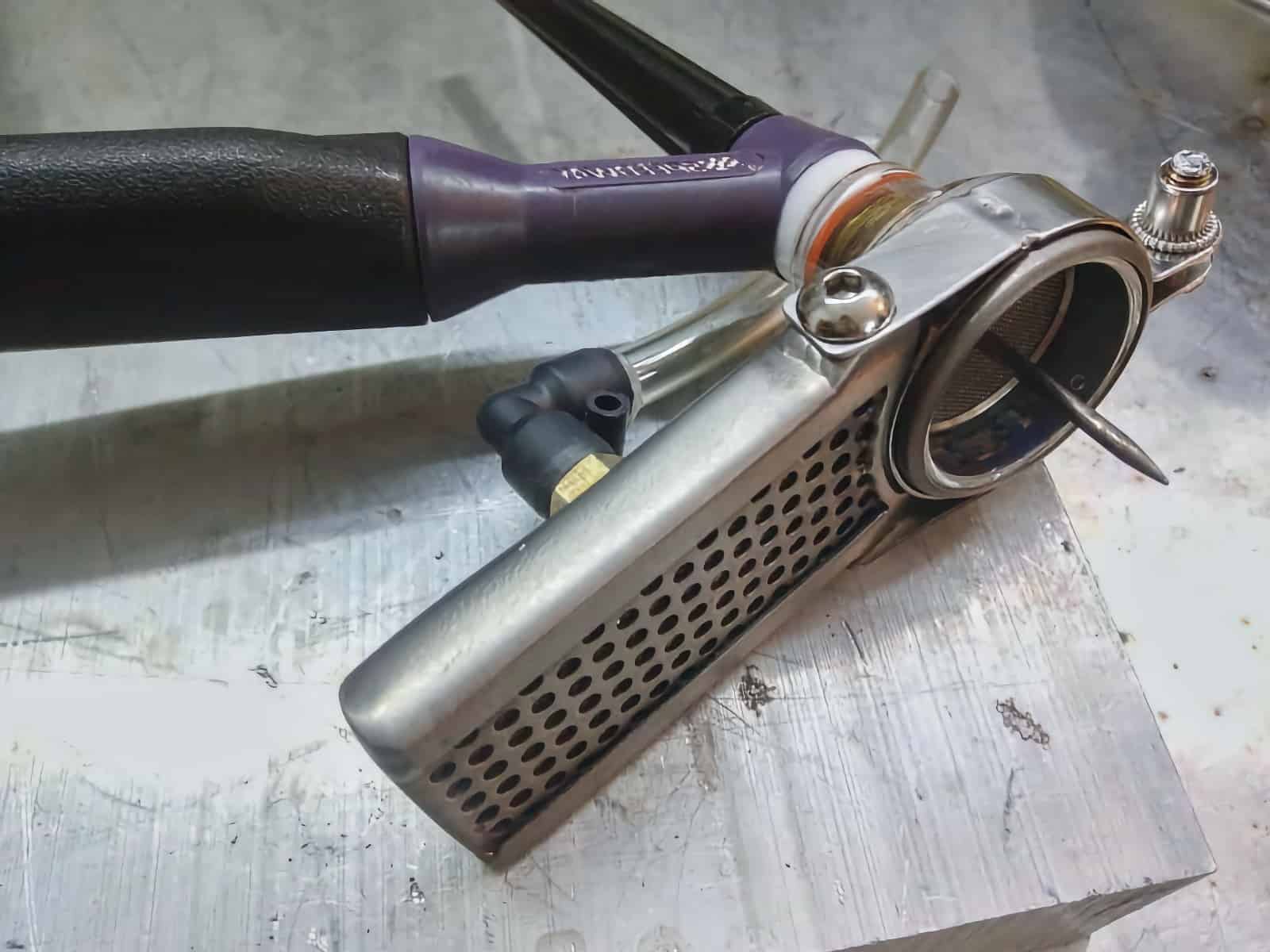
The gas lens replaces your standard collet body and dramatically improves shielding gas flow and coverage around the tungsten electrode, arc, and weld pool. This more laminar gas flow provides superior protection compared to standard gas distribution patterns. Set your gas lens flow at approximately 20 cubic feet per hour for optimal coverage in most applications.
The trailing shield provides continuous secondary shielding gas coverage as welding progresses, conforming to the pipe shape and following the GTAW torch around the circumference. This ensures the weld puddle and heat-affected zone remain protected throughout the entire cooling cycle. Without a trailing shield, your titanium weld will almost certainly develop unacceptable discoloration.
Implement Proper Back Purging for Pipe Welding
Back purging—the process of eliminating oxygen from inside the pipe—is mandatory when welding titanium tubing. Various dam configurations accomplish this, including water-soluble dams, rubber gaskets, specialty tapes, or inflatable bladders. Critical step: Allow argon to flow long enough to achieve ten volume exchanges, ensuring complete oxygen displacement before welding begins.
Time Your Gas Flow Correctly for Maximum Protection
Allow 2-5 seconds of pre-flow before striking the arc, ensuring the weld area is fully covered with shielding gas. Upon weld completion, allow 20-25 seconds of post-flow to protect the seam as it cools below the contamination threshold. Some welding codes require post-flow until temperatures drop below 500°F, so always follow the written procedure for specific applications.
Configure Your Welding Equipment for Titanium Pipe Success
Welding titanium pipe requires specific equipment configurations that differ from standard TIG applications, though the fundamental requirements remain straightforward from a power source perspective. Direct Current Electrode Negative (DCEN) provides deeper penetration and a narrower bead compared to Direct Current Electrode Positive (DCEP), making it the standard choice for titanium welding.
Select the Right Power Source Features for Titanium
Prioritize these power source features when selecting equipment for titanium pipe welding:
- High-frequency arc starting capabilities: Essential—the tungsten electrode should never touch base material
- Pulsing capabilities: Helps reduce heat input and improve arc stability
- Low amperage control: A range of 3-200 amps provides excellent coverage for most applications
- Remote amperage control: Allows real-time adjustment without removing attention from the weld pool
- Postflow timer: Ensures proper gas coverage after welding completion
For most titanium pipe welding, an output capacity of at least 250 amps provides adequate margin, though actual welding typically occurs below 150 amps.
Choose Between Air-Cooled and Water-Cooled Torches
Air-cooled torches provide good performance below 150 amps at lower cost and suit the majority of titanium pipe welding applications. Water-cooled torches are smaller, offering greater comfort and joint accessibility, but require higher investment and cooling equipment. For extended welding periods at higher amperages, water cooling provides advantages, though most titanium welds are relatively short and created below 150 amps.
Prepare Tungsten Electrodes Correctly for Titanium
Follow AWS D10.6 guidelines: thoriated and lanthanated tungsten electrodes are preferred, though 2% ceriated tungsten works commonly. Size the tungsten according to welding current—use 1/16-inch diameter or smaller for welding below 90 amps, 3/32-inch diameter for 90-200 amps, and 1/8-inch diameter above 200 amps. The grinding direction must be longitudinal, parallel to the tungsten length, ensuring proper electron emission and arc characteristics.
Match Filler Metals and Joint Designs to Your Titanium Pipe
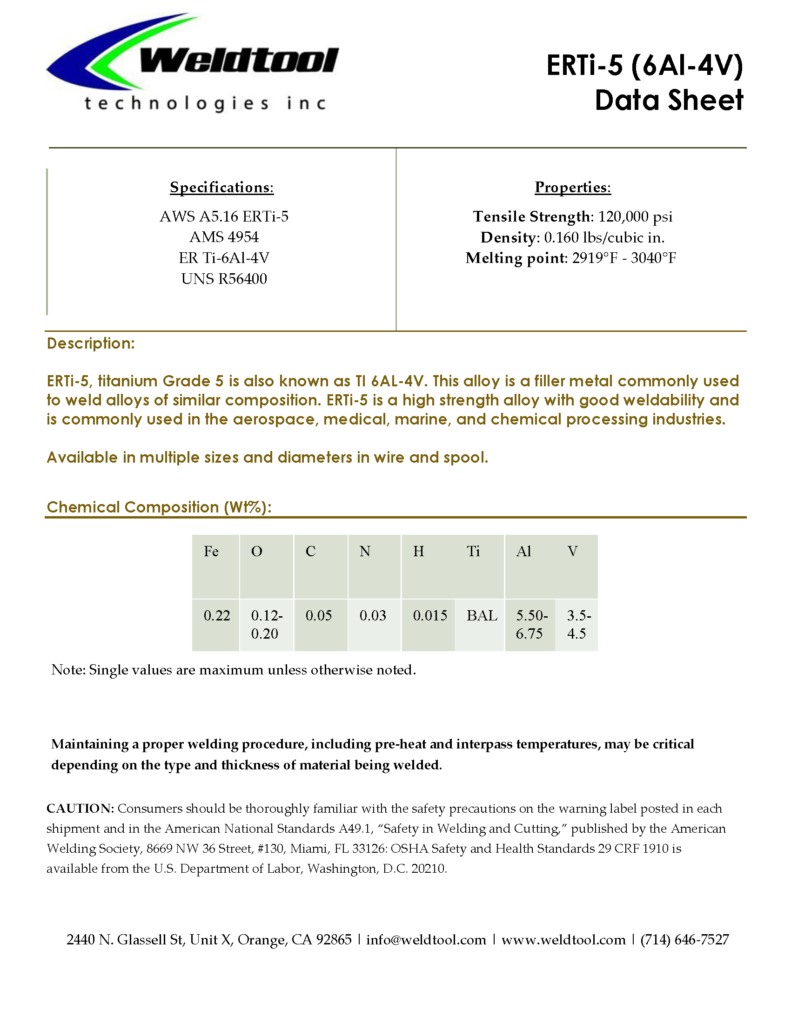
Filler metal selection should generally match the base metal being welded—the filler must be an exact grade match to the titanium being fabricated. Filler metal is typically required when welding titanium tubing thicker than 0.010 inches, while thinner materials should be welded autogenously without filler addition.
Select the Correct Filler Metal for Your Titanium Grade
| Base Metal Grade | Recommended Filler Metal |
|---|---|
| Grade 1 (Commercially Pure) | ERTi-2 |
| Grade 2 & 3 (Commercially Pure) | ERTi-2 |
| Grade 5 (Ti6Al4V) | ERTi-5 |
| Grade 9 | ERTi-3, ERTi-9, or ERTi-9ELI |
| Grade 23 (Ti6Al4V ELI) | ERTi-23 |
Exceptions to exact-match filler selection exist but require careful investigation. Some applications use filler metal with lower strength than the base metal to improve ductility in the weld joint. Any variation from standard matching practice should be thoroughly tested and approved before production use.
Design Joints for Minimum Heat Input and Maximum Protection
Titanium pipe thinner than 5 millimeters should be welded autogenously with a square butt joint and no filler metal, minimizing heat put into the part and reducing time above the critical 500-800°F temperature threshold. AWS D10.6 recommends V-grooves for thicknesses exceeding 2.4 millimeters and U-grooves for thicknesses exceeding 9.5 millimeters.
Tight fit-up in all joint configurations is essential for successful titanium welding. Proper fit-up lowers heat input by reducing required weld metal volume, minimizes surface area exposure to oxygen, and reduces burn-through risk. Secure pieces using positioner or workstation clamps ensuring ends are butted together as tightly and accurately as possible—any gaps require additional filler metal and extended welding time, both increasing contamination risk.
Execute Flawless Titanium Pipe Welds with Precision Technique
Before striking the arc, verify shielding gas has been flowing for 2-5 seconds to fully protect the weld area. Use the inverter’s high-frequency arc-starting feature to initiate the weld without contact between tungsten and base material. Torch angles, travel speed, and filler wire positioning similar to those used in stainless steel welding provide optimal conditions for titanium pipe.
Maintain Continuous Shielding During Welding
Cut off the end of each filler rod immediately before beginning to weld, exposing a pure contaminant-free point for the weld start. If filler metal becomes contaminated during welding or if welding is interrupted, clip off the contaminated section and start fresh with clean filler metal. This practice prevents inclusions and porosity from marring the weld.
Critical technique: Keep the filler rod within the shielding gas envelope at all times—exposing the filler rod to air even briefly causes contamination that compromises weld integrity. Pushing the weld puddle along with the arc and filler rod generally provides the best results.
Control Heat Input for Optimal Results
Minimize heat input throughout the welding process, as excessive heat can crack the weld. Use a dab technique with the filler metal, maintaining steady travel speed rather than leaving the rod in the puddle continuously. This approach controls the thermal cycle and prevents overheating that leads to distortion and potential cracking.
Tack welds must be made under identical conditions as the final weld—each tack is part of the final weldment and must meet the same quality standards. Inadequate tacks can open during welding, causing defects or requiring complete rework.
Verify Titanium Pipe Weld Quality Through Color Analysis
Titanium offers a unique advantage in weld quality verification: the final color of the weld joint directly indicates how well shielding gas protected the weld from contaminants and the thickness of the oxide layer formed during cooling. This visual inspection provides immediate feedback on weld quality without requiring complex testing equipment.
Recognize Acceptable Weld Colors for Titanium Pipe
Acceptable weld colors range from bright silver through light straw, dark straw, bronze, and brown. These colors indicate adequate shielding gas protection with minimal contamination. The exact shade can vary based on factors including gas purity, shielding coverage, and cooling rate, but this entire color range signals acceptable weld integrity.
Identify and Address Unacceptable Weld Discoloration
Unacceptable colors include violet, blue (both light and dark), green, gray, and white discolorations. These indicate unacceptable contamination from oxidation and atmospheric gas absorption during cooling when the weld was insufficiently protected. White discoloration indicates severe contamination and complete loss of properties in that area. Violet and blue colors signal embrittlement that will compromise service performance.
When unacceptable discoloration appears, the weld joint must be completely cut away and the weld restarted—quick fixes do not exist for contaminated titanium welds. Partial grinding and rewelding typically does not resolve underlying contamination issues that extend beyond the visible surface.
Avoid Critical Titanium Pipe Welding Mistakes That Cause Failure
Several recurring mistakes derail titanium welding projects and understanding them helps fabricators avoid costly errors. Touching the tungsten electrode to the base material represents one of the most common errors, causing contamination and electrode damage that compromises weld integrity. Always use high-frequency starting and maintain separation between tungsten and workpiece.
Prevent Gas Coverage Failures During Titanium Welding
Inadequate gas coverage ranks among the leading causes of weld discoloration and contamination. Insufficient gas flow, gaps in trailing shield coverage, incomplete back purging, and premature gas shutoff all allow oxygen to reach the hot metal. Double-check gas connections, flow rates, and timing before beginning each weld—your shielding gas system is your primary defense against contamination.
Eliminate Cross-Contamination Risks in Your Workspace
Cross-contamination from tools, gloves, or work surfaces used with other metals introduces embrittling elements into the weld. Never use the same tools for titanium that you use for steel, aluminum, or other alloys. Maintain dedicated workstations, grinding tools, and handling gloves for titanium work exclusively.
Control Heat Input to Prevent Cracking and Distortion
Excessive heat input causes cracking, distortion, and widened heat-affected zones where contamination reactions occur. Use the lowest amperage that provides adequate penetration, maintain steady travel speed, and avoid dwelling in any single area. The goal is minimizing time the material spends in the critical temperature range.
Rushing the preparation process invites contamination that manifests as weld defects later. Taking time for thorough cleaning, proper joint preparation, and careful fit-up prevents problems that require complete joint removal and rewelding. The extra minutes invested in preparation save hours of rework.
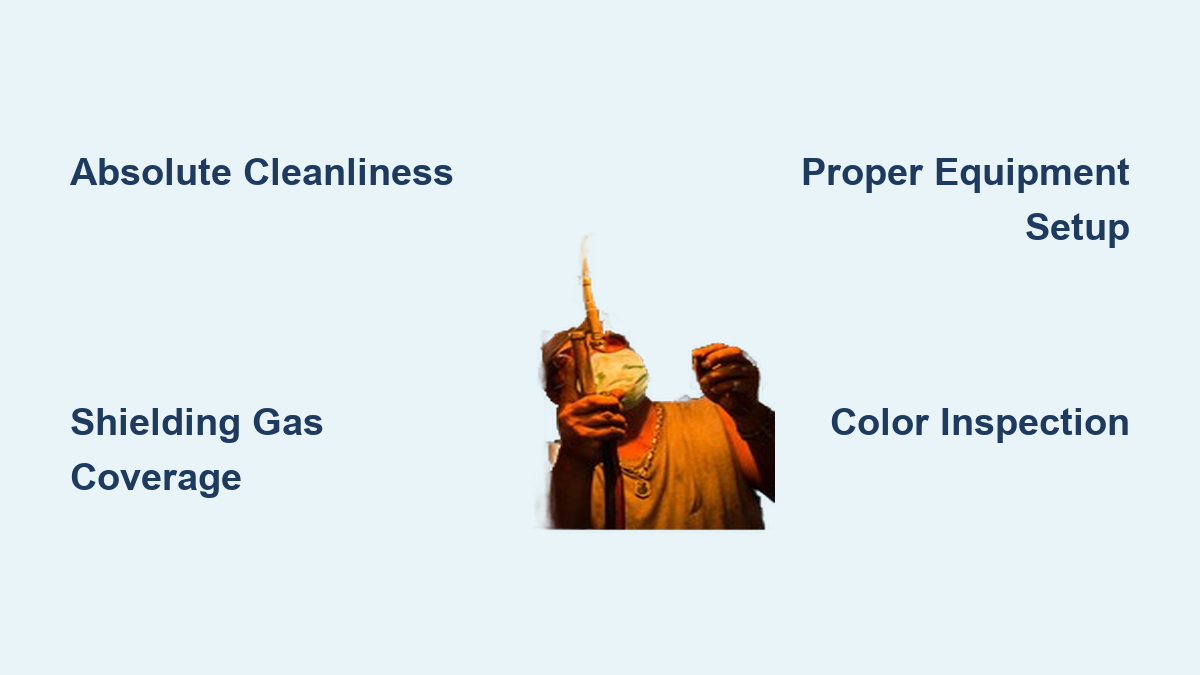
Mastering titanium pipe welding requires attention to these interconnected factors: absolute cleanliness maintained throughout the process, continuous and complete shielding gas coverage, appropriate equipment selection and configuration, controlled technique that minimizes heat input, and quality verification through color feedback. With dedication to these principles, fabricators can consistently produce titanium pipe welds that match the remarkable properties of the base material—high strength, excellent corrosion resistance, and long service life in the most demanding environments.
Leave a Reply