
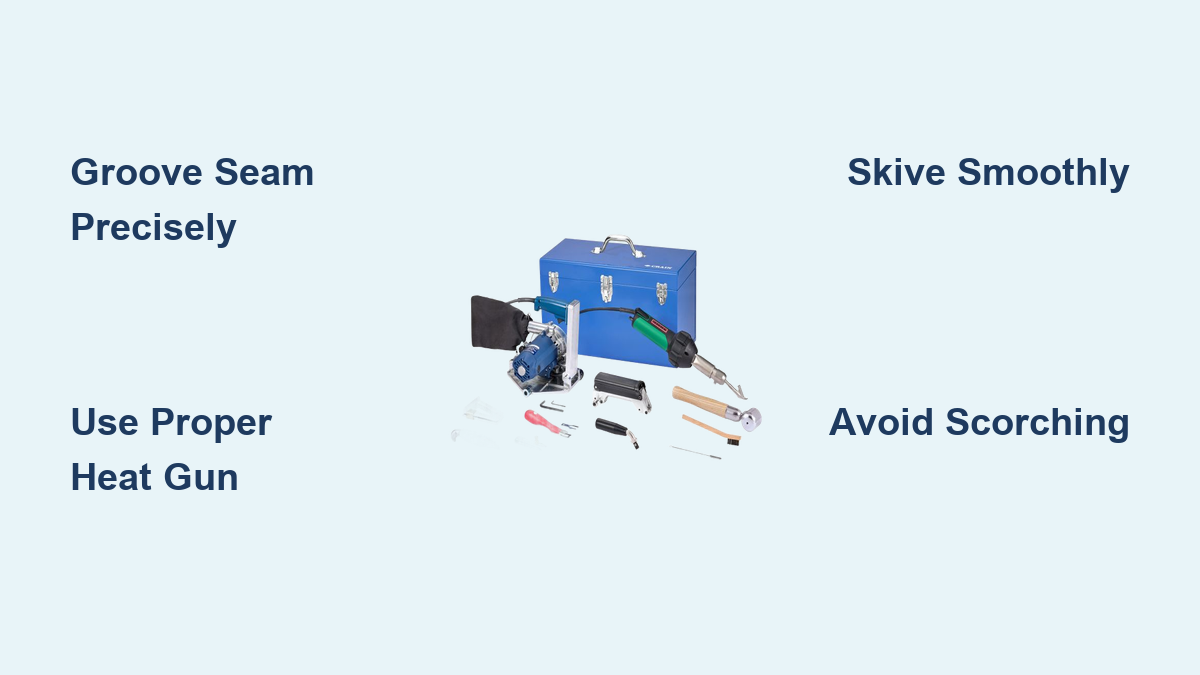
When your sheet vinyl flooring seams start to separate in high-traffic commercial spaces, heat welding provides the permanent, watertight solution professionals rely on. This technique creates bonds stronger than the surrounding material itself, making how to weld vinyl essential knowledge for installers working in healthcare facilities, commercial kitchens, and moisture-prone environments. Unlike adhesive seams that eventually fail, properly heat-welded vinyl becomes an integral part of the flooring, resisting years of foot traffic, moisture exposure, and daily wear. By mastering these techniques, you’ll transform from a basic installer to a professional who delivers flawless, long-lasting results in even the most challenging installations.
The entire vinyl welding process consists of three critical phases: grooving a precise channel to accept the welding rod, fusing the rod into the seam with controlled heat, and skiving away excess material for a smooth finish. Each phase requires specific tools and techniques that work together to create invisible, waterproof seams. Whether you’re tackling straight seams across open floors or navigating tight spaces beneath cabinets, understanding how these phases connect transforms what seems like an advanced skill into a repeatable process you can execute with confidence on every project.
Essential Tools for Vinyl Welding

Grooving Tools That Deliver Precision
The Turbo Cove Groover stands out as your most valuable tool for creating consistent grooves, especially in flash coving applications where visibility is limited. Its front guiding fin maintains position throughout the grooving motion, preventing the tool from jumping out of the seam and gouging material below—a common problem when working under toe kicks or cabinets. Always maintain the handle at approximately 90 degrees to the surface for even groove depth across the entire seam length. This consistent angle ensures uniform welding rod penetration and creates the foundation for seamless results that satisfy demanding clients.
Standard groovers work adequately for straight seams but struggle in curved or confined areas. The Turbo Cove Groover excels in any direction when you maintain proper technique, delivering the precision required for professional installations. Investing in this specialized tool reduces material waste and eliminates the frustration of correcting grooving errors in hard-to-see areas.
Heat Welding Guns for Every Application
The Leister Hot Jet S outperforms larger alternatives like the Triac when how to weld vinyl in challenging vertical applications. Its lightweight design allows precise control during extended work sessions, crucial when wrestling with tight spaces beneath cabinets. Fatigue leads to mistakes—heavy guns cause tired muscles that scorch vinyl through unsteady movements. The Hot Jet S maintains sufficient heating capacity while reducing operator fatigue, enabling the subtle wrist adjustments necessary for flawless seams in difficult locations.
When working on flash coving or vertical surfaces, the ability to make fine adjustments with simple wrist movements—not large arm motions—provides the precision that separates professional results from amateur attempts. This control becomes critical during complex installations that might take several hours to complete.
The Turbo L-Welding System for Vertical Applications
Traditional speed tips pose a burning risk on vinyl due to excessive hot air through large openings. The Turbo L-Welding System solves this with patented Turbo Precision Design, combining three components for complete vertical control:
- Leister Hot Jet S power source
- Adapter L Pencil Tip for comfortable angle
- Detail Nozzle for precise rod positioning
The Detail Nozzle deserves special attention—it holds the welding rod in position while directing heated air exactly where needed. This prevents scorching in low-visibility areas typical of flash cove work, allowing professional results even when you can’t see the weld taking place. The L-Welding System enables wrist-only movement, providing fine control impossible with arm-based techniques.
Finishing Tools for Smooth Results
You have two effective options for skiving excess material: a curved quarter moon knife or standard X-Acto blade. The quarter moon knife follows welded seam contours naturally, while the X-Acto offers familiarity for those comfortable with utility knives. Both produce excellent results when used with proper technique, but consistency matters more than tool choice—maintain the same pressure and angle throughout the skiving process for uniform results.
Prepare Vinyl Sheets for Welding
Create the Correct Seam Gap
Establish a precise 1/64th-inch gap before grooving begins—narrow enough for nearly invisible seams while providing sufficient space for full rod penetration. Gaps that are too narrow prevent proper rod insertion, while gaps that are too wide create visible seams that collect dirt and compromise waterproof integrity. Consistency matters as much as width—variations along the seam length create weak bonding points that fail prematurely under stress.
Take time during layout to ensure uniform gap width regardless of curves, corners, or obstacles. This preparation separates professional installations from amateur attempts that look adequate initially but deteriorate quickly.
Pre-heating for Flash Coving Applications
Lightly pre-heat vinyl with your heat gun before grooving flash coving areas to improve material pliability. This slight warming transforms stiff vinyl into cooperative material that responds consistently to your tools. Move the heat gun continuously across the area, maintaining several inches of distance to avoid scorching. Proper pre-heating reduces resistance during grooving, making the process smoother and more consistent.
Groove Vinyl Seams Correctly

Maintain Proper Tool Angle
Throughout the grooving process, keep your groover handle at a consistent 90-degree angle to the surface. Deviations create depth variations that compromise weld integrity. The guiding fin on specialized groovers assists significantly in maintaining this angle, particularly in low-visibility situations. When working under toe kicks, rely on the fin to maintain position rather than attempting to see around obstacles.
Groove Direction and Technique
The Turbo Cove Groover works effectively in any direction when operated correctly. Position yourself to maintain the 90-degree handle angle throughout the entire motion, adjusting your body rather than compromising tool angle. Proceed methodically without pausing—inconsistent speed creates variations in groove quality that affect your final weld. If obstacles require stopping mid-seam, plan your approach to minimize interruptions.
Heat Welding Technique Explained
Configure Your Equipment Properly
For vertical seams, attach the Detail Nozzle to the L-Welding System adapter on your Leister Hot Jet S. This configuration directs heated air precisely while holding the rod in optimal position. Adjust heat and air flow settings before beginning, but plan to make real-time adjustments as conditions change. Thicker material sections may require increased heat, while thinner areas near obstacles need reduced settings.
Execute the Welding Pass
Insert the welding rod into the Detail Nozzle with several inches extending beyond the tip. Position the nozzle at the seam start, activate heat flow, and move along the seam at consistent speed. Listen for subtle sound changes indicating proper melting, and watch for the slight gloss appearing on properly welded vinyl. For vertical welding, use wrist-only movements for finer control and reduced fatigue.
Manage Starting and Stopping Points
Place two small pieces of blue painter’s tape approximately 1/8 inch from groove endpoints. Begin and end your welding pass directly on these tape pieces, which protect vinyl from heat damage while ensuring strong weld bonds. This technique produces reliable results with no scorching at transition points—simply remove the tape after cooling for clean starting and stopping points.
Skiving and Finishing Welds
Allow Proper Cooling Time
Before skiving, wait several minutes for the welded seam to cool sufficiently. Skiving too early disrupts the curing process, creating weak spots or causing the rod to pull away from groove edges. This cooling period also allows assessment of weld quality before committing to skiving—look for no gaps between rod and groove edges with fully fused material.
Skiving Technique with X-Acto Knife
Begin at the curve where the rod exits the floor surface. Work systematically upward along one side, then return to start and work downward. Maintain a shallow blade angle directed away from the seam to avoid catching on groove edges. Alternate directions while applying consistent pressure until the rod becomes flush with surrounding vinyl.
Skiving Technique with Quarter Moon Knife
Start at the seam curve and pull the curved blade upward along one side, allowing the blade’s natural curve to follow the transition. Return to the starting point and repeat in the opposite direction. Continue alternating directions until the rod is completely flush and no edges are detectable by touch. The quarter moon knife’s design reduces gouging likelihood when used with proper technique.
Prevent Common Mistakes
Avoid Scorching and Burning
Scorching occurs from excessive heat due to temperatures set too high, moving too slowly, or dwelling in one position too long. Prevent it by maintaining consistent movement without pausing. Monitor your welding gun’s sound for temperature changes and adjust speed or settings immediately if you hear the characteristic sizzle signaling excessive heat.
Ensure Complete Rod Penetration
Insufficient penetration creates weak spots from shallow grooves, low temperatures, or moving too quickly. Verify groove depth is sufficient before welding. During the pass, monitor the rod’s appearance—properly melted rod appears slightly glossy and flows smoothly without gaps. If the rod maintains its original shape, reduce speed or increase heat.
Maintain Consistent Seam Appearance
Inconsistent appearance results from variations in groove depth, welding temperature, or skiving technique. Maintain the same angle, speed, and pressure from beginning to end of each seam. If pausing is necessary, minimize its impact on consistency or complete the entire seam in one session. Monitor environmental factors like temperature and humidity that affect results.
Maintenance and Quality Assurance
Tool Care for Consistent Results
After each use, inspect your Detail Nozzle for debris that might obstruct airflow. Clean components thoroughly and store equipment in protective cases. Establish routines for tool inspection before each installation—address wear or damage immediately to prevent compromised results on client work.
Verify Installation Quality
Run your hand along welded seams to detect irregularities invisible from standing position. Check for flushness, absence of gaps, and consistent appearance. For critical installations, consider additional verification tests like water application along seam edges to check for leakage. Taking these extra steps ensures your work meets demanding commercial standards.
Mastering how to weld vinyl creates permanent, watertight seams that maintain integrity throughout the floor’s life. The combination of proper grooving, appropriate heat settings, controlled movement speed, and skilled skiving produces results that become an integral part of the installation—not visible joints that collect dirt. By applying these techniques consistently, you’ll deliver professional results that satisfy demanding clients and withstand years of commercial use.
Leave a Reply