
If you’ve ever welded with a traditional fixed-shade helmet, you know the drill: position your electrode, flip the mask down, strike the arc—and hope you didn’t blink too late. That split-second delay can expose your eyes to intense ultraviolet (UV) and infrared (IR) radiation, leading to painful “arc eye” or long-term damage. Auto-darkening welding helmets eliminate this risk entirely by transforming from light to dark in less than a millisecond the moment an arc ignites. But how does an auto darkening welding helmet work? The answer lies in a sophisticated blend of optical science, electronic sensors, and liquid crystal technology—all engineered to protect your vision without sacrificing visibility or workflow.
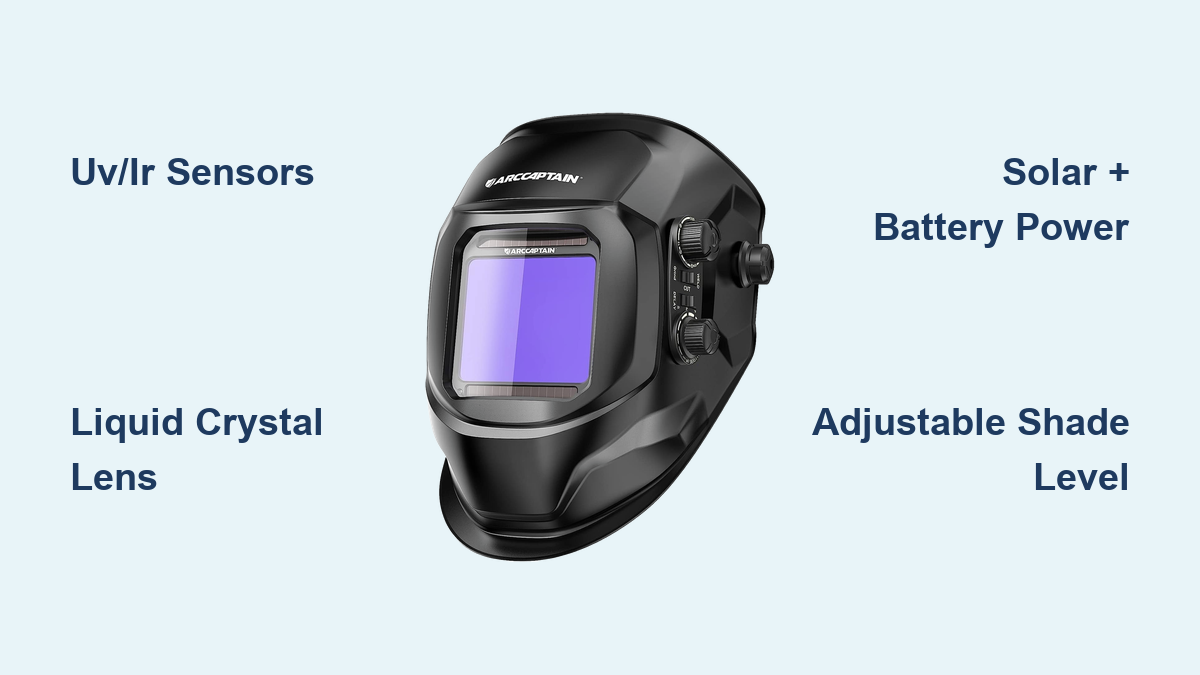
At its heart, an auto-darkening helmet uses UV and IR sensors to detect the sudden burst of light from a welding arc. This triggers a liquid crystal lens to instantly change shade, blocking harmful radiation while maintaining clear vision before and after the weld. Unlike passive helmets that require constant lifting and lowering, auto-darkening models let you see your workpiece clearly at all times, improving accuracy, safety, and efficiency—especially for precision tasks like TIG welding. In this guide, we’ll break down exactly how each component works together to deliver seamless protection, so you can choose the right helmet and use it with confidence.
UV/IR Sensors Detect the Arc in Microseconds
The process starts the moment you strike an arc. Surrounding the lens are UV and IR sensors, typically two or four in number, strategically placed to capture light from multiple angles.
- Four-sensor models offer superior coverage, crucial when welding overhead or in tight spaces where part of the arc may be blocked.
- These sensors are tuned to welding-specific light wavelengths, allowing them to ignore ambient light, sunlight, or sparks from grinding—reducing false triggers.
- Response time is as fast as 0.1 milliseconds, ensuring the lens darkens before your eye can even begin to react.
Without accurate, fast-responding sensors, the helmet won’t activate on time—making sensor count and placement a critical factor in performance and safety.
Auto-Darkening Filter (ADF): The Smart Lens System
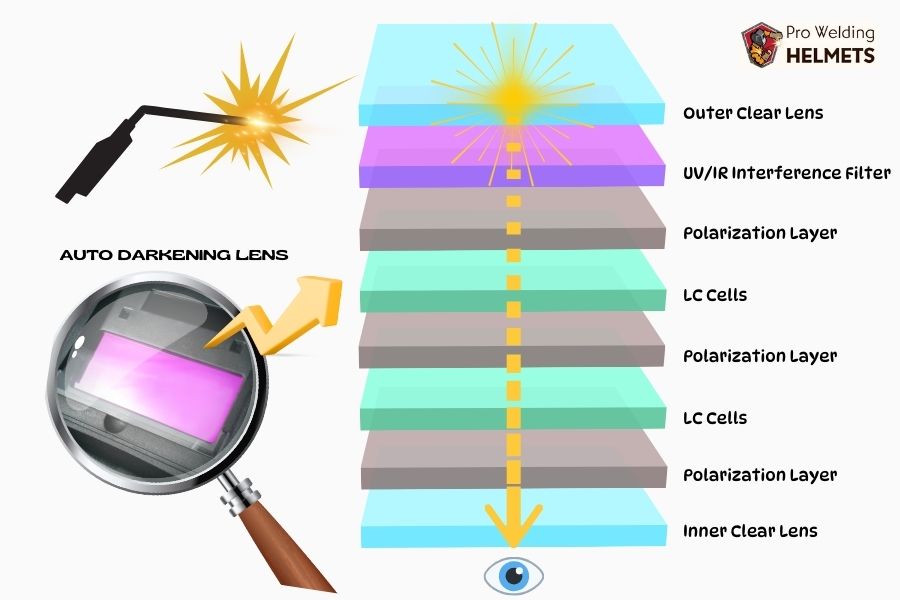
The ADF is the core of the helmet’s technology—an advanced multi-layer lens that dynamically adjusts to light conditions. It’s not just one component, but a stack of specialized layers working in harmony:
UV/IR Interference Filter: Always-On Protection
Even when the lens is in its clearest state, a multi-layer interference filter blocks nearly all harmful radiation.
- Constructed with 5 silver and 6 aluminum oxide layers, this filter reflects and absorbs over 99.9% of IR and 99.9997% of UV radiation.
- It remains effective even if the battery dies, ensuring constant protection.
- The metallic coating gives high-end filters a distinctive purple or blue reflective tint, as seen in brands like 3M Speedglas.
This passive protection is non-negotiable—your eyes stay safe whether the electronics are powered or not.
Polarizing Filters: Controlling Light Transmission
Two polarizing filters are positioned at 90 degrees to each other, forming a light gate.
- In the off state, twisted liquid crystals rotate light so it can pass through both filters—resulting in a shade 3–5 (light tint).
- When voltage is applied, the crystals untwist, preventing light from passing through the second polarizer—darkening the lens to shade 8–13.
This system allows precise control over brightness while enhancing contrast and weld pool clarity.
Liquid Crystal Cells: The Active Darkening Layer
The liquid crystal cell (LCC) is what makes real-time adjustment possible.
- In the rest state, liquid crystals are naturally twisted, allowing polarized light to pass—keeping the lens light.
- When sensors detect the arc, a voltage pulse untwists the crystals, blocking light transmission.
- The shift happens in as little as 0.05 milliseconds—over 200 times faster than a human blink (~150 ms).
This electro-optical reaction is far superior to photochromic lenses (like transition glasses), which take seconds to react—far too slow for welding.
Step-by-Step: From Clear to Dark in a Flash
The entire darkening process unfolds in stages, each happening almost instantaneously.
Pre-Weld: Clear Vision for Precision
Before striking the arc, the lens stays at shade 3–5, offering excellent visibility.
- You can align joints, position the torch, and inspect your work without lifting the helmet.
- This is especially valuable in TIG welding, where precise electrode placement is critical.
No more guessing or repositioning—your setup is always in view.
Arc Ignition: Sensors Trigger Instant Response
When you strike the arc, a burst of UV and IR light radiates outward.
- Sensors detect this within microseconds and send a signal to the control circuit.
- The system distinguishes welding arcs from other bright light sources, avoiding false triggers during grinding—unless the helmet is in grinding mode.
Lens Darkens: Millisecond Protection
Voltage is applied to the liquid crystal layer, causing the molecules to realign and block light.
- The lens shifts to your pre-set shade (e.g., 10–13).
- Full UV/IR protection is maintained throughout.
- Transition time: 0.05 to 0.5 milliseconds, depending on model.
You never see the flash. Your eyes are protected before they even register the light.
Post-Weld: Delay and Return to Clear
Once the arc stops, sensors detect the drop in light.
- A delay timer (0.2–2 seconds) keeps the lens dark briefly, protecting against residual glare.
- After the delay, voltage is cut, the crystals twist back, and the lens clears in 100–200 milliseconds.
You regain clear vision instantly—ready to inspect your weld without removing the helmet.
Pro Tip: Use a longer delay for long welds to reduce eye strain. Choose a shorter delay for quick tacks to speed up your workflow.
Power System: Solar, Battery, or Both?

Auto-darkening helmets need power—but not all components use the same source.
Solar Panels Power the Lens During Welding
Solar cells on the helmet’s exterior harvest energy directly from the arc light.
- They power the lens darkening function—not the battery.
- This means the lens can still operate even if the battery is weak, as long as there’s enough arc light.
Solar power ensures reliability during active welding, but it doesn’t work when you’re not welding.
Battery Powers the Sensors and Control Circuit
The battery (usually CR2032 or CR232) runs only the sensors and electronics.
- Without it, the helmet won’t detect the arc and won’t auto-darken.
- Non-replaceable batteries in budget models mean the helmet dies when the battery does.
- Replaceable batteries in professional models extend lifespan to 10+ years.
Even with solar, a dead battery means no protection—replace it proactively.
Hybrid Systems Offer Maximum Reliability
Top-tier helmets use solar + replaceable battery systems.
- Solar powers the lens during welding.
- Battery powers sensors and settings.
- Works in low-light starts and non-welding tasks.
This dual system is ideal for professionals who demand consistent performance.
Key Adjustable Settings for Optimal Performance
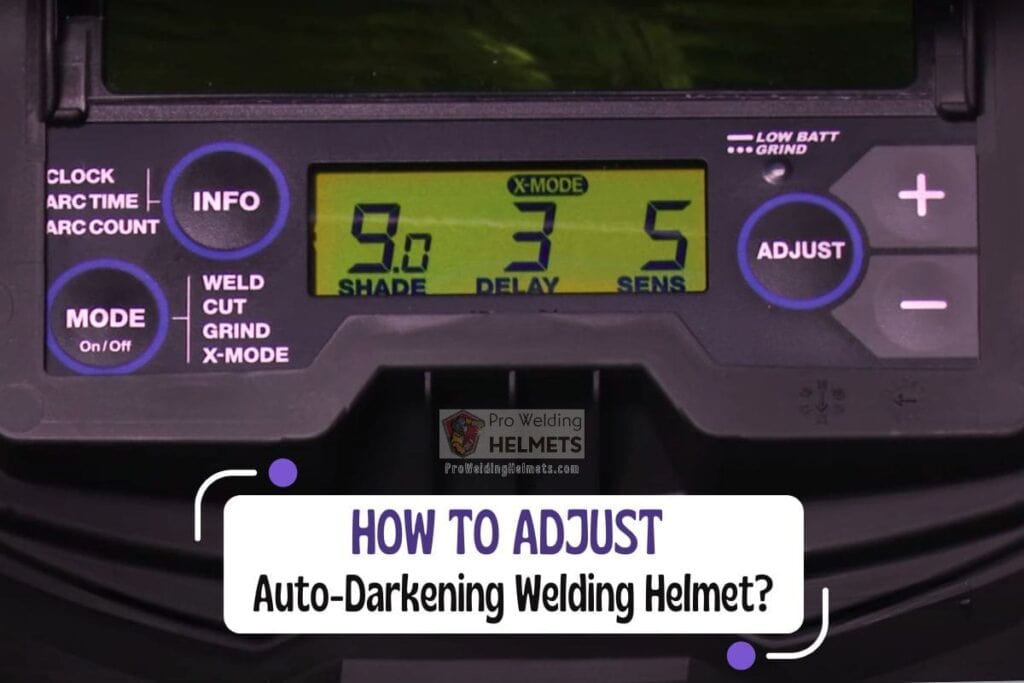
Modern helmets let you fine-tune performance for different tasks.
Set Your Shade Level (5–13)
- Shade 13: Best for high-amperage MIG or stick welding.
- Shade 8–10: Ideal for TIG on thin aluminum or stainless steel.
- Too dark? Hard to see the pool. Too light? Risk of UV exposure.
Adjust Sensor Sensitivity
- High sensitivity: Detects weak arcs (great for low-amp TIG).
- Low sensitivity: Prevents false triggers from grinding sparks.
Control Delay Time (0.2–2 sec)
- Long delay: Reduces fatigue on long welds.
- Short delay: Speeds up inspection for tacks.
Use Grinding Mode
Switch to grinding mode to disable auto-darkening.
- Lens stays at shade 5–8, allowing visibility without unwanted darkening.
- No need to remove the helmet—boosts safety and productivity.
Why Auto-Darkening Helmets Outperform Traditional Ones
Eliminate Neck and Shoulder Strain
No more flipping the helmet up and down—reducing fatigue during long shifts.
Improve Weld Quality
Clear pre-weld vision means better alignment, consistent starts, and accurate root passes—especially in TIG welding.
Boost Productivity
Save seconds per weld. Over a day, that adds up to minutes regained and fewer mistakes.
Provide Constant UV/IR Protection
Even in the clear state, the interference filter blocks harmful radiation—no accidental exposure.
Work Across Multiple Processes
Switch between MIG, TIG, stick, and flux-cored without changing gear.
Debunking Common Myths
| Myth | Reality |
|---|---|
| “Solar panels charge the battery” | False. Solar powers the lens; battery powers the sensors. |
| “It works like transition lenses” | False. Transition lenses react in seconds—auto-darkening in milliseconds. |
| “The lens is clear when off” | False. Most stay at shade 3–6 for built-in safety. |
| “All helmets are the same” | False. Differences in sensors, response time, and battery affect performance. |
Choosing the Right Helmet: Budget vs. Professional
| Feature | Budget Model | Premium Model |
|---|---|---|
| Sensors | 2 | 4 |
| Shade Range | Fixed or basic 5–13 | Adjustable 5–13 |
| Battery | Non-replaceable | Replaceable |
| Viewing Area | Small (2.5″ x 4.5″) | Large or curved (4.5″ x 4.5″+) |
| Controls | Internal or limited | External, adjustable on the fly |
| Best For | Occasional use | Daily, professional welding |
For serious work, invest in a four-sensor, wide-view, replaceable-battery model.
Maintenance Tips for Long Life
- Replace outer lenses when scratched or cloudy.
- Clean sensors regularly—dirt can block detection.
- Replace battery every 2–3 years, even if still working.
With proper care, a premium helmet can last a decade or more.
Final Note
An auto-darkening welding helmet works by combining UV/IR sensors, liquid crystal cells, polarizing filters, and multi-layer interference coatings to deliver instant, reliable eye protection. The lens shifts from shade 3–5 to 8–13 in under a millisecond, all while maintaining continuous UV/IR blocking. Solar power drives the lens during welding, while the battery powers only the sensors—ensuring performance even in demanding conditions.
For welders, the benefits are clear: safer eyes, faster workflow, better precision, and less fatigue. Whether you’re running MIG on thick steel or TIG on thin aluminum, an auto-darkening helmet adapts to your needs. By understanding how it works, you can choose the right model, use it effectively, and maintain it for years of reliable service. In the end, the best helmet isn’t just smart—it’s essential.