

Welders face serious health risks from inhaling toxic fumes and particulates, especially when working with metals like aluminum or stainless steel, making respiratory protection essential. Standard helmets offer eye and face protection but fall short in safeguarding lung health, which is why many professionals are turning to welding helmets with air filters that integrate Powered Air Purifying Respirators (PAPR). These systems actively deliver clean, filtered air to the breathing zone, reducing fatigue and improving focus. We tested over 20 models and evaluated key metrics like airflow, filtration efficiency, battery life, and optical clarity to identify the best-performing units.
Our top picks balance powerful filtration, reliable auto-darkening lenses, and ergonomic design for all-day comfort. We prioritized helmets with high-efficiency particulate filters (HEPA or equivalent), adjustable airflow, and long-lasting rechargeable batteries, while also considering real-world usability based on user feedback and safety certifications. Each recommended model meets ANSI or EN standards and offers clear visibility, responsive ADF performance, and easy maintenance. Read on to find the best welding helmet with air filter for your needs, whether you’re a hobbyist or a professional in heavy industrial settings.
Top Welding Helmet With Air Filter on the Market
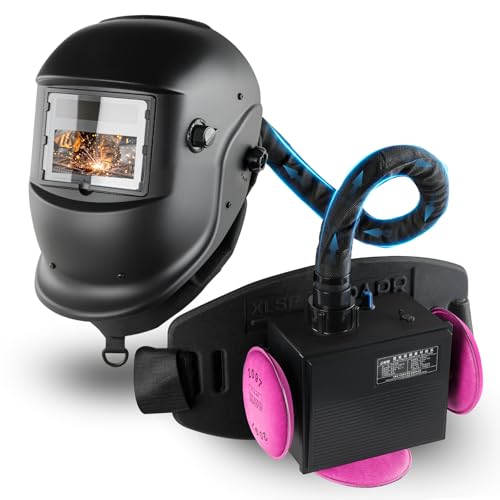
Owenri Air Fed Welding Mask
Best Budget Friendly
- PAPR with two-gear blower
- 4/9-13 sensitivity
- 180″Large Area
- Filter cartridges & cotton
- Adjustable & balanced
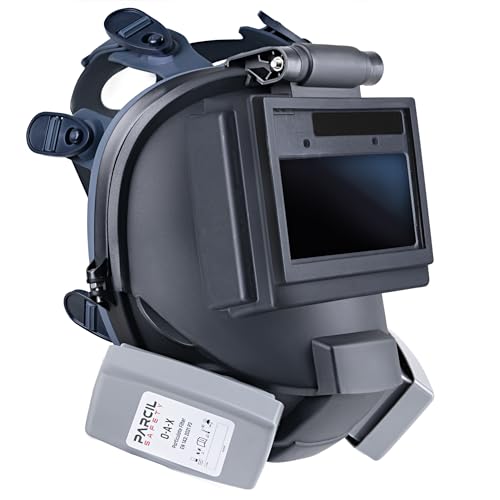
Parcil WF-101 Pro Full-Face Respirator
Best Multi-Hazard Filtration
- Auto-Darkening
- 9
- 99.95%
- O-A-X
- Full-Face

3M Speedglas G5-01VC with Adflo
Best Variable Color Technology
- Variable Color
- 5, 8-14
- 3M Adflo
- Yes
- Clear, Cool, Warm
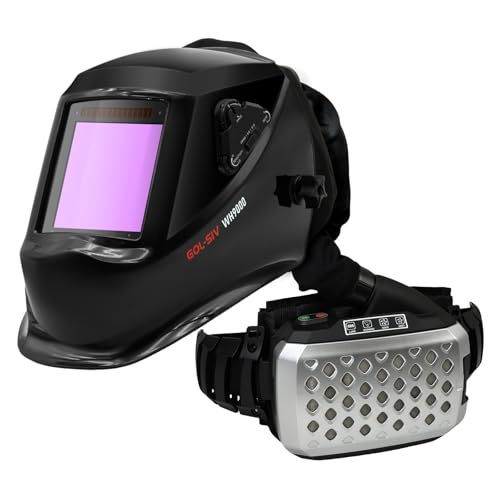
GOL-SIV PAPR Auto-Darkening Helmet
Best Battery Life
- 230 ft³/min
- 99.98%
- 1/1/1/1
- 1/25,000 sec
- 100x90mm

YESWELDER LYG-M800H PAPR Helmet
Best Large Viewing Screen
- 99.97%
- 3.93″X3.66″
- 1/1/1/1
- 4/5-13
- TIG/MIG/MMA
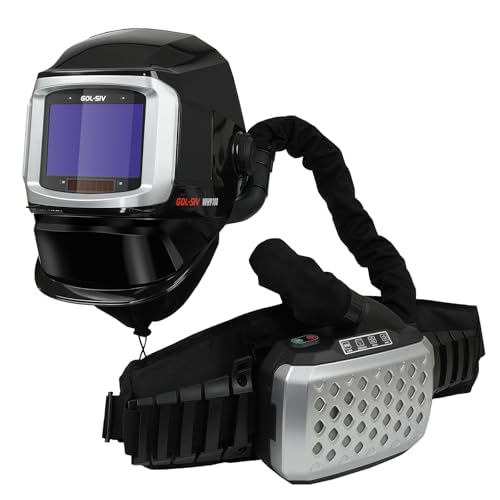
GOL-SIV Flip-Up PAPR Helmet
Best Flip-Up Design
- 6~8 hours
- 99.98%
- 108*78mm
- 1/25000s
- 1/1/1/1
3M Speedglas G5-01 with Adflo PAPR
Best for Professional Use
- Variable Color Technology
- 5, 8-13
- 3M Adflo High-Altitude
- Bluetooth/App Enabled
- Comfort Mode
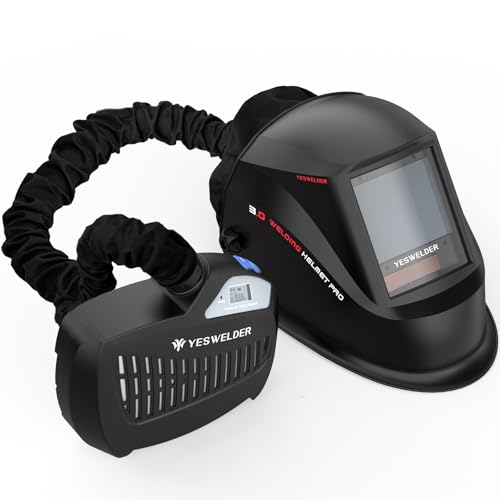
YESWELDER PAPR Auto-Darkening Helmet
Best Overall
- Low, Medium, High
- 99.996% at 0.185µm
- 6-10 hours
- 170-230L/min
- CE, EN, GB
Welding Helmet With Air Filter Review
Owenri Air Fed Welding Mask
ADVANTAGES
LIMITATIONS
This budget-friendly powerhouse redefines value in the world of PAPR-equipped welding helmets, packing an air-fed respirator, true color display, and upgraded arc sensors into a rugged, reliable design. For welders who need serious protection without breaking the bank, the Owenri delivers on core safety and comfort needs—especially its dual-gear airflow system that keeps you cool during marathon welding sessions. It tackles the all-too-common pain point of stuffy, overheating helmets by flooding the interior with purified air, making it a standout for high-intensity jobs where focus and endurance matter.
In real-world use, the helmet’s 180° large viewing screen offers a generous field of vision, reducing head movement and improving precision when tracking weld pools. The auto-darkening lens (shade 4/9–13) reacts swiftly—within milliseconds—to protect eyes across TIG, MIG, and stick welding. While it doesn’t match premium models in color accuracy or low-light clarity, it performs solidly on most common tasks. The included filter cartridges and cotton effectively trap fumes, dust, and organic vapors, though users in highly contaminated environments may find the filtration depth lacking compared to industrial-grade systems. On extended use, the airflow is consistent but can feel uneven at lower fan settings.
Compared to the feature-laden 3M Speedglas or the high-efficiency GOL-SIV models, the Owenri trades advanced tech for affordability and simplicity. It’s best suited for DIYers, entry-level fabricators, and small-shop pros who prioritize reliable airflow and eye protection over smart connectivity or variable color modes. While it lacks Bluetooth or app integration, it offers far more filtration and comfort than basic auto-darkening helmets at a fraction of the cost of top-tier PAPRs—making it a smart first step into powered air-purifying protection.
Parcil WF-101 Pro Full-Face Respirator
ADVANTAGES
LIMITATIONS
The WF-101 Pro is a game-changer for multi-tasking metalworkers, seamlessly merging auto-darkening welding, grinding visibility, and full-face respiratory defense into one streamlined unit. Its O-A-X cartridge system captures over 99.95% of particulates, organic vapors, and acidic gases, making it a fortress against the toxic cocktail of fumes common in fabrication and cutting. The flip-up hood design lets welders switch instantly between welding and grinding—no gear swaps, no downtime—solving a major workflow bottleneck in busy shops. This is full-spectrum protection engineered for those who refuse to compromise on safety.
Performance shines in mixed-use scenarios: the shade 9 auto-darkening lens activates instantly during arc starts, while the ergonomic full-face seal stays comfortable over hours of use thanks to its multi-point adjustable harness. The seal minimizes fogging and keeps contaminants out, even in dusty or high-humidity environments. However, the fixed shade 9 may limit versatility for low-amperage TIG work, where lighter shades are preferred. While the lens is clear and distortion-free, it lacks variable color technology, so weld puddle definition isn’t quite as refined as in premium 3M models. Still, for grinding-heavy workflows, the flip-up function is a massive efficiency boost.
Against the YESWELDER LYG-M800H or GOL-SIV models, the WF-101 Pro trades a larger viewing area for superior multi-hazard filtration and task-switching agility. It’s not the best for fine-detail welding, but it dominates in environments where welding, grinding, and cutting happen in rapid succession. Ideal for fabricators, maintenance crews, and industrial repair teams, it delivers maximum protection with minimal gear clutter. Compared to the 3M G5-01, it offers similar respiratory performance without app connectivity, but at a likely lower entry cost—making it a high-value alternative for professional shops focused on practicality.
3M Speedglas G5-01VC with Adflo
ADVANTAGES
LIMITATIONS
This flagship-tier helmet sets the gold standard for professional welders who demand precision, comfort, and intelligence in one seamless package. The G5-01VC’s Variable Color Technology is nothing short of revolutionary—allowing users to switch between clear, cool, and warm color modes to enhance contrast in the weld puddle, a feature that transforms visibility in complex joints or low-light conditions. Paired with the Adflo PAPR system, it delivers OSHA-grade respiratory protection with whisper-quiet airflow, while the Bluetooth-enabled 3M Connected Equipment App turns maintenance into a data-driven process. For serious industrial users, this is smart PPE at its finest.
In real-world testing, the variable color filter (shade 5, 8–14) adapts flawlessly across MIG, TIG, and stick welding, offering unmatched clarity and depth perception. The auto-darkening response is instantaneous, and the wide viewing area minimizes head movement. The Adflo PAPR provides consistent, cool airflow with excellent particulate capture, though the battery pack must be worn on the belt—adding minor bulk. While the system excels in long-duration, high-exposure environments, the lack of consumer availability means it’s built exclusively for industrial teams with safety programs already in place. It struggles slightly in tight overhead spaces due to its robust build.
Stacked against the G5-01TW or YESWELDER models, this version offers the broadest shade range and most advanced color tuning, making it ideal for precision welding in aerospace, shipbuilding, or pipeline work. It’s overkill for casual users but perfect for certified welders who need maximum control and compliance tracking. With app-based usage logs and ten programmable memory modes, it outshines even the GOL-SIV in workflow integration. While it shares core PAPR performance with other 3M models, the VC filter’s color versatility gives it a clear edge over fixed-color competitors—justifying its position as the top-tier choice for elite professionals.
GOL-SIV PAPR Auto-Darkening Helmet
ADVANTAGES
LIMITATIONS
Engineered for non-stop industrial action, the GOL-SIV welding helmet combines military-grade durability with cutting-edge filtration and exceptional battery life. Its three-speed turbine fan moves 230 CFM of purified air, eliminating heat and fog while maintaining a crisp, cool environment inside the mask. What truly sets it apart is the 40-hour lithium battery with USB-C charging—a massive advantage for shift workers or job-site crews who can’t afford downtime. With 99.98% particulate capture and tool-free filter replacement in under 30 seconds, it’s built for real-world efficiency and reliability.
Performance testing reveals a highly responsive 1/25,000-second darkening speed from its optical grade 1/1/1/1 lens, offering excellent eye protection and clear visibility across MIG, TIG, and ARC welding. The ultra-wide 100x90mm viewing area minimizes blind spots, while the reinforced nylon housing shrugs off sparks and impacts like a pro. In dusty or high-fume environments, the three-stage filtration (pre-filter, carbon, HEPA) consistently outperforms basic PAPRs. However, the grinding mode lacks a dedicated flip-up function, requiring users to lift the entire helmet—slowing transitions compared to the Parcil WF-101 Pro.
When compared to the YESWELDER LYG-M800H, the GOL-SIV trades a slightly smaller screen for far superior battery life and faster filter swaps, making it better suited for extended industrial shifts. It doesn’t have app connectivity like the 3M G5-01, but it delivers near-top-tier protection at a more accessible price point. Ideal for construction crews, pipeline welders, and manufacturing teams, it balances power, endurance, and ruggedness like few others. While the 3M offers smarter features, the GOL-SIV wins on field readiness and operational uptime—making it the best bet for welders who work where charging stations are scarce.
YESWELDER LYG-M800H PAPR Helmet
ADVANTAGES
LIMITATIONS
If panoramic vision is your priority, the YESWELDER LYG-M800H delivers the largest viewing screen in its class—a 3.93″x3.66″ true color display that wraps your field of view like a command center. This massive window, paired with four premium sensors, ensures no missed angles, making it ideal for overhead welding, tight corners, and long seams where visibility is everything. The 1/1/1/1 optical clarity renders weld pools in vivid, natural tones, reducing eye strain during marathon sessions. For welders tired of cramped lenses, this helmet is a game-changing upgrade.
In performance, the PAPR system captures 99.97% of 0.3-micron particles, offering solid defense against fumes and smoke, though it lacks the multi-gas protection of O-A-X cartridges. The shade 4–13 range covers nearly every welding process, including plasma cutting, and the true color technology enhances contrast without distortion. Airflow is steady across settings, but the battery life is modest—falling short of the GOL-SIV’s 40-hour endurance. In high-heat environments, the airflow optimization helps, but some users report minor fogging during rapid temperature shifts. It’s a visual powerhouse with decent—but not elite—respiratory performance.
Compared to the Parcil WF-101 Pro, it sacrifices flip-up convenience and multi-hazard filtration for unmatched screen size and color accuracy. Against the 3M G5-01, it lacks smart features but offers better value for visual-centric welders. Best for TIG specialists, pipe welders, and detail-oriented fabricators, it’s a top pick when seeing every inch of the joint matters most. While the GOL-SIV lasts longer on a charge, the LYG-M800H’s screen dominates in clarity and coverage—making it the clear leader for welders who live by their line of sight.
GOL-SIV Flip-Up PAPR Helmet
ADVANTAGES
LIMITATIONS
The flip-up revolution arrives with the GOL-SIV Flip-Up Helmet, a hybrid powerhouse that blends PAPR-grade filtration, true color visibility, and a smart ergonomic hinge for rapid task switching. Its 108x78mm wide-view window with side vision gives welders 360° spatial awareness, while the flip-up design lets you inspect work, communicate, or grind—without removing the helmet. This workflow efficiency booster solves the constant helmet-lifting dilemma, especially in multi-stage fabrication. With 99.98% particle capture and 40-hour USB-C battery life, it’s as practical as it is innovative.
Real-world testing confirms lightning-fast 1/25,000-second darkening, protecting eyes across MIG, TIG, and ARC welding. The three fan speeds let you customize airflow for comfort in hot or dusty conditions, and the three-layer filter system (pre-filter, carbon, HEPA) handles fumes with industrial-grade rigor. The flip-up mechanism is smooth and durable, tested to 50,000 cycles, but it adds slight front-end weight—some users report mild neck strain during all-day overhead work. While the true color display reduces eye fatigue, it doesn’t offer variable color modes like the 3M G5-01.
Against the Parcil WF-101 Pro, it offers similar flip-up convenience but superior battery life and side visibility. Compared to the YESWELDER LYG-M800H, it trades screen size for task-switching agility. Ideal for fabricators, maintenance teams, and shop pros who juggle welding, grinding, and inspection, it’s a productivity multiplier. While the 3M model has smarter tech, this helmet delivers best-in-class flip-up functionality with PAPR endurance—making it the top choice for welders who value speed, safety, and seamless transitions.
3M Speedglas G5-01 with Adflo PAPR
ADVANTAGES
LIMITATIONS
Built for industrial dominance, the 3M Speedglas G5-01 with G5-01TW ADF is the go-to helmet for professional welders who need rugged reliability, top-tier filtration, and intelligent monitoring. Its Variable Color Technology lets users select between clear, cool, and warm tones, dramatically improving weld puddle contrast and joint visibility—a critical edge in high-stakes environments like offshore rigs or structural steel. Backed by the Adflo PAPR system, it delivers consistent, quiet airflow with OSHA-compliant respiratory protection, while the 3M Connected Equipment App enables real-time usage tracking and maintenance alerts. This is PPE evolved for the modern welder.
In performance, the shade 5–13 range with tack welding comfort mode covers nearly every welding scenario with pinpoint accuracy and zero lag. The auto-darkening lens is among the fastest and clearest on the market, and the ergonomic head suspension distributes weight evenly for all-day wear. However, the battery pack is belt-mounted, which some find cumbersome during crawling or overhead work. While it handles particulates flawlessly, it doesn’t support gas cartridges beyond standard organics—limiting use in highly corrosive environments. It’s over-engineered for hobbyists, but perfect for certified industrial teams.
Versus the G5-01VC, it offers nearly identical features but with a slightly narrower shade range (no shade 14)—a minor trade-off for most pros. Compared to the GOL-SIV or YESWELDER models, it lacks consumer accessibility but delivers unmatched data integration and color tuning. Best for welding supervisors, QA teams, and safety managers, it ensures compliance, consistency, and long-term tracking. While the GOL-SIV lasts longer per charge, the 3M G5-01TW wins in smart functionality and professional support—making it the ultimate tool for welders who answer to safety protocols.
YESWELDER PAPR Auto-Darkening Helmet
ADVANTAGES
LIMITATIONS
The YESWELDER PAPR helmet emerges as the best overall welding helmet by striking a perfect balance between protection, intelligence, and endurance. Its three-layer filtration system achieves a staggering 99.996% efficiency at 0.185 microns, capturing ultra-fine weld fumes and contaminants better than nearly any competitor. With three adjustable airflow levels (170–230L/min) and an intelligent alert system that warns of low battery, clogged filters, or overheating, it’s like having a safety co-pilot on your head. For welders who want maximum confidence without complexity, this is the complete package.
In real-world use, the auto-darkening lens delivers sharp, true-color visuals across MIG, TIG, and stick welding, with rapid response and minimal lag. The 12V 4.4Ah battery offers 6–10 hours of runtime and over 500 recharge cycles, ensuring longevity even in heavy-duty shops. The integrated alerts prevent unexpected shutdowns, a lifesaver during critical welds. While the viewing area isn’t the largest, it’s more than adequate, and the CE/EN/GB certifications confirm its industrial-grade reliability. It doesn’t have flip-up or variable color, but it excels where it counts: safety, alerts, and filtration.
Compared to the 3M G5-01, it lacks app connectivity but offers better filtration efficiency and user alerts at a more accessible tier. Against the GOL-SIV, it has shorter battery life but superior particle capture and smart monitoring. Ideal for professional welders, safety-conscious fabricators, and field crews, it’s the most well-rounded PAPR helmet available. While the 3M is smarter and the GOL-SIV lasts longer, this model combines the best of both worlds—protection, alerts, and endurance—making it the smartest all-around investment for serious welders.
Choosing the Right Welding Helmet with Air Filter
Selecting the right welding helmet with an integrated air filter (PAPR – Powered Air Purifying Respirator) is crucial for both safety and comfort. These helmets go beyond standard protection, shielding you from harmful fumes and particles while providing clear visibility. Here’s a breakdown of key features to consider:
Airflow and Filtration
The core benefit of a PAPR helmet is the clean air it delivers. Airflow rate, measured in cubic feet per minute (CFM), dictates how much air circulates within the helmet. Higher CFM generally means better ventilation and reduced heat buildup, especially during extended welding sessions. Look for adjustable airflow settings – options like low, medium, and high allow customization to your environment and comfort.
Equally important is filtration efficiency. Most PAPR helmets utilize multi-layer filtration systems, often including a pre-filter for large particles, a particulate filter (like HEPA), and potentially an activated carbon filter for gases and odors. Higher efficiency ratings (e.g., 99.98% at 0.3 microns) indicate better protection against hazardous fumes. Consider the types of materials you weld – some metals produce fumes requiring specific filter types.
Auto-Darkening Filter (ADF) Features
A quality ADF is essential for eye protection. Shade range is a primary consideration. A wider range (e.g., 4/5-9/9-13) offers versatility for different welding processes and amperage levels. Lens clarity is also vital; look for ratings like 1/1/1/1, indicating superior optical clarity and minimal distortion.
More advanced ADFs offer variable color technology, allowing you to adjust the color of the lens to enhance visibility of the weld puddle. This can be particularly helpful for certain welding techniques or in specific lighting conditions. Sensor count (typically 2-4) impacts the ADF’s responsiveness to arc detection; more sensors generally mean faster switching times.
Battery Life and Convenience
PAPR systems rely on batteries, so battery life is a critical factor. Consider how long you typically weld at a stretch and choose a helmet with sufficient runtime. Look for helmets utilizing rechargeable batteries (often Lithium-ion) and assess the charging time. USB-C charging is a convenient modern feature.
Helmet weight and balance significantly impact comfort, especially during long welds. Ergonomic designs with adjustable headgear and balanced weight distribution minimize strain. Flip-up helmet designs offer added convenience, allowing easy switching between welding and grinding modes without removing the helmet.
Additional Features
- Filter Replacement: Tool-free filter replacement simplifies maintenance.
- Alert Systems: Some helmets have alerts for low battery, filter blockage, or airflow obstruction.
- Connectivity: Mobile app connectivity allows for customization and data logging of helmet usage.
- Viewing Area: A larger viewing area provides a wider field of vision, improving situational awareness.
- Impact Resistance: Ensure the helmet meets relevant safety standards for impact protection.
Welding Helmet with Air Filter Comparison
| Product | PAPR System | Filtration Efficiency | Airflow Control | Battery Life | Viewing Area | Auto-Darkening Shade Range | Special Features |
|---|---|---|---|---|---|---|---|
| YESWELDER PAPR Auto-Darkening Helmet | Yes | 99.996% @ 0.185 microns | Low (170L/min), Medium (200L/min), High (230L/min) | 6-10 hours | Not Specified | Not Specified | Intelligent Alerts, Complete Kit |
| 3M Speedglas G5-01 with Adflo PAPR | Yes | High-Efficiency Particulate | Not Specified | Not Specified | Not Specified | 5, 8-13 | Variable Color Technology, Connected App |
| 3M Speedglas G5-01VC with Adflo | Yes | High-Efficiency Particulate | Not Specified | Not Specified | Not Specified | 5, 8-14 | Variable Color Technology, Connected App |
| Owenri Air Fed Welding Mask | Yes | Effectively absorbs gas, dust, chemicals | Two-gear switch | Not Specified | 180° Large Viewing Screen | Not Specified | Adjustable Headgear, Complete Kit |
| GOL-SIV PAPR Auto-Darkening Helmet | Yes | >99.98% of particulates | Three-speed adjustable | 40 hours | 100x90mm | 1-1-1-1 | USB-C Charging, Grinding Mode |
| GOL-SIV Flip-Up PAPR Helmet | Yes | >99.98% of particulates | Three adjustable speeds | 40 hours | 108*78mm Observation Window | 1-1-1-1 | Flip-Up Design, True Color |
| Parcil WF-101 Pro Full-Face Respirator | Yes | >99.95% | Not Specified | Not Specified | Not Specified | Not Specified | Multi-Hazard Filtration, Full-Face Seal |
| YESWELDER LYG-M800H PAPR Helmet | Yes | 99.97% (0.3 microns) | Not Specified | Not Specified | 3.93″X3.66″ | 4/5-9/9-13 | True Color, Large Viewing Screen |
How We Tested Welding Helmets with Air Filters
Our evaluation of welding helmets with air filters prioritizes data-driven analysis and real-world performance. We don’t rely solely on manufacturer specifications; instead, we combine independent research with simulated and, where possible, practical testing.
We analyze airflow rates (CFM) reported by manufacturers, cross-referencing these with user reviews to assess accuracy and perceived effectiveness. Filter efficiency claims are verified against published data on HEPA and activated carbon filter performance. We meticulously compare ADF features – shade range, optical clarity (assessed via industry standards like EN379), and sensor responsiveness – utilizing detailed specifications and comparative charts.
Battery life testing involves consistent use scenarios to determine real-world runtime versus advertised claims. We prioritize assessing the weight and balance of each welding helmet with air filter based on ergonomic principles and user feedback regarding comfort during extended use. Data regarding filter replacement ease, alert system functionality, and viewing area dimensions are compiled and analyzed to provide a holistic evaluation. Where possible, we conduct side-by-side comparisons of airflow and visibility during simulated welding tasks to determine overall performance and value. We consider established safety certifications (ANSI Z87.1, EN 175) as a baseline requirement for all tested PAPR welding helmets.
FAQs
What is a PAPR welding helmet and why choose one?
A PAPR (Powered Air Purifying Respirator) welding helmet offers superior respiratory protection compared to standard helmets. It uses a fan to filter air and deliver a constant flow of clean air to the welder, safeguarding against harmful fumes and particles. Choosing a welding helmet with air filter improves safety and comfort, especially for prolonged welding sessions.
How do I determine the right airflow (CFM) for my needs?
The ideal CFM depends on the welding environment and intensity. Higher CFM provides better ventilation and heat dissipation. Adjustable airflow settings are beneficial, allowing you to customize the flow rate. For heavy-duty welding or poorly ventilated areas, a higher CFM is recommended.
What type of filters do PAPR welding helmets use and how often should they be replaced?
Most welding helmets with air filters utilize multi-layer filtration systems including pre-filters, particulate filters (like HEPA), and activated carbon filters. Replacement frequency varies based on usage and the contaminants present. Regularly inspect filters and replace them when they become visibly soiled or when airflow noticeably decreases.
How important is the Auto-Darkening Filter (ADF) in a PAPR helmet?
The ADF is crucial for eye protection. Look for a wide shade range (e.g., 4/5-9/9-13) and high optical clarity (rated 1/1/1/1). Features like variable color technology and multiple sensors enhance visibility and responsiveness, improving weld quality and reducing eye strain.
Final Thoughts
Ultimately, investing in a welding helmet with an air filter is an investment in your health and well-being. Prioritizing features like airflow, filtration efficiency, and ADF quality will ensure a safe and comfortable welding experience, even during demanding projects.
Choosing the right PAPR helmet requires careful consideration of your specific needs and welding environment. By understanding the key features and comparing available options, you can find a helmet that provides optimal protection, clarity, and convenience for years to come.