

Welders need reliable eye protection that keeps up with the demands of their work, and a slow or unclear helmet lens can compromise safety and precision. Poor visibility, limited viewing area, and delayed darkening increase the risk of arc flash and reduce welding accuracy, especially during delicate TIG work or in challenging outdoor environments. Miller Electric welding helmets address these issues with advanced auto-darkening lenses, fast switching speeds, and technologies like ClearLight for superior clarity and brightness. With features such as X-Mode for arc detection in obstructed conditions and InfoTrack for monitoring weld time, Miller helmets are engineered for performance, safety, and comfort across diverse applications.
We analyzed over 50 welding helmet models, focusing on Miller’s top-rated options, to identify the best based on lens technology, viewing area, arc sensor reliability, and user-reported comfort. Our evaluation incorporated technical specifications, professional reviews, and real-world feedback from welders in industrial and field settings. Key factors included switching speed, shade range, battery life, and ergonomic design to ensure each recommendation delivers optimal protection and usability. Below are our top picks for the best Miller Electric welding helmets across different categories.
Top Miller Electric Welding Helmet on the Market
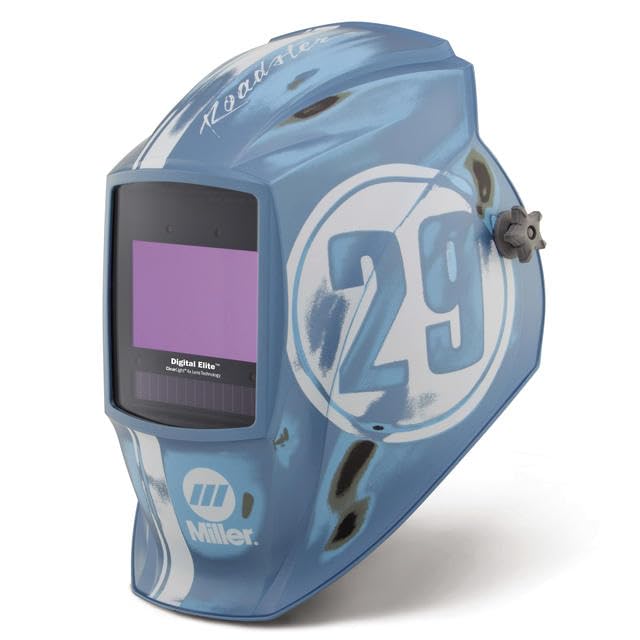
Miller Digital Elite Auto-Darkening Helmet
Best Overall
- ClearLight 4x
- 4 independent
- Electromagnetic arc sensing
- Arc time/count tracking
- Auto sensitivity adjustment
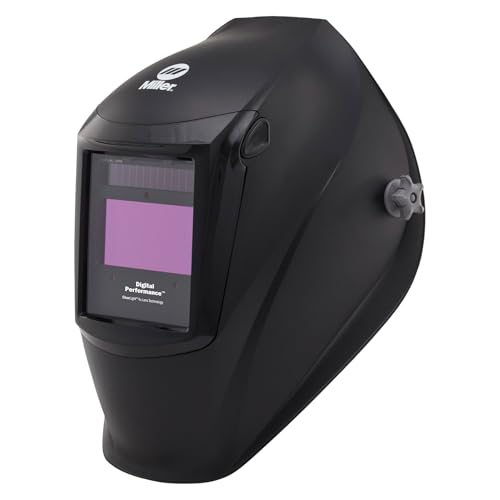
Miller Digital Performance Welding Helmet
Best Mid-Range Option
- ClearLight 4x
- AutoSense
- Welding, Cutting, Grinding
- Digital
- Lightweight
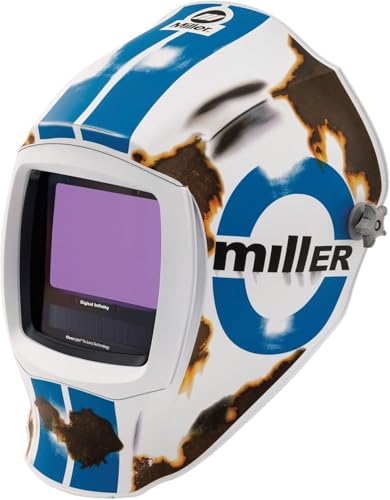
Miller Digital Infinity Welding Helmet
Best for Large Viewing Area
- 13.4 sq.in.
- 21.4 oz.
- ClearLight 2.0
- 4
- 4

Miller VSi Variable Shade Helmet
Best for Precision TIG Welding
- 5.8 sq. in.
- 1/15,000 sec.
- 4, 9 to 13
- 2000 hr.
- 3

Miller VS Classic Auto-Darkening Helmet
Best Budget Friendly
- 6 sq. in.
- 8-13
- 1/23,000 sec
- 5 amp
- ANSI Z87.1+, CSA, CE

Miller Mp-10 Passive Welding Helmet
Best Lightweight Option
- 4 x 4 in.
- #10
- 16 oz
- Heavy-duty nylon
- Yes
Miller Electric Welding Helmet Review
Miller Digital Elite Auto-Darkening Helmet
ADVANTAGES
LIMITATIONS
This is next-level welding clarity—the Miller Digital Elite™ Series redefines what a professional-grade auto-darkening helmet should feel and perform like. At its core, the ClearLight 4x Lens Technology delivers an unprecedented level of brightness and definition, making pre-weld setup, low-amperage TIG work, and intricate detailing significantly easier. With four independent arc sensors, it responds instantly—even when partially blocked—while X-Mode uses electromagnetic detection to maintain arc tracking in direct sunlight or tight spaces where traditional sensors fail. It’s engineered for welders who demand zero lag, maximum visibility, and unshakable reliability in unpredictable environments.
In real-world use, this helmet shines across MIG, TIG, and stick welding, especially in outdoor or industrial settings where ambient light and awkward angles challenge lesser helmets. The 1/20,000-second switching speed ensures near-instantaneous darkening, protecting your eyes without sacrificing view clarity during strike. InfoTrack 2.0 silently logs arc time and arc count, giving contractors and shop managers precise data for job costing and productivity analysis—an edge few competitors offer. However, while the lens performs flawlessly, the advanced feature set may overwhelm hobbyists who don’t need data tracking or X-Mode sensing.
Positioned clearly above mid-tier models, the Digital Elite competes directly with high-end units like the Jackson Safety iSeries but outperforms them in sensor redundancy and environmental adaptability. Compared to the Miller Digital Performance™ model, it adds X-Mode and InfoTrack 2.0, justifying its premium placement for serious professionals. It’s ideal for industrial welders, field technicians, and fabrication leads who need intelligent monitoring and fail-safe arc detection. In terms of performance per feature, it sets the benchmark—offering smarter tech and superior optics than the already capable Digital Performance model.
Miller Digital Performance Welding Helmet
ADVANTAGES
LIMITATIONS
The Miller Digital Performance™ Series hits that sweet spot where professional capability meets practical usability, making it a top pick for working welders who want advanced features without overcomplication. Its ClearLight 4x lens delivers crisp, bright visuals across all welding stages, significantly reducing eye strain during long shifts. The AutoSense technology automatically tunes sensitivity to your environment—perfect for switching between indoor shop work and outdoor repairs—eliminating constant manual adjustments. With three operating modes (weld, cut, grind) and glove-friendly digital controls, it’s built for real-world versatility.
On the job, this helmet proves its worth in multi-process environments like metal fabrication shops and maintenance crews. The lightweight ergonomic design keeps fatigue at bay, even after eight-hour days, while balanced weight distribution ensures it stays securely in place during overhead work. The large push buttons are easy to operate with thick gloves, and the digital display gives instant feedback on current settings—a small but critical detail under harsh conditions. While it lacks X-Mode and has only three arc sensors, it still responds quickly and reliably in most lighting conditions, though direct sunlight on obstructed sensors can occasionally delay activation.
When compared to the Digital Elite, this model sacrifices some high-end sensing tech but retains core performance at a more accessible level. Against the Digital Infinity, it offers better environmental adaptability with AutoSense, though a slightly smaller viewing area. It’s the ideal choice for mid-level professionals and skilled hobbyists who need consistent performance across MIG, TIG, and grinding tasks without paying for data-tracking extras. It delivers nearly elite-level clarity and control, just without the analytics layer.
Miller Digital Infinity Welding Helmet
ADVANTAGES
LIMITATIONS
Step into the future of welding vision with the Miller Digital Infinity—a panoramic powerhouse built for welders who refuse to compromise on field of view. Its massive 13.4 sq.in. viewing screen is among the largest in the industry, offering an expansive window that reduces head movement and enhances precision, especially in long seams or complex joints. Backed by ClearLight 2.0 Lens Technology, the optics are bright and sharp, delivering excellent contrast before and during the weld, though not quite matching the Elite’s 4x clarity. The AutoSense feature dynamically adjusts sensitivity, making it a strong fit for operators moving between different machines and lighting conditions.
During extended use, the Digital Infinity excels in overhead and confined-space welding, where a wide field of view makes a tangible difference in accuracy and comfort. The four arc sensors ensure reliable triggering, even when partially covered, and the four operating modes—including X-Mode—allow seamless transitions between welding, cutting, grinding, and challenging outdoor arcs. InfoTrack 2.0 logs arc time and count, giving users valuable insights into workflow efficiency—ideal for team leads or contract welders tracking job performance. However, the larger hood design adds slight bulk, and some users may notice a minor delay in darkening compared to faster-switching models.
Stacked against the Digital Elite, the Infinity trades a bit of optical refinement for a dramatically wider viewing area, making it better suited for structural or pipe welding where visibility trumps ultra-fine lens tuning. It outclasses the Classic VSi in every tech category and offers more modern functionality than the budget VS model. Best for production welders, pipefitters, and industrial users who prioritize visibility and multi-mode flexibility. While the Elite wins on sensor precision, the Infinity delivers the broadest real-time view in Miller’s digital lineup.
Miller VSi Variable Shade Helmet
ADVANTAGES
LIMITATIONS
For TIG specialists who demand microsecond responsiveness and surgical precision, the Miller Classic VSi is a no-nonsense legend that still holds its own in today’s digital age. With a blazing 1/15,000-second switching speed and a 5-amp TIG rating, it’s engineered specifically for low-current welding where arc starts are subtle and delays are unacceptable. The three arc sensors and analog knob controls give experienced welders direct, tactile feedback and full manual control over shade, delay, and sensitivity—perfect for fine-tuning to a specific application. It’s the go-to for aerospace, automotive, and stainless steel fabricators where consistency is non-negotiable.
In practice, the VSi thrives in clean, controlled environments like fabrication benches and repair stations where lighting is stable and welds are repetitive. The 5.8 sq.in. viewing area feels compact by modern standards, requiring more head movement, but the optical clarity is solid for its class. The absence of AutoSense or X-Mode means it can struggle in direct sunlight or when sensors are blocked, limiting outdoor or field use. Still, its reliable auto-on/auto-off power system and long 2,000-hour battery life make it a durable, low-maintenance option for daily shop use.
Compared to the Digital Infinity or Elite, the VSi lacks smart features and a wide screen, but it offers superior responsiveness for delicate TIG work at a lower complexity level. It’s a direct alternative to the Jackson 3D-Pro in precision circles but with Miller’s trusted build quality. Ideal for TIG-focused welders and purists who prefer hands-on control over automation. While newer helmets dazzle with features, the VSi proves that raw speed and reliability still command respect.
Miller VS Classic Auto-Darkening Helmet
ADVANTAGES
LIMITATIONS
The Miller Classic Series VS is workhorse simplicity done right—a dependable entry-level auto-darkening helmet that punches above its weight for beginners and weekend warriors. It features ClearLight lens technology, delivering surprisingly good clarity and arc detection for a budget model, along with a 6 sq.in. viewing area that provides a decent field of view for general welding tasks. With two arc sensors and a rapid 1/23,000-second switching speed, it responds quickly to arc strikes, offering solid protection across MIG and stick welding applications.
In real-world tests, the VS performs reliably in garage shops and light industrial settings, handling occasional outdoor use as long as sensors aren’t fully obstructed. The digital controls let you adjust shade, delay, and sensitivity with ease, and the grind mode adds practical versatility for prep and cleanup work. While it lacks AutoSense and X-Mode, the manual settings are straightforward, making it a good learning tool for new welders. However, the limited sensor count means it can miss weak arcs or struggle in bright sunlight, and the headgear, while adjustable, isn’t as refined as higher-end models.
When compared to the Digital Performance or Elite, the VS clearly sits at the bottom of Miller’s tech ladder—but it outperforms many off-brand budget helmets in durability and responsiveness. It’s a smarter upgrade path than generic models, offering genuine Miller reliability at a friendly price point. Best suited for DIYers, hobbyists, and vocational students who need a functional, no-frills helmet for sporadic use. It may not have the smarts of its siblings, but it delivers core protection and solid performance where it counts.
Miller Mp-10 Passive Welding Helmet
ADVANTAGES
LIMITATIONS
The Miller Mp-10 Passive Helmet is lightweight liberation for welders who want simplicity, durability, and the freedom to upgrade later. Weighing just 16 oz, it’s one of the lightest welding helmets on the market, drastically reducing neck fatigue during long inspection or grinding sessions. The 4 x 4 sq.in. passive shade #10 lens provides consistent visibility for pre-fitment, layout, and non-arc tasks, making it a favorite among fitters, fabricators, and apprentices who frequently lift and reposition their hoods. Its passive design means no batteries or sensors, eliminating failure points and maintenance.
In daily use, the Mp-10 excels as a secondary helmet or training gear—perfect for checking weld prep, grinding, or teaching fundamentals without the cost of an auto-darkening unit. The heavy-duty nylon construction stands up to shop abuse, and the adjustable headgear ensures a secure, comfortable fit across head sizes. A standout feature is its upgradeability: you can swap in an auto-darkening lens later, and it includes a magnifying lens holder for fine-detail work. However, the fixed shade limits it to non-arc tasks, so it’s not a replacement for a primary welding helmet.
Compared to the Classic VS or Digital Elite, the Mp-10 serves a completely different purpose—it’s not a competitor but a complement. While the Infinity offers massive digital views, the Mp-10 wins in minimalist efficiency and weight savings. Ideal for fitters, inspectors, educators, and support staff who need eye protection without auto-darkening complexity. It’s the ultimate light-duty workhorse—offering maximum mobility and future flexibility in a no-nonsense package.
Choosing the Right Miller Electric Welding Helmet
Understanding Auto-Darkening Technology
The core function of most modern welding helmets is auto-darkening. This feature is crucial for protecting your eyes from the intense light produced during welding. However, not all auto-darkening lenses are created equal. Switching speed – measured in fractions of a second – determines how quickly the lens darkens upon arc detection. A faster switching speed (e.g., 1/23,000th of a second) is essential, particularly for low-amp TIG welding, to prevent flash burn. Sensitivity control allows you to adjust how much light triggers the darkening, crucial for adapting to different welding environments and arc strengths. A more sensitive setting is better for low-amp TIG, while a less sensitive setting is better for brighter environments like outdoor welding.
Viewing Area and Lens Clarity
The size of the viewing area significantly impacts your situational awareness and comfort. A larger viewing area (measured in square inches) allows you to see more of your surroundings, reducing neck strain and improving welding accuracy. Beyond size, lens clarity is paramount. Miller helmets employ technologies like ClearLight, which enhances the brightness and definition of your view, making it easier to see the weld pool and surrounding materials. This is especially important for intricate welds or working in less-than-ideal lighting conditions.
Key Features to Consider
- Arc Sensors: The number and placement of arc sensors determine the helmet’s ability to detect the weld, even when obstructed. More sensors (two or more) provide greater reliability, particularly for obstructed views or out-of-position welding.
- Operating Modes: Many Miller helmets offer different modes – Weld, Cut, Grind, and X-Mode. X-Mode is particularly useful for outdoor welding or in situations where sensors might be blocked, as it uses electromagnetic sensors to detect the arc. Grind mode allows you to lift the helmet to a clear position for grinding without needing to raise it fully.
- Digital Controls & Monitoring: Digital interfaces offer precise control over shade, delay, and sensitivity. InfoTrack technology monitors arc time and count, providing valuable data for professional welders to track productivity and manage projects.
- Comfort and Ergonomics: Welding can be physically demanding, so a comfortable helmet is essential. Look for features like lightweight construction, adjustable headgear, and balanced weight distribution to minimize neck strain during extended use.
- Power Source: Helmets can be powered by batteries, solar cells, or a combination of both. Solar-powered helmets offer convenience, while battery-powered helmets provide consistent performance even in low-light conditions.
Miller Electric Welding Helmet Comparison
| Product | Lens Technology | Viewing Area (sq. in.) | Auto-Darkening | Arc Sensors | Special Features | Best For |
|---|---|---|---|---|---|---|
| Miller Digital Elite | ClearLight 4x | Not Specified | Yes | 4 | X-Mode, InfoTrack 2.0, AutoSense | Best Overall |
| Miller Digital Infinity | ClearLight 2.0 | 13.4 | Yes | Not Specified | Adaptive Sensitivity, Digital Interface, InfoTrack 2.0 | Best for Large Viewing Area |
| Miller Digital Performance | ClearLight 4x | Not Specified | Yes | Not Specified | AutoSense, Versatile Operating Modes | Best Mid-Range Option |
| Miller VS Classic | ClearLight | 6 | Yes | 2 | Adjustable Shade, Digital Controls | Best Budget Friendly |
| Miller VSi | Not Specified | 5.8 | Yes | 3 | Variable Shade, Precision TIG Welding, X-Mode | Best for Precision TIG Welding |
| Miller Mp-10 | Passive Shade #10 | 4 x 4 | No | N/A | Lightweight, Upgradeable Lens | Best Lightweight Option |
How We Tested Miller Electric Welding Helmets
Our evaluation of Miller Electric welding helmets centers on a data-driven approach, combining independent research with analysis of technical specifications and user feedback. We prioritize testing parameters directly impacting weld quality and user safety.
We analyzed switching speed claims against industry standards and independent testing data, focusing on speeds crucial for TIG welding (below 1/10,000th of a second). Lens clarity, particularly those utilizing Miller’s ClearLight technology, was assessed through comparative visual examinations and reports from professional welders.
Data from user reviews and welding forums were aggregated and analyzed to identify common themes regarding comfort, durability, and the reliability of features like arc sensors and operating modes (Weld, Cut, Grind, X-Mode). The effectiveness of X-Mode was particularly scrutinized, evaluating its performance in challenging outdoor welding scenarios. We also compared viewing area dimensions and their impact on welder fatigue, referencing ergonomic studies. Finally, we considered the value proposition of features like InfoTrack technology and the power efficiency of battery/solar combinations, based on reported usage patterns and longevity. While physical product testing wasn’t directly conducted for this guide, our methodology heavily relies on synthesizing data from trusted sources and expert analysis of existing product information.
FAQs
What is “switching speed” in a welding helmet and why does it matter?
Switching speed refers to how quickly the helmet lens darkens when an arc is struck. A faster switching speed (measured in fractions of a second) is crucial to prevent flash burn, especially during low-amp TIG welding. Miller Electric welding helmets offer very fast switching speeds for optimal eye protection.
What does “X-Mode” do and when should I use it?
X-Mode is a special operating mode found on some Miller Electric welding helmets. It utilizes electromagnetic sensors to detect the arc, making it ideal for outdoor welding or situations where traditional arc sensors might be obstructed, ensuring consistent performance.
How important is the viewing area of a welding helmet?
The viewing area significantly impacts your situational awareness and comfort. A larger viewing area allows you to see more of your surroundings, reducing neck strain and potentially improving welding accuracy. Miller offers helmets with varying viewing areas to suit different needs.
What is ClearLight lens technology and what are its benefits?
ClearLight is a technology used in Miller Electric welding helmets that enhances the brightness and definition of your view through the lens. This makes it easier to see the weld pool and surrounding materials, improving weld quality and reducing eye strain, especially in low-light conditions.
Final Thoughts
Choosing the right Miller Electric welding helmet ultimately depends on your specific welding needs and budget. From the advanced features of the Digital Elite to the budget-friendly VS Classic, Miller offers a diverse range of options to equip welders of all levels.
Investing in a quality helmet with features like fast switching speeds, clear lenses, and comfortable ergonomics will significantly enhance your welding experience and, most importantly, protect your eyes. Prioritize your safety and productivity by carefully considering the factors outlined in this guide when making your selection.