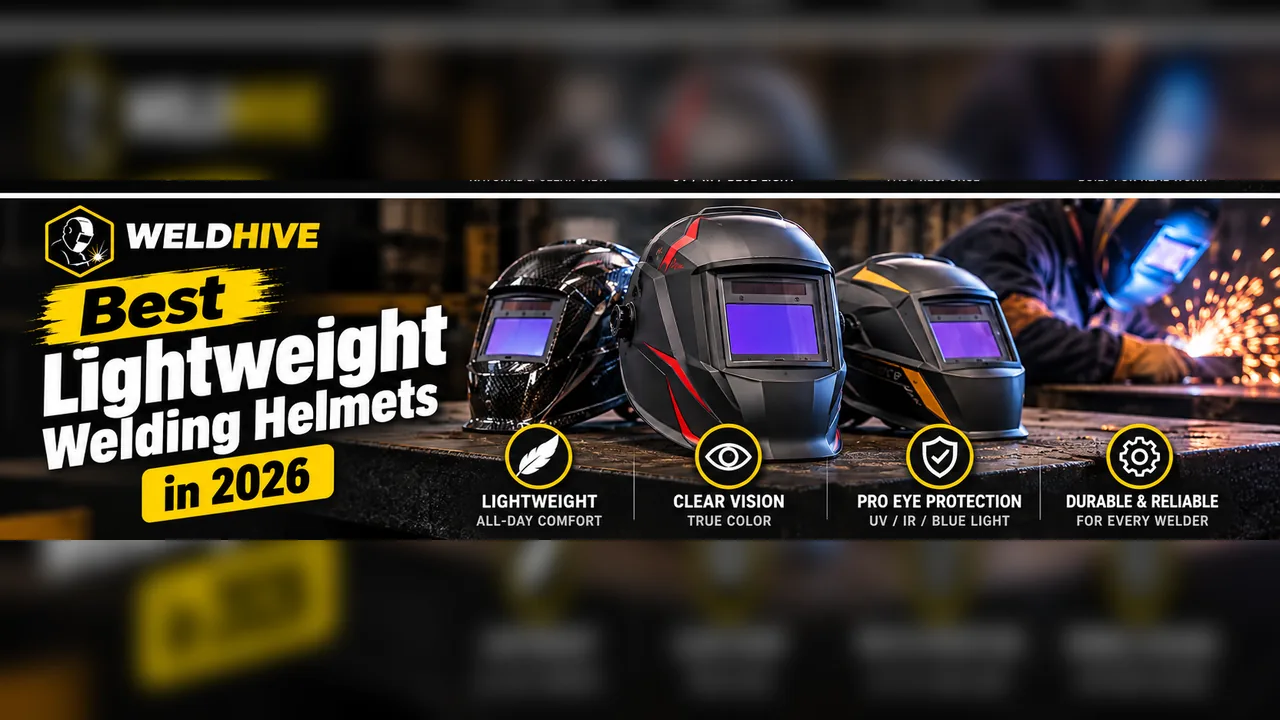
Best Lightweight Welding Helmets in 2026
Looking for a welding helmet that will not feel heavy after hours under the hood? A lightweight helmet can make a noticeable difference when you weld overhead, work in awkward positions, or spend a full shift moving around the shop.
But the lightest helmet is not automatically the best helmet. Shell construction, headgear balance, auto-darkening performance, viewing area, shade range and lens quality all matter. We compared lightweight options across several price levels to find the models that make the most sense for real welding work.
Quick Picks
ICONIC WELD
About 12–13 oz
Lincoln Fierce
About 17 oz
ESAB Savage A40
About 500 g
Optrel crystal2.0
About 460 g
Our Picks at a Glance
| Helmet | Best for | Weight | Lens / Shade | Notable feature |
|---|---|---|---|---|
| ICONIC WELD VS8000 | Lightest option | Approx. 12–13 oz | Variable 4/9–13 | Vulcanized-fiber shell + flip-up lens |
| Lincoln Fierce K3063-1 | Recognized-brand value | Approx. 17 oz | Variable 7–13 / grind | Ratchet headgear |
| ESAB Savage A40 | Professional value | Approx. 500 g | 4/9–13 | 4 sensors + external controls |
| Optrel crystal2.0 | Premium comfort | Approx. 460 g | Automatic 4–12 | Crystal Lens Technology 2.0 |
Important: Published weight can vary by configuration, accessories and measurement method. Always check the exact Amazon listing and manufacturer documentation for the model you are buying.
1. ICONIC WELD Auto-Darkening Welding Helmet — Best Overall for Minimum Weight
ICONIC WELD Auto-Darkening Welding Helmet — VS8000

If your first priority is keeping helmet weight as low as possible, the ICONIC WELD is the standout. The VS8000 configuration is listed at roughly 12–13 ounces, substantially lighter than many conventional auto-darkening helmets.
The helmet uses a vulcanized-fiber shell and a flip-up lens design. The variable auto-darkening configuration provides a 4/9–13 shade range, while the design also makes switching between welding and other shop tasks more convenient.
The main reason to choose this helmet is simple: less weight on your head and neck. If you regularly weld overhead or spend several hours under a helmet, that can be more important than adding another electronic feature.
- Exceptionally light at about 12–13 oz
- Vulcanized-fiber construction
- Flip-up lens design
- Variable 4/9–13 configuration available
- Good choice for long welding sessions
- Not the largest viewing area
- Different design philosophy from conventional full-shell ADF helmets
- Verify the exact VS6000/VS8000 configuration before ordering
2. Lincoln Electric Fierce K3063-1 — Best Recognized-Brand Lightweight Option
Lincoln Electric FIERCE RED K3063-1

The Lincoln Electric Fierce is a practical middle ground for welders who want a lighter helmet without moving into a specialized ultra-light fiber-shell design.
The K3063-1 is listed at roughly 17 ounces in current lightweight-helmet comparisons. It uses variable shade operation and includes a grind mode, while the ratchet-style headgear gives it a more conventional fit and adjustment system.
It is not the lightest helmet here, but that is not necessarily a disadvantage. If you want a familiar full-shell welding helmet from a major welding equipment manufacturer, the Fierce is a sensible option.
- Lightweight for a conventional helmet
- Lincoln Electric brand
- Ratchet-adjustable headgear
- Variable shade and grind mode
- Good everyday option for hobby and shop use
- Heavier than ICONIC WELD
- Optical specification is not as premium as top-end 1/1/1/1 helmets
- Check the exact shade configuration on Amazon
3. ESAB Savage A40 — Best Lightweight Professional Value
ESAB Savage A40 Auto-Darkening Welding Helmet

The ESAB Savage A40 is a strong choice when lightweight design matters but you still want a conventional professional welding helmet with four sensors and external controls.
ESAB lists the A40 at about 500 g, with a 100 × 50 mm viewing area, four sensors, a 4/9–13 shade configuration and a published light-to-dark switching time of 0.08 ms. It also provides external shade and grind controls. citeturn8search3
This is the helmet to consider when your definition of “lightweight” means comfortable enough for extended shop use without sacrificing conventional welding-helmet features.
- About 500 g
- Four arc sensors
- External controls
- Fast published switching time
- Suitable for TIG, MIG, stick and related processes
- Not as light as ICONIC WELD
- Viewing area is smaller than some large-view helmets
- Optical rating is not the main reason to buy this model
4. Optrel crystal2.0 — Best Premium Lightweight Comfort
Optrel crystal2.0 Auto-Darkening Welding Helmet
The Optrel crystal2.0 is the premium choice for welders who care about both weight distribution and optical performance. Optrel lists the helmet at approximately 460 g (17.46 oz) and uses Crystal Lens Technology 2.0 for a more color-realistic bright-state view. citeturn8search1turn8search2
Its automatic protection system works from shade 4–12 manually, with ShadeTronic automatic adjustment. Optrel also lists three sensors, solar cells plus replaceable CR2032 batteries, and a 0.10 ms light-to-dark switching time at room temperature. citeturn8search36turn8search37
This is not the cheapest way to reduce helmet weight. Instead, it is aimed at welders who want premium optics, balanced headgear and long-session comfort in one package.
- About 460 g / 17.46 oz
- Premium Crystal Lens Technology 2.0
- Automatic ShadeTronic operation
- Excellent weight distribution
- Very fast published switching time
- Premium price
- 1/1/1/2 optical classification rather than 1/1/1/1
- Not the lightest helmet in this comparison
Lightweight Welding Helmet Comparison
| Model | Approx. weight | Darkening / shade | Sensors | Best for |
|---|---|---|---|---|
| ICONIC WELD VS8000 | 12–13 oz | Variable 4/9–13 | Verify exact configuration | Minimum weight |
| Lincoln Fierce K3063-1 | ~17 oz | Variable 7–13 / grind | Verify exact configuration | Recognized-brand value |
| ESAB Savage A40 | ~500 g | 4/9–13 | 4 | Professional value |
| Optrel crystal2.0 | ~460 g | Automatic 4–12 | 3 | Premium comfort |
How Much Does Welding Helmet Weight Really Matter?
Helmet weight matters most when you wear the helmet for long periods or work in positions that force your neck away from a neutral posture. A difference of several ounces may seem insignificant when you hold a helmet for a few seconds, but it can become much more noticeable over repeated hours.
However, do not choose a helmet by weight alone. A slightly heavier helmet with better headgear balance can feel more comfortable than an extremely light helmet with poor weight distribution.
What Is a Good Weight for a Welding Helmet?
There is no universal “safe” or “ideal” helmet weight. As a practical buying guide, helmets around the 12–18 ounce range can be attractive for welders who prioritize low weight, while conventional professional helmets may weigh more because of their shell, ADF, headgear and additional features.
The most important comparison is not just the number on the scale. Look at weight distribution, headgear adjustment, viewing position and how securely the helmet stays in place.
What to Look for in a Lightweight Welding Helmet
1. Weight
Start with the published helmet weight, but confirm whether the manufacturer is listing the shell, complete helmet or a particular configuration.
2. Headgear
A good headgear system can make a heavier helmet feel surprisingly comfortable. Look for easy adjustment, a secure lock-up position and good balance.
3. Viewing Area
A lightweight helmet with a very small viewing area may not suit your work. If you weld large joints, work overhead or frequently move around a workpiece, compare the viewing dimensions before buying.
4. Auto-Darkening Performance
Look at switching time, sensor count, sensitivity adjustment and shade range. These features matter more to welding performance than weight alone.
5. Lens Quality
Optical clarity helps you see the puddle and workpiece more naturally. Do not assume that every helmet advertised as “true color” has the same optical performance.
6. Your Welding Process
TIG, MIG, stick, flux-cored welding, cutting and grinding can place different demands on a helmet. Make sure the shade range and modes match your work.
Who Should Buy a Lightweight Welding Helmet?
- Welders who work long shifts under the hood
- People who frequently weld overhead or out of position
- Fabricators who move between workstations frequently
- Hobbyists who dislike bulky conventional helmets
- Welders who are especially sensitive to neck and shoulder fatigue
Who Should Not Choose a Helmet Solely Because It Is Lightweight?
If you need a very large viewing area, specialized low-amp TIG performance, advanced digital controls, respiratory integration or heavy-duty industrial durability, a slightly heavier helmet may be the better choice.
Weight is one specification—not the specification.
Lightweight vs. Large-View Welding Helmets
There is often a trade-off between a very large viewing area and minimum weight. Larger ADF cartridges, cover lenses and shells can add mass. If your priority is peripheral visibility, compare large-view models separately rather than automatically choosing the lightest helmet.
For more visibility-focused options, see our best welding helmets for visibility guide.
Lightweight vs. True Color Welding Helmets
True Color technology can improve the natural appearance of the weld scene, but it does not automatically mean the helmet is lightweight. If you want both characteristics, compare weight, optical classification and viewing area together.
You can also see our true color welding helmet guide if that page is available on your site.
Frequently Asked Questions
What is the lightest auto-darkening welding helmet?
Among the models compared here, the ICONIC WELD VS8000 is the clear lightweight specialist at approximately 12–13 ounces. Exact weight can vary by configuration.
Are lightweight welding helmets less safe?
Not necessarily. Safety depends on the helmet’s certification, filter performance, shade range, construction and correct use—not simply its weight.
Is a heavier welding helmet better?
Not automatically. Heavier helmets may offer larger viewing areas, more electronics or different shell designs, but a well-balanced lightweight helmet can be more comfortable for extended work.
Is the Optrel crystal2.0 lightweight?
Yes. Optrel lists the crystal2.0 at approximately 460 g (17.46 oz), making it lighter than many conventional professional helmets, although it is not the lightest model in this comparison. citeturn8search1
Should I choose weight or viewing area?
Choose according to your work. If neck fatigue is your biggest problem, prioritize weight and balance. If positioning and peripheral visibility are more important, a larger viewing area may justify a little extra weight.
Final Verdict
For the lowest weight: choose the ICONIC WELD VS8000.
For a recognizable welding brand at a lighter weight: consider the Lincoln Fierce K3063-1.
For professional features without moving into premium pricing: the ESAB Savage A40 is a strong choice.
For premium optical technology and comfort: the Optrel crystal2.0 is the upgrade pick.
The best lightweight welding helmet is ultimately the one that combines low enough weight, good balance, suitable lens performance and the right shade range for your welding process.
- Confirm the four Amazon links open the exact model/configuration you intend to recommend.
- Use Amazon Associates SiteStripe or another approved Amazon image method for product images.
- Confirm your active Amazon Associates tracking ID is
shahedru-20. - Do not hard-code Amazon prices, ratings or availability because they change.
- Check the finished page on both desktop and mobile before publishing.
Research note: Product specifications were checked against manufacturer information and current 2026 product research. Published specifications and Amazon configurations can change; verify the exact listing before purchase.