
If you’ve ever welded with a traditional fixed-shade helmet, you know the struggle: lifting the helmet to align your torch, quickly flipping it down as you strike the arc—only to miss the start of the weld or get a painful flash of unfiltered light. That constant up-and-down motion slows you down, increases fatigue, and risks eye damage if you’re even a fraction of a second too late.
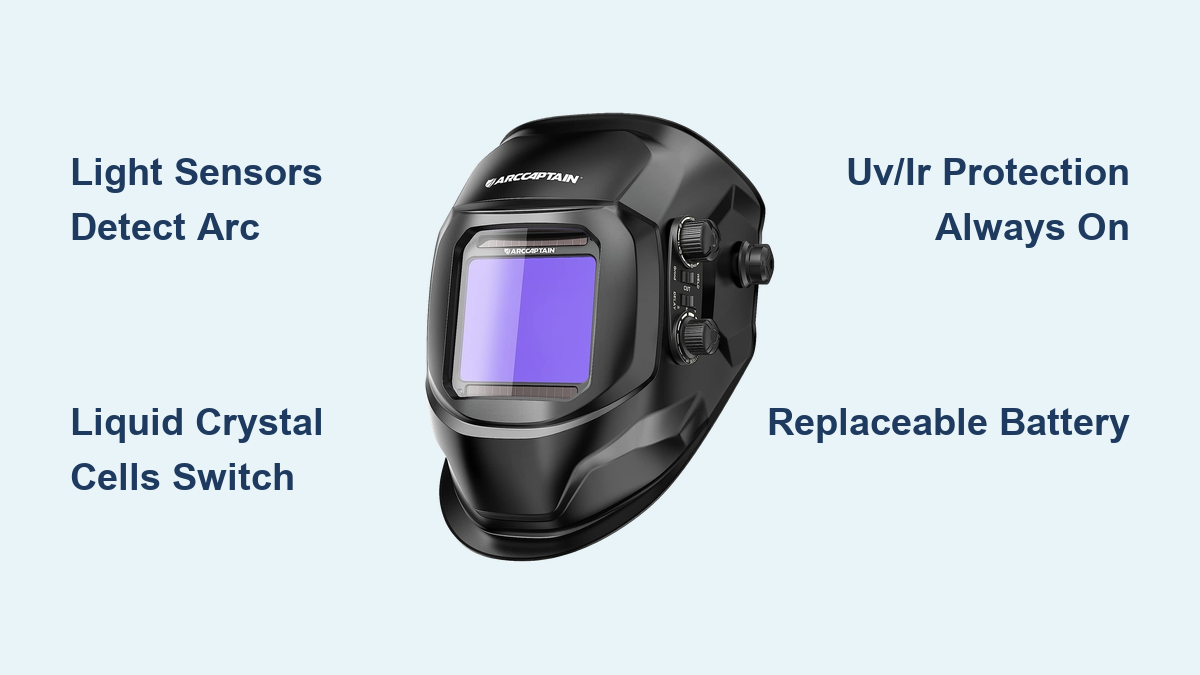
Auto-darkening welding helmets solve this problem with intelligent, real-time lens technology that shifts from clear to dark in less than a millisecond the moment an arc ignites. But how do auto-darkening welding helmets work? At their core, they combine light sensors, liquid crystal cells, polarization filters, and passive UV/IR protection into a seamless system that protects your eyes while keeping your view of the workpiece uninterrupted.
These helmets use a hybrid power system—often solar-assisted with a backup battery—to detect arcs, trigger near-instant shade changes, and return to clarity after welding, all without any manual input. Whether you’re running a TIG bead on thin stainless or laying down a heavy stick weld, an auto-darkening helmet adapts on the fly. In this guide, we’ll break down every component of how these smart helmets function, how fast they respond, and what features matter most when choosing one.
Sensors Detect the Arc in Microseconds
The first step in the auto-darkening process is arc detection—and it all starts with light sensors mounted around the lens.
These sensors are tuned to detect the sudden spike in ultraviolet (UV), infrared (IR), and visible light that occurs when a welding arc strikes. Unlike older models that relied only on brightness, modern sensors recognize the unique radiation signature of a welding arc, reducing false triggers from grinders or sunlight.
Two vs. Four Sensors: Why More Is Better
Most helmets come with either two or four sensors. Budget models use two—typically on the sides—while premium helmets feature four-sensor systems positioned at all corners of the lens.
- Four sensors provide 360° detection, ensuring the helmet darkens even when you’re welding in tight corners, overhead, or at awkward angles where one side might be blocked.
- With only two sensors, a blocked view can delay or prevent darkening—putting your eyes at risk.
High-end models react in as little as 0.05 milliseconds (1/20,000th of a second)—faster than the human blink reflex. This speed ensures your eyes are protected before they can even register the flash.
Auto-Darkening Filter (ADF): The Smart Lens Technology
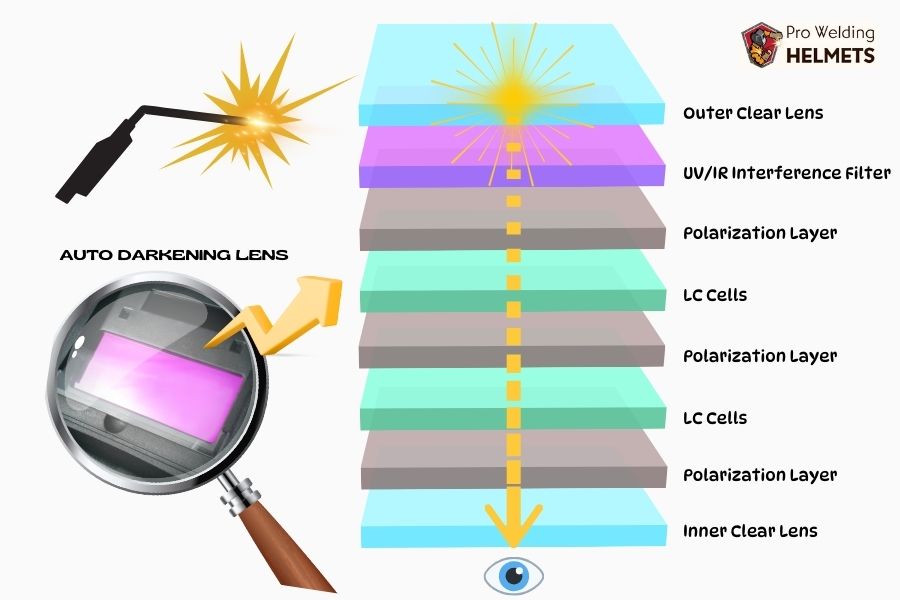
The Auto-Darkening Filter (ADF) is the heart of the helmet. It’s not just one layer, but a precision-engineered stack of optical components working together to control light transmission and block harmful radiation.
UV/IR Interference Filter: Always-On Protection
Even if the battery dies or the electronics fail, your eyes are never left exposed. The UV/IR interference filter is a passive, non-electronic layer built into the lens that blocks dangerous radiation 24/7.
- Made of up to 11 alternating layers of silver and aluminum oxide, this filter reflects and absorbs 99.9% of IR radiation and 99.9997% of UV radiation.
- It’s always active—no power required.
- This layer gives high-end lenses (like those in 3M Speedglas helmets) their signature purple or bluish reflective tint.
Polarization Filters Control Light Flow
Two polarizing filters sit on either side of the liquid crystal cells. When aligned perpendicularly (90° apart), they block nearly all visible light. When aligned in parallel, more light passes through.
- In clear mode (shade 3–5), the filters are aligned to allow maximum visibility for setup.
- In dark mode (shade 9–13), they cross-polarize to block light completely.
The shift between these states is controlled electronically through the liquid crystals.
Liquid Crystal Cells Enable Instant Shade Change
The liquid crystal cells (LCC) are the active component that makes auto-darkening possible.
- Default (no power): Crystals are twisted, rotating light by 90°—this allows light to pass through both polarizers, creating a safety backup shade of 5–6.
- Powered “clear” mode: Voltage untwists the crystals, minimizing obstruction and enabling a light transmission state (shade 3).
- Arc-triggered “dark” mode: Sensors signal the circuit to apply voltage, realigning the crystals to block light, switching the lens to the selected shade (9–13).
Modern LCCs can switch states in under 0.1 milliseconds, ensuring protection before your eyes react.
Curved ADFs Improve Vision and Ergonomics
Newer models like the 3M Speedglas G5-02 use curved auto-darkening filters for enhanced performance.
- Wider field of view and better peripheral vision
- Lower profile reduces neck strain
- Improved color accuracy helps with TIG puddle control
- Capable of detecting arcs as low as 1A, ideal for precision work
Power System: Solar + Battery Hybrid Design
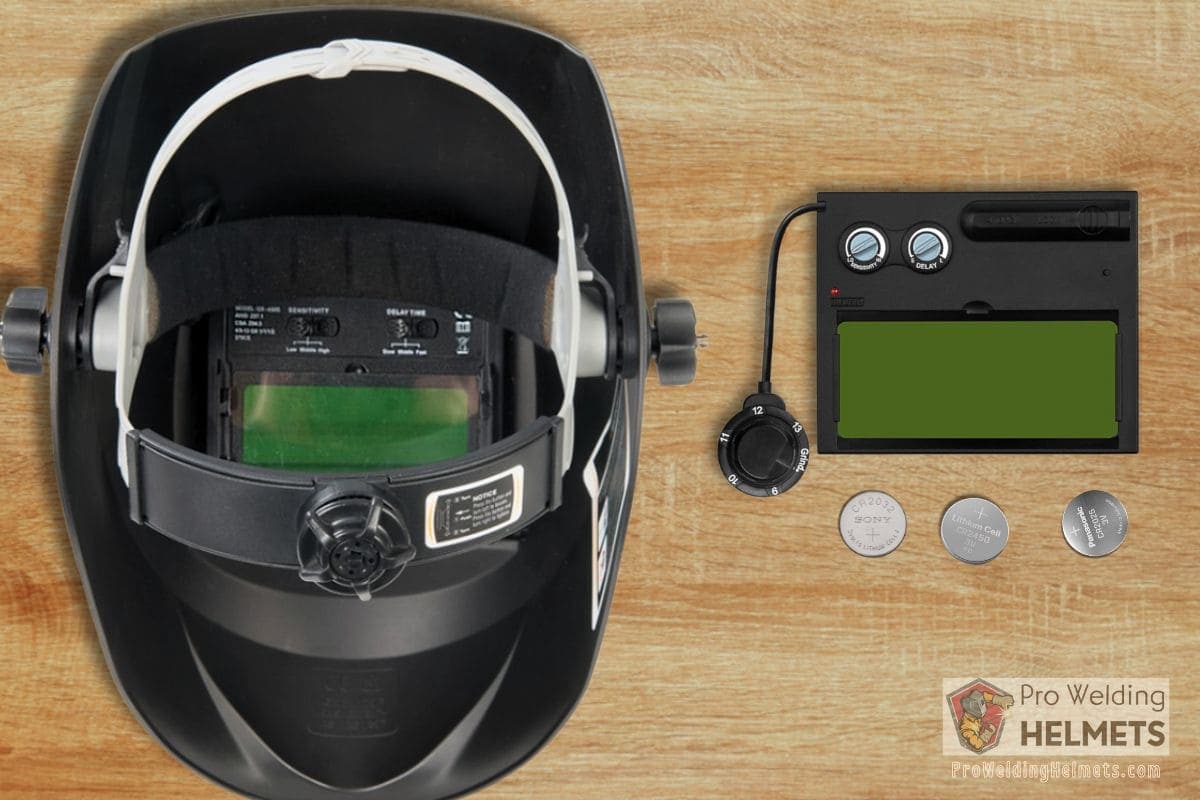
Auto-darkening helmets rely on a dual-power system to stay operational in all conditions.
Battery Powers the Electronics (Not the Lens)
A common misconception: the battery does not power the darkening process. Instead, it runs the sensors, control circuit, and user interface.
- The actual energy to maintain the dark state comes from solar panels powered by the welding arc.
- Most use CR2032, CR2050, or AAA batteries—lithium types last longer and handle heat better.
Replaceable vs. Soldered Batteries
- Replaceable batteries let you extend the helmet’s life to 7–10+ years (e.g., Miller, 3M).
- Soldered-in batteries (common in budget models) can’t be replaced. Once dead, the helmet is unusable—often within 2–3 years, even with light use.
Solar Panels Sustain the Dark State
Front-mounted photovoltaic cells convert arc light into electricity.
- They do not charge the battery.
- They supply direct power to keep the lens dark during welding, even in low-light environments.
This means the helmet can function efficiently indoors or in shaded areas—the arc itself keeps the system alive.
Four Power Configurations Ranked
| Type | Best For | Lifespan |
|---|---|---|
| Solar + Replaceable Battery | Pros & frequent users | 7–10+ years |
| Solar + Non-Replaceable Battery | Mid-range users | 3–5 years |
| Non-Solar + Replaceable Battery | Occasional use | Limited runtime |
| Non-Solar + Non-Replaceable Battery | Avoid if possible | <3 years |
How the Auto-Darkening Process Works: Step by Step
From clear to dark and back again—the entire cycle happens in milliseconds.
Pre-Weld: Clear View for Setup
Before striking the arc, the lens is in shade 3–5, offering excellent visibility.
- You can see your joint clearly without lifting the helmet.
- UV/IR filters remain active—eye protection never turns off.
Arc Detection: Sensors React in <0.1 ms
When you strike the arc:
- Intense UV, IR, and visible light flood the area.
- Front and side sensors detect the spike.
- Signal is sent to the control board in microseconds.
Because sensors detect radiation—not just brightness—they’re highly accurate and rarely trigger from grinders or sunlight.
Darkening Phase: Lens Switches in Under 0.1 Milliseconds
Once triggered:
- Voltage is applied to the liquid crystal cells.
- Crystals realign to block light.
- Lens transitions to user-selected shade (9–13).
Even at 0.05 ms response time, the lens darkens before your eye can react—preventing arc eye and retinal damage.
Post-Weld: Delayed Clearing for Safer Inspection
After the arc stops, the lens stays dark based on the delay setting (0.2–2 seconds).
- Lets you watch the weld pool cool.
- Prevents sudden light exposure.
- Especially useful in stick welding, where spatter and post-arc glow require continued protection.
Adjustable Settings for Custom Performance
High-end helmets let you fine-tune settings without lifting the hood.
Sensitivity: Avoid False Triggers
- High sensitivity: Ideal for low-amperage TIG.
- Low sensitivity: Prevents grinding false triggers.
- Pro Tip: Set high for TIG, lower for MIG/stick in bright areas.
Delay: Control How Long Lens Stays Dark
- Short (0.2–0.5 s): Best for rapid MIG passes.
- Long (1–2 s): Great for stick weld inspection.
Shade Range: Match Your Process
- Shade 5–9: TIG, gouging, light MIG.
- Shade 9–13: MIG, stick, flux-core.
- Dual-range knobs (e.g., Iron and Ink) offer maximum flexibility.
Grind Mode: Stay Visible Without Flipping
Disables auto-darkening, keeping the lens at shade 8–10.
- No more accidental darkening while grinding.
- Activated via side switch.
Viewing Window Size and Optical Clarity
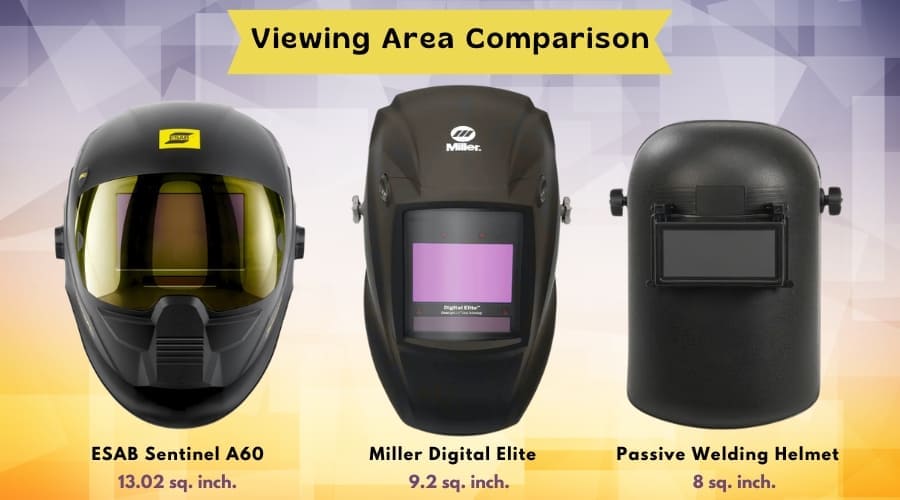
A smart helmet is only as good as what you can see.
Standard vs. Large Windows
- Standard (2.5 x 4.5 in): Adequate but limits visibility.
- Large (4.5 x 4.5 in or larger): Found in Iron and Ink, 3M, Miller—offers wider view, less neck strain.
Pixel Density Affects Image Quality
- Higher pixel density = sharper, crisper image.
- Premium models (e.g., 3M Speedglas G5-01) offer adjustable color tones for better contrast.
- Some still prefer fixed-shade lenses for puddle clarity—but high-end ADFs are closing the gap.
Fail-Safe Design Keeps You Protected
Even if electronics fail, safety isn’t compromised.
- UV/IR filter works 24/7—no power needed.
- If the ADF fails, the lens defaults to shade 5–6, preventing flash blindness.
- Full-lens darkening avoids risks of partial exposure—no eye-tracking or localized dimming in consumer models.
Compatibility Across Welding Processes
Auto-darkening helmets work with all major methods.
- MIG: Fast, reliable detection.
- TIG: Needs high sensitivity and shade 5–8.
- Stick: Use long delay to watch bead solidify.
- Flux-Cored/Plasma: Verify sensor compatibility—some need high sensitivity.
Benefits Over Fixed-Shade Helmets
| Feature | Auto-Darkening | Fixed-Shade |
|---|---|---|
| Visibility | Clear before/during/after | Always dark |
| Workflow | No interruptions | Constant flipping |
| Precision | Continuous alignment | Risk of misalignment |
| Fatigue | Less neck/eye strain | Repetitive motion |
Choosing the Right Helmet: Key Features
- Replaceable battery – Ensures long life
- External controls – Adjust without lifting
- Four-sensor system – Reliable in all positions
- Large window (≥4.5″) – Better visibility
- Adjustable shade (5–13) – Multi-process support
- Solar + replaceable battery – Best uptime
- Curved ADF or HD display – Improved optics
Top Recommendations
- Budget: Antra ANTFi X60 ($30–$35) – Solar, replaceable battery
- Mid-Range: Iron and Ink – Large window, dual shade, external controls
- Premium:
- 3M Speedglas G5 – Curved lens, superior clarity
- Miller Titanium 9400 – Durable, fast response
- Esab Sentinel A50 – Lightweight, balanced for all-day use
Final Note
Auto-darkening welding helmets work by combining sensors, liquid crystals, polarization filters, and passive UV/IR protection into a fast, reliable system. They offer instant protection, continuous visibility, and customizable settings—making them essential for modern welding. Choose one with replaceable batteries, four sensors, and a large, high-definition window to maximize safety, efficiency, and comfort on every job.