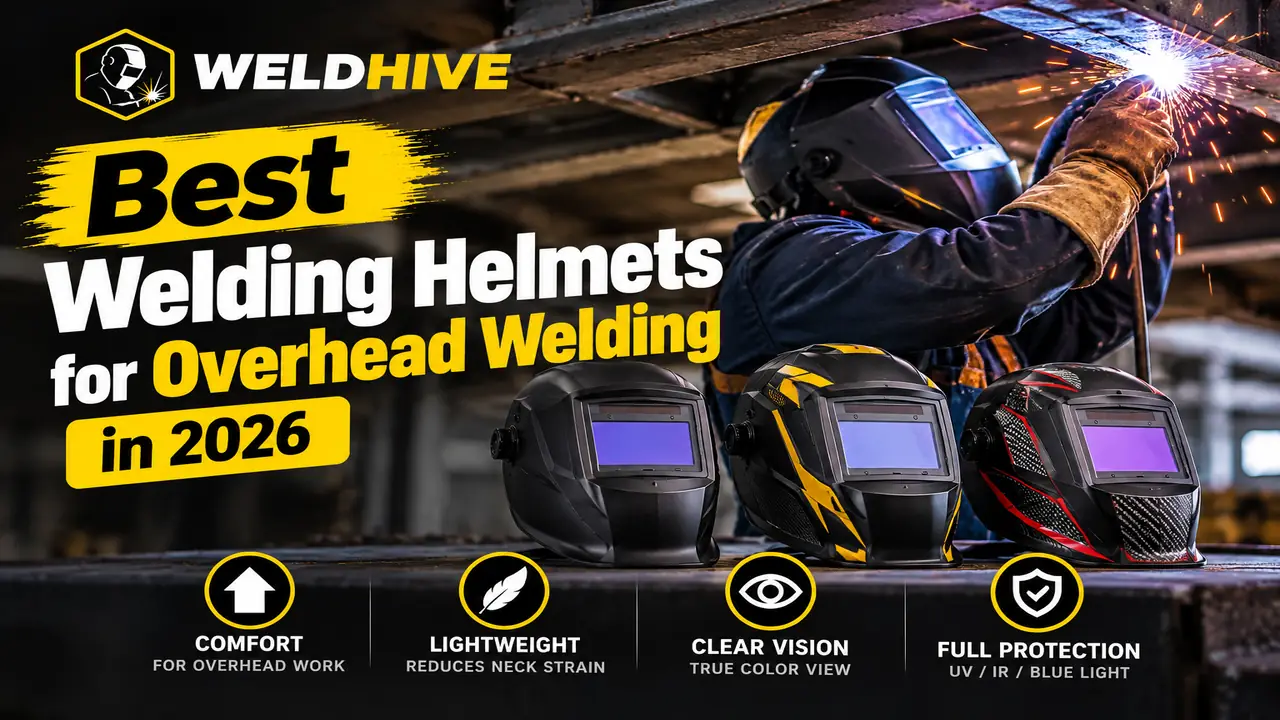
Best Welding Helmets for Overhead Welding in 2026
Overhead welding changes what you should look for in a welding helmet. When the work is above eye level, helmet balance, headgear stability, viewing position, sensor coverage and protection from falling spatter become much more important than they are during ordinary bench welding.
A helmet that works beautifully in a flat position can feel awkward overhead. We focused on helmets with features that make out-of-position work easier: secure headgear, useful viewing areas, reliable auto-darkening, multiple sensors, manageable weight and practical process controls.
Quick Picks
Jackson Safety Insight 46129
Narrow HSL shell + 4 sensors
ESAB Sentinel A60
Large 1/1/1/1 True Color view
Lincoln VIKING 3350
4C optics + X6 headgear
Our Picks at a Glance
| Helmet | Best for | Viewing area | Optics | Key overhead advantage |
|---|---|---|---|---|
| Jackson Safety Insight 46129 | Tight spaces and overhead work | 3.8 × 2.35 in | 1/1/1/1 | Narrow HSL shell + 370 Speed Dial headgear |
| ESAB Sentinel A60 | Premium visibility | 4.65 × 2.80 in | 1/1/1/1 | Large view + 4 sensors + Halo headgear |
| Lincoln VIKING 3350 | Professional all-round use | 12.5 sq. in. | 1/1/1/1 4C | X6 balanced headgear + external grind control |
Important: Overhead welding involves falling hot material and other hazards beyond eye protection. Use the helmet with the rest of your required welding PPE and follow the manufacturer’s instructions and applicable workplace safety requirements.
1. Jackson Safety Insight 46129 — Best Overall for Overhead Welding
Jackson Safety Insight Variable ADF Welding Helmet — HSL100 / 46129

The Jackson Safety Insight is our strongest fit for overhead work because its narrow HSL shell is designed for tighter working areas, while the helmet combines four arc sensors with a ratcheting 370 Speed Dial headgear system.
Jackson Safety lists 1/1/1/1 optical clarity, four sensors, a 3.8 × 2.35-inch viewing area, a 4/9–13 variable shade range and a 1/10,000-second switching speed. It also supports welding, cutting and grinding modes and is rated for TIG down to 5A. citeturn3search1turn6search5
For overhead welding, the appeal is less about having the biggest screen and more about having a helmet that stays manageable when your head position changes. The narrower shell can also be useful when you’re working around structures, beams or confined spaces.
- Narrow HSL shell for tighter work areas
- Four arc sensors
- 1/1/1/1 optical clarity
- 370 Speed Dial ratcheting headgear
- Welding, cutting and grinding modes
- 5A TIG rating
- Viewing area is smaller than the ESAB and Lincoln picks
- 1/10,000-second published switching is slower on paper than some premium ADFs
- Less suitable if maximum panoramic visibility is your top priority
2. ESAB Sentinel A60 — Best Premium Overhead Visibility
ESAB Sentinel A60

The Sentinel A60 is the premium choice when overhead work demands a larger, clearer view without giving up a professional headgear system.
ESAB lists a 4.65 × 2.80-inch viewing area, 1/1/1/1 optical classification, four arc sensors, DIN 3/5–13 shade adjustment and a 0.04 ms light-to-dark switching time. The helmet weighs about 644 g (1.4 lb) and uses adjustable Halo headgear. citeturn3search0
The A60’s large viewing area can make it easier to monitor the joint and surrounding workpiece without repeatedly repositioning your head. Its external grind control is also useful when an overhead fabrication job involves frequent transitions between welding and cleanup.
- Large 4.65 × 2.80-inch viewing area
- 1/1/1/1 optical clarity
- Four arc sensors
- Fast published 0.04 ms switching time
- Adjustable Halo headgear
- External grind control
- Heavier than some lightweight specialist helmets
- Premium price
- Large shell may feel less convenient in very tight spaces
3. Lincoln Electric VIKING 3350 — Best All-Round Professional Choice
Lincoln Electric VIKING 3350 K3034-4

The VIKING 3350 is the choice for welders who want one premium helmet that handles overhead work as part of a broader professional workload. Its biggest strengths are optics, balance and versatility.
Lincoln Electric lists the VIKING 3350 with 4C Lens Technology, 1/1/1/1 optical clarity, a 12.5-square-inch auto-darkening viewing area and X6 Headgear designed to distribute weight and improve balance. The series also supports stick, TIG, pulsed TIG, MIG, pulsed MIG, flux-cored welding, gouging and grinding. citeturn11search12turn11search16
That balance matters overhead. A large lens is useful, but a poorly balanced large helmet can become tiring when your head is tilted upward. The VIKING’s X6 headgear is specifically designed around weight distribution, making it a strong choice for welders who spend time in several positions rather than only overhead.
- 12.5-square-inch viewing area
- 4C Lens Technology
- 1/1/1/1 optical clarity
- X6 Headgear for balance
- Four arc sensors
- Broad process versatility
- External grind control
- Premium price
- Larger shell is not ideal for every confined space
- Overkill for occasional hobby welding
What Makes a Welding Helmet Good for Overhead Work?
1. Stable Headgear
Overhead work changes the position of your head and helmet. A good suspension system should let you adjust the helmet securely so it does not constantly slide, rotate or pull away from your preferred viewing angle.
2. Manageable Weight and Balance
Weight becomes more noticeable when your head is tilted upward. Look beyond the total weight and consider where that weight sits relative to your head. A balanced helmet can feel better than a lighter helmet with poor weight distribution.
3. Reliable Sensor Coverage
Multiple sensors can help the auto-darkening filter detect an arc when the helmet is not facing the arc directly. Four-sensor systems are common on the professional models in this comparison.
4. A Useful Viewing Area
A larger viewing area can reduce the need to move your head when following a joint or checking the surrounding workpiece. However, maximum size is not always best if the work area is cramped.
5. Good Spatter and Face Coverage
When welding overhead, hot spatter and debris can fall toward your face and neck. Helmet coverage is therefore only one part of the protection system. Wear the appropriate jacket, gloves, hearing protection and other PPE for the job.
Overhead Welding vs. Regular Welding: What Changes?
| Feature | Regular / Flat Welding | Overhead Welding |
|---|---|---|
| Helmet balance | Important | Very important |
| Headgear stability | Important | Critical |
| Sensor coverage | Important | Especially important |
| Viewing area | Important | Highly useful |
| Spatter protection | Important | Especially important |
| Low weight | Helpful | More valuable during long overhead work |
Should You Buy a Lightweight Helmet for Overhead Welding?
Usually, lightweight construction is helpful because your neck is already working harder when you look upward. But do not automatically choose the lightest helmet. Headgear balance, shell coverage, sensor placement and viewing position can matter more than a small difference in weight.
Our Best Lightweight Welding Helmets guide covers the weight-focused options separately.
Do You Need a Panoramic Helmet for Overhead Welding?
Not necessarily. A wide or panoramic view can make it easier to monitor a larger work area, but a panoramic helmet can also be larger or heavier. For tight overhead spaces, a narrower shell such as the Jackson Safety Insight can make more sense.
If visibility is your main concern, see our Best Welding Helmets for Visibility guide.
What Shade Should You Use for Overhead Welding?
There is no single shade setting specifically because a weld is overhead. Choose the correct shade for the welding process, electrode/current and applicable safety guidance. A variable-shade helmet is useful because it allows you to adjust the dark state for different welding jobs.
Who Should Buy an Overhead Welding Helmet?
- Structural and fabrication welders who frequently work above eye level
- Pipe and field welders who change position often
- Maintenance welders working around beams, machinery or structures
- Professionals who spend long periods welding out of position
- Welders who need stable headgear and dependable arc detection
Who Should Not Choose a Helmet Specifically for Overhead Work?
If you almost exclusively weld at a comfortable bench position, you may get more value from a helmet optimized for your actual process, such as TIG precision, panoramic visibility or lightweight comfort. “Overhead” should be a buying priority when your work actually requires it.
Frequently Asked Questions
What is the best welding helmet for overhead welding?
Our top pick is the Jackson Safety Insight 46129 because its narrow HSL shell, four sensors, stable ratcheting headgear and 1/1/1/1 optics make it particularly well suited to out-of-position and tighter work.
Is the Lincoln VIKING 3350 good for overhead welding?
Yes. Its 1/1/1/1 4C optics, large viewing area and X6 headgear make it a strong professional all-rounder. It is especially attractive if you need one helmet for overhead work plus many other welding positions. citeturn11search12
Is the ESAB Sentinel A60 good for overhead welding?
Yes. Its large 4.65 × 2.80-inch viewing area, four sensors, 1/1/1/1 optics and adjustable Halo headgear make it a strong premium choice. citeturn3search0
Are four sensors important for overhead welding?
Multiple sensors can improve the likelihood that the helmet detects an arc when the light reaches the filter from different angles. Four-sensor helmets are therefore attractive for out-of-position work, although sensor count should not be considered in isolation.
Does a lightweight welding helmet reduce neck fatigue?
It can help, particularly during long sessions, but balance and headgear design matter too. A well-balanced helmet can feel more comfortable than a slightly lighter helmet with poor weight distribution.
Final Verdict
Best overall for overhead work: Jackson Safety Insight 46129.
Best premium visibility: ESAB Sentinel A60.
Best professional all-rounder: Lincoln Electric VIKING 3350.
For overhead welding, do not shop by lens size or weight alone. The best helmet is the one that stays securely positioned, detects the arc reliably, gives you enough visibility and remains comfortable while you work in the position your job actually requires.
- Confirm each Amazon link opens the exact model shown in the article.
- Confirm your active Associates tracking ID is
shahedru-20. - Use Amazon-approved image/link methods such as SiteStripe where required by your Associates terms.
- Do not hard-code changing prices, ratings or availability.
- Preview the page on desktop and mobile before publishing.
Research note: Product specifications were checked against current manufacturer information and current Amazon listing data. Specifications, configurations and availability can change; verify the exact listing before purchase.