
WeldHive Buyer’s Guide • 2026
Best Pipeline Welding Helmets in 2026: 5 Low-Profile Picks for Field Welders
Pipeline welding puts different demands on a helmet than ordinary shop fabrication. You may be working around pipe, in awkward positions, outdoors, in changing light, or in spaces where a tall conventional hood simply gets in the way. The best pipeline welding helmet is therefore not automatically the helmet with the biggest viewing area or the most electronics.
For this guide, we focused on compact pipeline profiles, durability, fit, field comfort, lens flexibility, and suitability for tight pipe work. We also separated traditional passive pipeliner hoods from modern auto-darkening options so you can choose the right type rather than simply buying the most expensive helmet.
Quick Picks
| Pick | Best For | Type | Why It Stands Out |
|---|---|---|---|
| Fibre-Metal Pipeliner 110WH | Best Overall | Passive / fixed shade | Proven low-profile design, SuperGlas construction, ratchet headgear |
| Jackson Safety PL280 | Best Flip-Front Value | Passive / fixed shade | Compact nylon shell, spring-loaded front, 2 × 4.25-in lens |
| Sarge’s Pancake Welding Hood | Best Outdoor Pipeline Hood | Passive / lens-flexible | Very close-fitting pancake design that helps block backlight |
| Tefuawe PL-4×5 | Best Auto-Darkening Option | Auto-darkening | Large 14.3-sq-in view, 1/1/1/1 optics, four sensors |
| SturdyShape 10-oz Carbon Fiber Pancake | Best Ultralight | Passive / lens-flexible | Extremely low weight and right/left-hand flexibility |
1. Fibre-Metal Pipeliner 110WH — Best Overall

The Fibre-Metal Pipeliner 110WH is the classic choice for welders who want a purpose-built pipeline hood rather than a modified general-purpose helmet. Its compact profile is designed for tight pipe work, while the SuperGlas Plus shell is built for demanding field conditions.
The current model uses ratcheting headgear, making it a stronger all-day choice than a basic elastic-band setup. Fibre-Metal’s manufacturer information describes the 110WH as a fixed-front pipeline helmet with a compact 2 × 4¼-inch viewing area and shade-10 lens.
Why we like it
- Purpose-built for pipeline and confined-space welding.
- SuperGlas Plus construction is moisture- and impact-resistant.
- Ratchet headgear gives more precise fit adjustment.
- Compact shape helps when a conventional hood is too bulky.
- Excellent field reputation
- Compact and rugged
- Comfortable ratchet suspension
- Simple, dependable design
- Fixed shade by default
- Smaller viewing area than shop-style ADF helmets
- Less convenient for frequent grinding
Amazon ASIN: B00JRKI2QI • Model: 110WH
2. Jackson Safety PL280 — Best Flip-Front Value

The Jackson Safety PL280 is a strong alternative if you want a compact pipeline hood with a spring-loaded flip front. That makes setup, inspection, and preparation easier without removing the entire hood.
The PL280 uses a Super Tuff Nylon shell and a 2 × 4.25-inch shade-10 filter. Jackson Safety also specifies a 370 Speed Dial ratcheting headgear and a design intended for tight pipeline spaces.
Why we like it
- Compact bucket-style pipeline profile.
- Spring-loaded lift front is useful for fit-up and inspection.
- Ratchet headgear makes frequent adjustments easier.
- ANSI Z87.1+ and CSA certification are listed for the model.
- Excellent tight-space design
- Flip-front convenience
- Durable nylon shell
- Good headgear
- Passive lens by default
- Not as visually open as a large ADF helmet
- More specialized than a general shop helmet
Amazon listing: B0BVTFWBTC
3. Sarge’s Pancake Welding Hood — Best for Outdoor Pipeline Work

A pancake hood is a specialist tool, and Sarge’s Pancake Welding Hood is one of the better-known options for welders who spend serious time in the field. The close-fitting design is especially useful when sunlight and surrounding brightness make it difficult to see the joint through a conventional open-profile hood.
The Amazon listing for this model identifies a lightweight balsa-wood eyepiece with phenolic face and side shields and compatibility with standard lenses, cheater lenses, or a Miller-style fixed electronic lens. The listed version weighs about 12.5 ounces.
Why we like it
- Very close-fitting pancake profile.
- Designed around pipeline field work.
- Lightweight construction helps during long shifts.
- Can accept different 2 × 4-type lens solutions depending on configuration.
- Excellent backlight control
- Very light
- Classic pipeline design
- Lens flexibility
- Not a universal shop helmet
- Fit may require customization
- Right-hand/left-hand variants matter
Amazon ASIN: B07KRJRBZD
4. Tefuawe PL-4×5 — Best Auto-Darkening Pipeline Helmet

If you want a true pipeline profile but prefer modern auto-darkening convenience, the Tefuawe PL-4×5 is the most interesting option in this group. It combines a fiberglass shell with a large auto-darkening viewing area.
The product listing specifies a 14.3-square-inch viewing area, 1/1/1/1 optical clarity, four arc sensors, and a real-gold-coated auto-darkening lens. These features make it a very different proposition from traditional fixed-shade pipeliner hoods.
Why we like it
- Large viewing area for a pipeline-oriented helmet.
- 1/1/1/1 optical rating is a strong specification.
- Four sensors provide multiple arc-detection points.
- Auto-darkening removes the need to manually swap a passive lens for many jobs.
- Large field of view
- Auto-darkening convenience
- Four sensors
- Pipeline-oriented shell
- More electronics to maintain
- Heavier/less minimalist than a classic pancake hood
- Not every pipeline welder needs a large ADF
Amazon ASIN: B0CRDNDSBC • Model family: PL-4×5
5. SturdyShape 10-oz Carbon Fiber Pancake — Best Ultralight
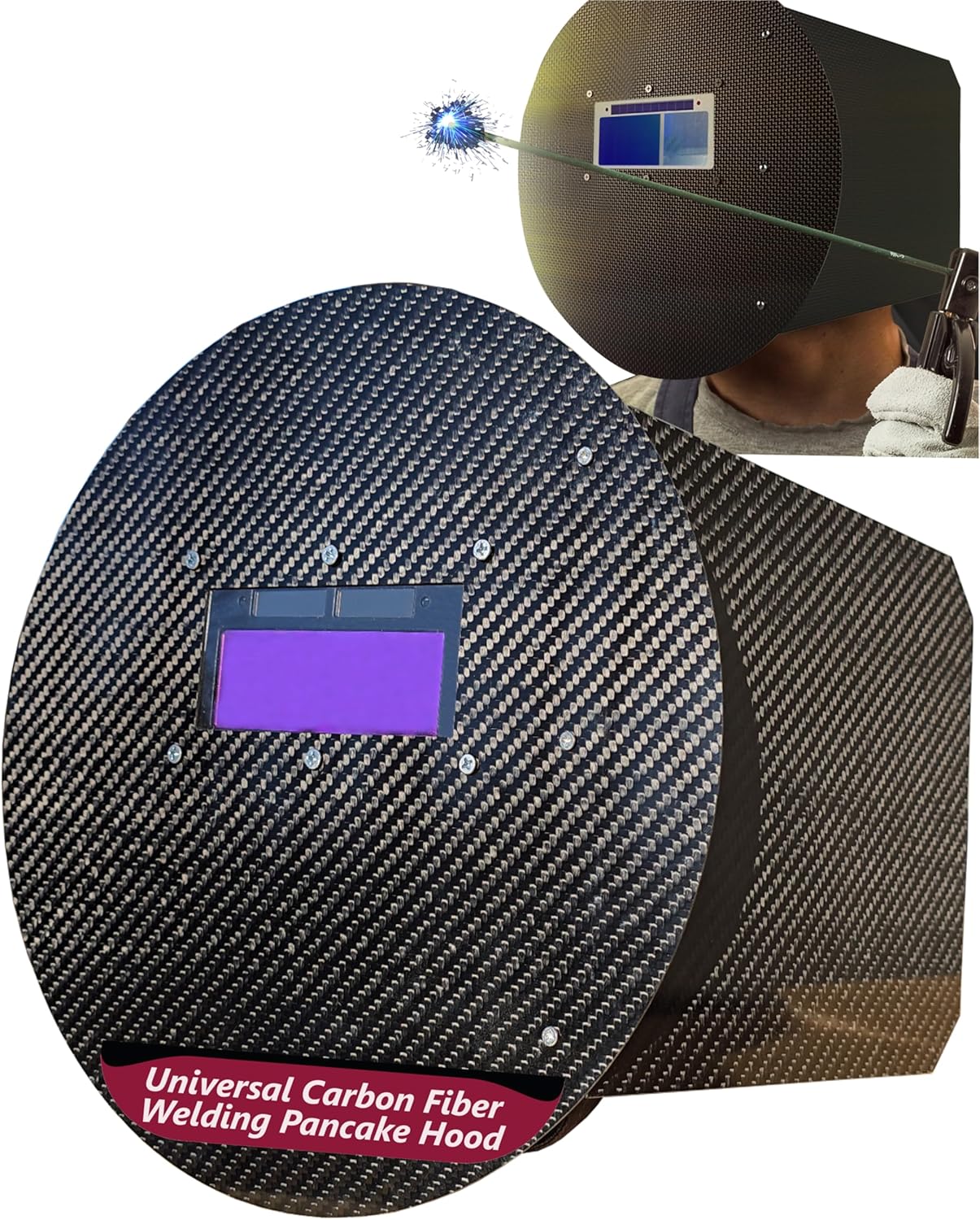
The SturdyShape carbon-fiber pancake hood is aimed squarely at welders who put a premium on weight. The listed model weighs about 10 ounces and is designed to work for either hand orientation, making it particularly interesting for long field shifts.
Current Amazon-market listings describe the hood as a carbon-fiber pancake design for pipeline welders, with a very low weight and a customizable fit.
Why we like it
- Extremely low listed weight.
- Right- or left-hand use.
- Carbon-fiber construction targets strength without adding bulk.
- Strong option for welders who already know they prefer pancake hoods.
- Only about 10 oz
- Very low-profile
- Universal hand orientation
- Good for long field shifts
- Lens is sold separately
- More expensive than traditional pancake hoods
- Specialist design rather than an all-purpose helmet
Amazon ASIN: B0C3B86MVT
Pipeline Welding Helmet vs. Regular Welding Helmet
A conventional auto-darkening helmet is usually the better choice for a general fabrication shop. Pipeline helmets solve a different problem: access and positioning around pipe.
| Feature | Pipeline Hood | Standard Shop Helmet |
|---|---|---|
| Profile | Low and compact | Usually taller/larger |
| Tight pipe work | Excellent | Can be awkward |
| Viewing area | Often smaller | Often much larger |
| Outdoor backlight | Pancake designs can excel | Depends heavily on lens and fit |
| Auto-darkening | Optional depending on model | Very common |
| General fabrication | Usually less versatile | Usually better |
How to Choose a Pipeline Welding Helmet
1. Start with the pipe and position
If you regularly weld small-diameter pipe, tie-ins, or joints where a large hood hits the work, a compact pipeliner or pancake design can be a major advantage.
2. Decide between passive and auto-darkening
Passive hoods are simple and have fewer components that can fail. Auto-darkening lenses are faster to use when you frequently move between setup, welding, inspection, and grinding. Neither is automatically better for every pipeline welder.
3. Pay attention to lens compatibility
Many traditional pipeline hoods use standardized 2 × 4¼-inch lens formats. That gives you the ability to change lens technology without replacing the entire hood. Always verify the exact lens dimensions and retention system before buying.
4. Fit matters more than people think
A pipeline helmet may sit closer to the face and can feel very different from a conventional shop hood. If you use safety glasses, cheater lenses, or respiratory protection, make sure the helmet and headgear provide enough room for your actual setup.
5. Outdoor welding changes the equation
Sunlight can make a weld pool harder to see. This is one reason pancake hoods remain popular among field welders. If most of your work is indoors, however, the benefits may be less important than a larger optical window and adjustable ADF.
Who Should Buy a Pipeline Welding Helmet?
- Pipeline and pipe welders working in tight positions.
- Field welders who need a compact hood.
- Welders who regularly work around pipe where a tall helmet gets in the way.
- Outdoor welders who benefit from the close-fitting design of a pancake hood.
- Professionals who prefer specialized gear for a specific welding environment.
Who Should Not Buy One?
- Someone who mainly welds flat work on a fabrication table.
- A beginner who wants one helmet for every possible application.
- Someone who needs a very large viewing area above all else.
- Welders who frequently switch between welding, grinding, plasma cutting, and inspection and would benefit from a versatile multi-process ADF helmet.
FAQs
Are pipeline welding helmets better than regular welding helmets?
Not generally. They are better suited to pipeline work because their compact profiles make it easier to access pipe joints and awkward positions. A standard auto-darkening helmet can be the better all-purpose choice for shop fabrication.
Is a pancake welding hood good for pipeline welding?
Yes, particularly for outdoor pipeline work and situations where a close-fitting hood helps reduce surrounding light. Pancake hoods are specialist equipment, so they are not the best universal helmet for every welder.
Do pipeline welding helmets use auto-darkening lenses?
Some do. Traditional pipeline hoods often use passive 2 × 4¼-inch lenses, while modern products such as the Tefuawe PL-4×5 offer auto-darkening configurations.
What lens size is common in a pipeline welding hood?
The 2 × 4¼-inch format is common in traditional pipeliner and pancake-style hoods. Always confirm the exact dimensions of the helmet and lens before ordering a replacement filter.
Can I use a pipeline helmet for MIG or TIG welding?
Yes, provided the lens configuration and shade are appropriate for the process. However, the compact viewing area of traditional pipeline hoods may be less convenient for general MIG or TIG fabrication than a modern large-view auto-darkening helmet.
Final Verdict
For most professional pipe welders, the Fibre-Metal Pipeliner 110WH is the safest starting point because it is purpose-built, compact, durable, and fitted with ratcheting headgear. The Jackson PL280 is a compelling alternative if you want a flip-front design, while Sarge’s Pancake is the specialist choice for outdoor field work and backlight control.
If you specifically want modern auto-darkening convenience without giving up a pipeline-oriented design, the Tefuawe PL-4×5 is the standout option in this lineup. And if minimizing helmet weight is your number-one priority, the SturdyShape carbon-fiber pancake deserves a serious look.
Related WeldHive Guides
- Best Welding Helmets for Visibility
- Wide-View Welding Helmets
- Best Lightweight Welding Helmets
- How to Choose a Welding Helmet