
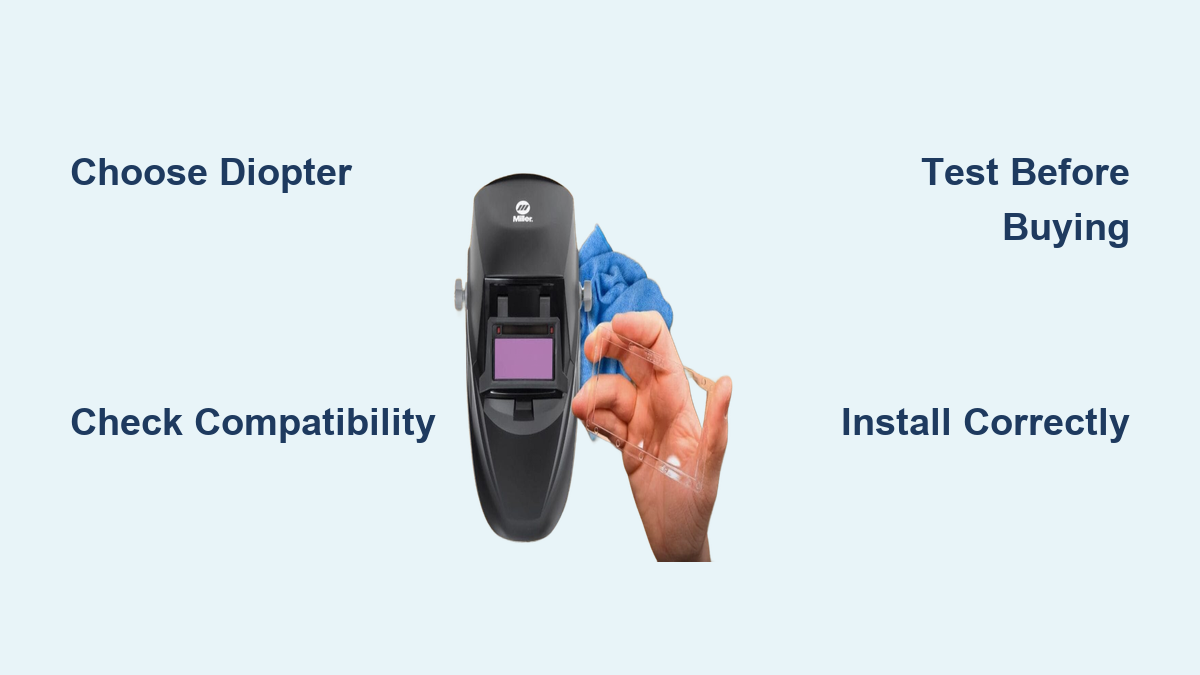
If your TIG welds are inconsistent, your filler rod keeps sticking, or you find yourself leaning in too close just to see the puddle, poor near vision might be the culprit. For welders over 40, presbyopia—the age-related loss of close-up focus—is a common but often overlooked issue. A welding helmet with cheater lens offers a simple, affordable fix. These magnifying inserts fit inside your helmet, bringing the weld zone into sharp focus without the hassle of reading glasses that fog, slip, or misalign. Whether you’re working on intricate stainless steel joints or precision aluminum welds, a cheater lens restores clarity, control, and confidence. This guide covers how to choose the right magnification, install it correctly, ensure compatibility, and avoid common pitfalls—so you can weld with precision and comfort.
Choose the Right Magnification for Your Working Distance

Use the Diopter Formula for Accurate Focus
The key to effective magnification is matching the lens strength—measured in diopters (D)—to your natural welding distance. Most TIG welders work between 12 and 18 inches from the arc. To find the ideal diopter, use this simple formula:
Diopter (D) = 1 / Distance in meters.
For example:
– 0.5 meters (19.7 inches) → +2.00 D
– 0.67 meters (26.4 inches) → +1.50 D
A +2.00 D lens is the most popular choice, perfectly suited for standard TIG distances. If you weld closer than 12 inches—common in tight joints or micro-welding—a +2.25 or +2.50 D lens may be better. For longer-range MIG or stick welding, +1.00 to +1.75 D is often sufficient. Choose too strong a lens, and you’ll be forced unnaturally close, risking neck strain and blurred vision.
Test with Drugstore Readers Before Buying
Don’t guess your ideal strength. Buy inexpensive reading glasses (between +1.50 and +2.50 D) and simulate welding under bright light. Hold a welding torch or similar tool at your typical distance and test each power. The one that gives you crisp, strain-free vision is your target diopter. One experienced TIG welder noted: “I use 2.0 power—it’s perfect for my 1.75 to 2.0 range.” This low-cost test saves money and prevents frustration.
Match Lens Strength to Your Welding Process
| Welding Type | Ideal Magnification | Why |
|---|---|---|
| TIG | +1.75 to +2.50 D | Requires extreme close-up detail of puddle, filler, and joint |
| MIG | +1.00 to +1.75 D | Moderate working distance, less fine control needed |
| Stick | +1.00 to +1.50 D | Longer arc, less reliance on magnification |
| Precision Fabrication | +2.00 to +2.50 D | Micro-joints, thin materials, tight tolerances |
Avoid over-magnifying. A lens that’s too strong narrows your focal range and can cause eye fatigue or dizziness.
Install Your Cheater Lens for Maximum Flexibility
Follow These Installation Steps
- Open the helmet’s interior compartment—usually behind the auto-darkening filter.
- Remove the inside cover lens if present.
- Slide the cheater lens into the slot, typically above or below the main viewing area.
- Ensure it’s flush and secure, with no gaps or wobble.
- Reassemble and test with a mock weld to confirm clarity and alignment.
Some welders install the lens on top of the viewing window, allowing them to look up through the magnifier during TIG welding and down through the unmagnified area for grinding or fit-up.
Position for Multi-Task Efficiency
For welders switching between TIG and grinding, consider offset mounting. Place the cheater lens in the upper third of the viewing area. This lets you:
– Look through it when welding
– Use the lower, unmagnified zone for chipping or grinding
– Avoid tilting your head or removing glasses
Ensure the lens stays fixed—shifting during use defeats the purpose and can cause visual distortion.
Confirm Compatibility Before You Buy

Lincoln Electric KP3046 Series
Lincoln’s KP3046 cheater lenses fit a wide range of models:
– Compatible: VIKING™ 750S, 1740, 1840, 2450, 3350, 700G series
– Powers: +1.00 to +2.50 D
– Part Numbers: KP3046-100 (+1.00 D), KP3046-200 (+2.00 D), etc.
– Price: $9.51–$10.00
– Warranty: 30-day limited
These lenses also fit many non-Lincoln helmets, making them a versatile, trusted option.
Harris 2″ x 4.25″ Lenses
Harris offers affordable, reliable lenses:
– Available: +1.25, +1.50, +1.75, +2.00, +2.50 D
– Price: $5.95–$7.00
– Best Value: +2.00 D at $7.00
Note: +1.50 D is often out of stock—order early if needed.
YesWelder FDJ-L Series
YesWelder provides larger lenses for wider visibility:
– Sizes: 2″ x 4.25″, 3.54″ x 4.25″
– Magnification: +2.0 D, +2.5 D
– Price: $16.00 for +2.5 D (includes 2 lenses)
– Compatible With: Q800D, M800H, 17800F, 22800F
– Not Compatible: W700A, 900B, 1980GK, 28800G
The larger 3.54″ width improves field of view—ideal for wide-window helmets.
Jackson and Metal Man Helmets
- Jackson Safety: No official cheater lenses, but third-party models (like Lincoln’s) often fit Truesight and Nexgen helmets.
- Metal Man: No dedicated magnifiers, but MLK725 and MLK735i kits can be modified.
Always measure internal space before purchasing—some helmets have tight lens cavities.
Maximize Safety, Precision, and Comfort
Improve TIG Welding Accuracy
TIG demands pinpoint control of the arc, filler rod, and puddle. A +2.00 D cheater lens brings all three into focus. You’ll see:
– Filler rod tip position clearly
– Puddle fluidity and wetting action
– Joint alignment without leaning in
This leads to smoother beads, fewer restarts, and higher-quality welds—especially on thin or reflective materials like aluminum.
Adapt to Material and Arc Brightness
- Mild Steel (DCEN): Dimmer arc, harder to see puddle. Magnification is critical.
- Aluminum (AC): Brighter arc, easier visibility—but fine detail still needs magnification for consistent bead profile.
Even with a bright arc, a cheater lens improves depth perception, helping maintain consistent torch angle and travel speed.
Prevent Eye Fatigue and Dizziness
Some users report dizziness or eye strain. This usually means:
– The diopter is too strong or weak
– Working distance doesn’t match lens focal length
– Lens is improperly positioned
If discomfort occurs, retest with reading glasses and adjust your distance. A mismatched lens forces your eyes to overwork, leading to fatigue.
Avoid These Common Mistakes
Don’t Ignore Fit and Alignment
A poorly seated lens can:
– Shift during use
– Create blind spots
– Distort vision
Always ensure it’s fully inserted and flush. Test head movement and neck rotation before welding.
Don’t Use for Multi-Distance Tasks
Cheater lenses have a narrow focal range. If you frequently switch between close welding and distant grinding, consider:
– Progressive safety glasses
– Dual-lens helmets
– Offset mounting
Using a +2.50 D lens for grinding will blur your vision and increase accident risk.
Don’t Skip the Test Phase
Never buy blind. Test with $5 reading glasses first. As one user warned: “They’re more of a pain in the ass… if it’s not the right distance, it’s blurry and makes me dizzy.” Proper testing avoids wasted money and frustration.
Compare Top Cheater Lens Options
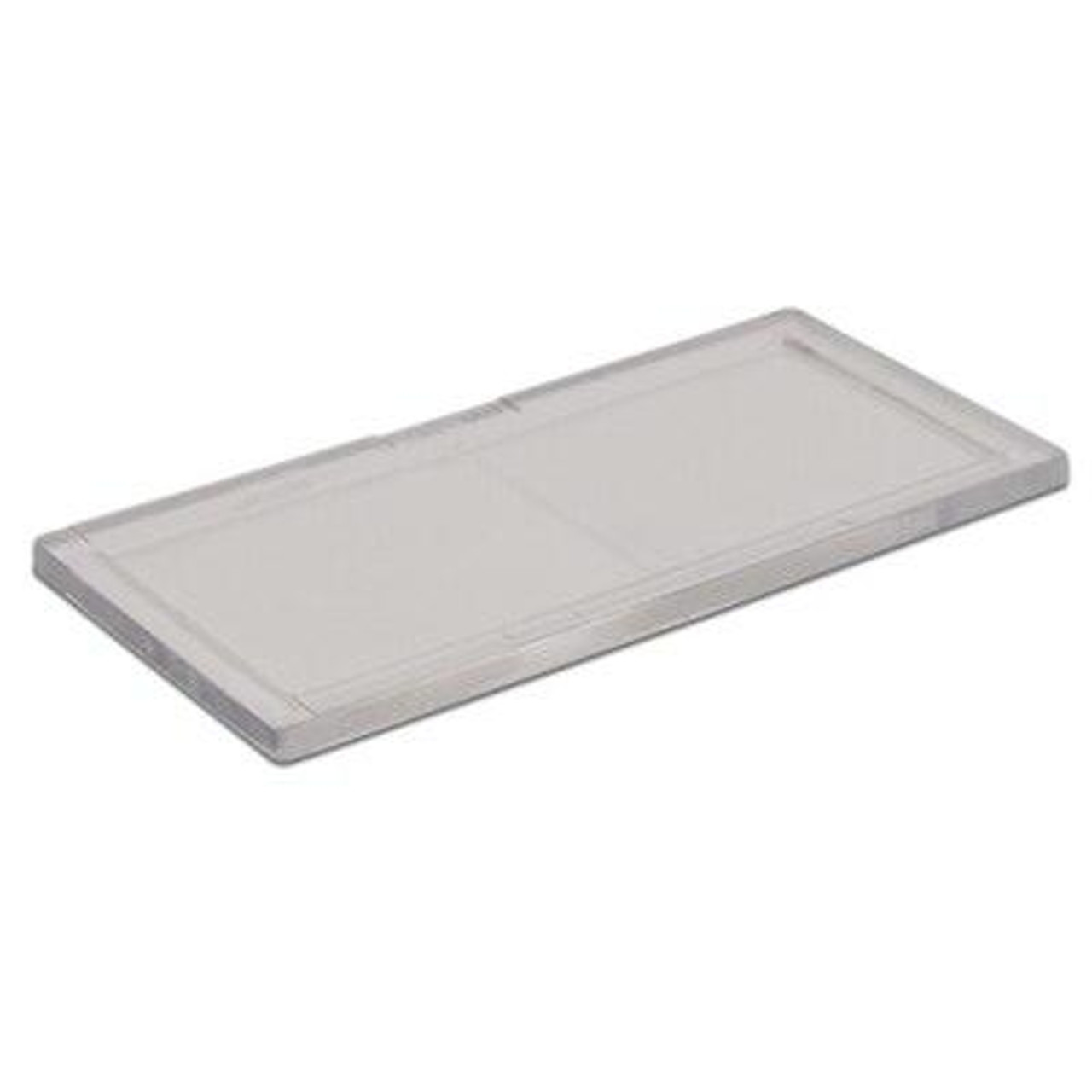
Budget Pick: Harris +2.00 D
- Price: $7.00
- Size: 2″ x 4.25″
- Best For: First-time users, cost-conscious welders
Precision Pick: YesWelder FDJ-L-2-5
- Price: $16.00
- Magnification: +2.50 D
- Size: 3.54″ x 4.25″
- Best For: TIG specialists, micro-welding
Industrial Pick: Lincoln KP3046-200
- Price: $10.00
- Compatibility: Broad across brands
- Warranty: 30-day
- Best For: Shops, field welders
Best Value Overall: Harris or Lincoln +2.00 D
Choose Harris for savings, Lincoln for reliability and warranty.
Maintain and Replace as Needed
Inspect Before Every Use
Check for:
– Scratches that distort vision
– Cracks that compromise safety
– Loose fit that affects alignment
Replace immediately if damaged.
Clean Safely
Use a microfiber cloth and lens-safe cleaner. Avoid:
– Abrasive wipes
– Alcohol-based solutions
– Excessive pressure
Store in a protective case when not in use.
Understand Prop 65 Warning
Most polycarbonate lenses carry a California Prop 65 warning:
WARNING: This product can expose you to chemicals known to cause cancer and reproductive harm.
This relates to manufacturing chemicals, not normal use. Risk is minimal—wash hands after handling.
When Cheater Lenses Aren’t Enough
Consider Prescription Safety Glasses
If you already wear prescription lenses, custom safety glasses with built-in magnification may be better. They correct both distance and near vision and fit securely under any helmet.
Try Progressive or Bifocal Inserts
Some welders use industrial progressive inserts for seamless vision at multiple distances. They’re pricier but growing in availability.
Stick with Reading Glasses (Cautiously)
Some prefer drugstore readers for easy swapping. But watch for:
– Slippage when lowering the helmet
– Fogging under the shield
– Misalignment requiring head tilting
If you use them, choose non-slip nose pads and anti-fog coating.
Final Tips for Success
- Start with +2.00 D—it’s the sweet spot for most TIG work.
- Buy two strengths if unsure—test both on the job.
- Use a headband light for better pre-weld visibility.
- Pair with a helmet light to eliminate shadows.
YesWelder’s FDJ-L series has 41 reviews:
– 95% positive: Users praise clarity and comfort
– 5% neutral: Some mention lack of instructions
One user said: “Able to weld without my reading glasses. These are great. Wish I’d found them sooner.”
A welding helmet with cheater lens is more than a vision aid—it’s a productivity and safety upgrade. By improving focus, reducing eye strain, and enhancing control, it helps you produce better welds with less fatigue.
Whether you’re a hobbyist or pro, investing $6–$16 in a cheater lens could be the easiest upgrade you’ll ever make. Test your magnification, confirm compatibility, and install it right—then see your work in a whole new light.