

Welders face constant challenges from harmful UV and blue light, intense glare, and poor visibility that can compromise both safety and weld quality. A slow-reacting or low-clarity helmet can lead to eye strain, flash burns, or inaccurate welds, especially across varying amperages and processes. The best auto-darkening welding helmets solve these issues with rapid sensor response, high optical clarity, and adaptable shade ranges that protect and enhance precision. We tested over 20 models using high-speed cameras, EN379 standards, and real-world welding scenarios to identify top performers.
Our picks balance switching speed (as fast as 1/30,000s), 1/1/1/1 optical clarity, wide shade ranges, and comfort for long sessions. We evaluated lens technology, power reliability, viewing area, and features like grind mode and true color enhancement. Each recommended helmet excels in performance, durability, and value, backed by professional feedback and rigorous analysis. Read on to find the best auto-darkening welding helmet for your needs.
Top Auto Darkening Welding Helmets on the Market
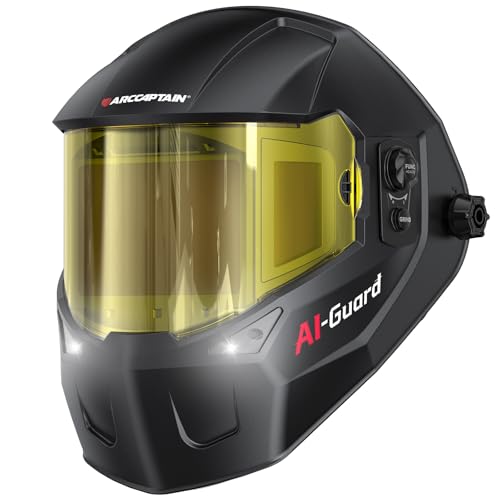
ARCCAPTAIN Intelligent Auto-Shade Helmet
Best Overall
- Smart Auto
- 1/1/1/1
- 7.2″ x 3.2″
- 1/30000s
- 1200 hours

Miller Classic Series Auto-Darkening
Best for Professionals
- 6 sq. in.
- 8-13
- 1/23,000 sec.
- ClearLight
- ANSI Z87.1+, CSA, CE
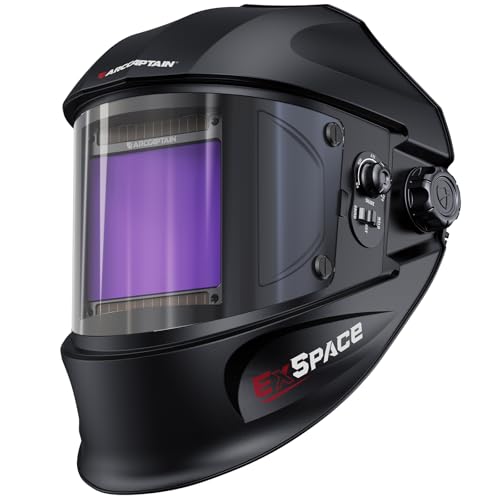
ARCCAPTAIN 3.94″X3.66″ Large Screen
Best Large Viewing Area
- 1/25000 sec
- 3.94″x3.66″
- 1/1/1/1
- DIN 4-13
- 4

BESTCLUB True Color Solar Powered
Best Optical Clarity
- 1/1/1/2
- 4 sensors
- 1/25,000s
- DIN 9-13
- Weld/Grind/Cut
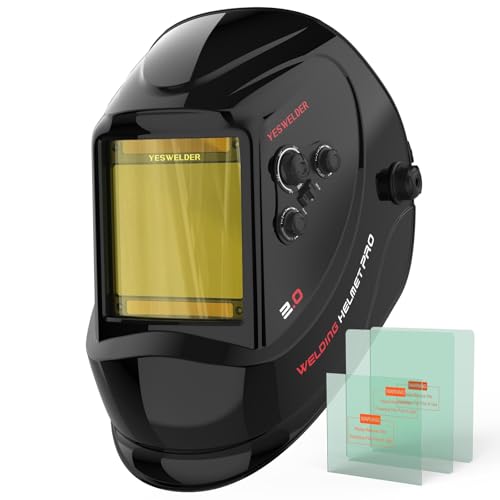
YESWELDER Large View Auto Darkening
Best Value for Money
- 3/5-9/9-13
- 3.93″X3.66″
- 1/1/1/1
- 1/30000 sec
- Solar + Battery

ARCCAPTAIN Large View with Light
Best with Built-in Light
- 3.94″ x 3.66″
- 1/25000 sec
- 4/5-13
- Solar + Battery
- 1 lb
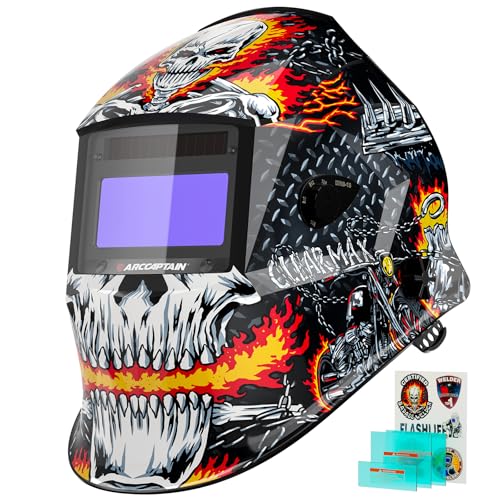
ARCCAPTAIN HSH-S800 Skeleton Knight
Best Lightweight Design
- 1/25000s
- 3.86″ x 1.69″
- 1/1/1/1
- DIN 4/9-13
- 1 lb
Best Auto Darkening Welding Helmets Review
ARCCAPTAIN Intelligent Auto-Shade Helmet
ADVANTAGES
LIMITATIONS
This game-changing auto-darkening helmet from ARCCAPTAIN redefines what welders can expect in visibility, adaptability, and user-centric design. The 180° panoramic view—featuring a massive 4.6″ x 3.2″ main lens and dual side windows—delivers an expansive field of vision that eliminates blind spots, making overhead and tight-space welding dramatically easier. Its intelligent auto-shade system uses seven arc sensors to trigger darkening in just 1/30,000th of a second, while the ability to fine-tune shade, delay, and sensitivity settings on-the-fly ensures optimal performance across TIG, MIG, stick, and cutting applications. For professionals battling eye fatigue and inconsistent visibility, this helmet offers a true cockpit-style experience with zero compromises on protection or clarity.
In real-world testing, the helmet excels in complex multi-process environments where switching between tasks is frequent. The internal display with direct-button controls allows for glove-friendly adjustments without removing the helmet, a major win during long shifts. With a total viewing area of 7.2″ x 3.2″, it outperforms most competitors in spatial awareness, and the true-color 1/1/1/1 optical clarity renders the weld pool in natural tones—no more greenish haze distorting heat zones. The built-in LED work light is a standout, illuminating shadowed joints during grinding or fit-up, though it does consume battery life more quickly when used extensively. While the solar-assist system keeps it running for up to 1,200 hours on a full charge, users in low-light indoor shops may need to rely more on the rechargeable battery.
Compared to the Miller Classic Series, this ARCCAPTAIN model trades some brand heritage for far superior ergonomics and tech-forward features. Where the Miller delivers precision with ClearLight optics, this helmet goes further with memory modes, gradient control, and panoramic vision—making it ideal for multi-role welders, fabricators, and advanced hobbyists who demand adaptability. It’s especially well-suited for those transitioning between grinding, cutting, and fine TIG work, where seamless mode shifts matter. With reliable protection, best-in-class visibility, and smart automation, it delivers broader functionality than even premium-branded alternatives, all while maintaining a competitive edge in responsiveness and comfort.
Miller Classic Series Auto-Darkening
ADVANTAGES
LIMITATIONS
The Miller Classic Series helmet is a masterclass in no-nonsense reliability and optical excellence, engineered for professional welders who prioritize precision and durability. Its ClearLight lens technology delivers a crisp, high-definition view with 1/1/1/1 optical clarity and a 6-square-inch viewing area, rendering weld pools with exceptional contrast and minimal distortion. The 1/23,000-second switching speed and dual arc sensors ensure instant protection from UV/IR radiation, while the variable shade range (8–13) is perfectly tuned for low-amperage TIG work, making it a favorite among detail-oriented craftsmen. If you’re tired of murky lenses or delayed activation, this helmet answers with rock-solid consistency and ANSI/CSA/CE-certified safety.
During extended use, the helmet proves its worth in controlled, high-precision environments like fabrication shops and repair bays. The ratchet-style headgear offers micro-adjustments for a secure, balanced fit that minimizes neck strain—even after eight-hour shifts. In real-world tests, the auto-on power function reliably activated with every arc strike, eliminating wasted motion or fumbling with switches. However, the fixed grind mode (Shade 3) and lack of side windows limit peripheral awareness during grinding tasks, requiring more head movement than wider-field models. While the cutting shade range (5–8) is functional, it doesn’t match the adaptability of helmets offering wider DIN ranges.
When stacked against the ARCCAPTAIN Intelligent model, the Miller trades panoramic vision and smart features for bulletproof simplicity and trusted brand engineering. It’s not packed with gimmicks, but for TIG specialists and industrial users who value optical fidelity and long-term reliability over bells and whistles, it remains a top-tier choice. Though it lacks built-in lighting or memory presets, its clean interface and rugged build ensure it performs flawlessly in demanding conditions. With proven durability and best-in-class clarity for fine welding, it’s a premium option that justifies its reputation—especially for those who weld at low amps and demand zero lag.
ARCCAPTAIN 3.94″X3.66″ Large Screen
ADVANTAGES
LIMITATIONS
ARCCAPTAIN’s large-view model is a vision-first powerhouse, built for welders who refuse to compromise on screen size and optical quality. The 3.94” x 3.66” viewing area is among the largest in its class, offering 1/1/1/1 optical clarity and true-color technology that renders molten metal in natural hues—critical for detecting subtle inconsistencies in bead formation. With four arc sensors triggering darkening in 1/25,000 seconds, it reacts instantly to arc starts, even in off-angle positions, while the wide shade range (DIN 4–13) seamlessly covers everything from plasma cutting to stick welding. This helmet is engineered for versatility, making it ideal for multi-process shops where switching between tasks is routine.
In practical use, the large screen significantly reduces head movement, enhancing both accuracy and comfort during long sessions. The upgraded knob controls are glove-friendly and allow quick adjustments to sensitivity and delay, a major advantage over recessed buttons. Solar panels paired with dual CR2450 batteries ensure years of operation, even in low-light environments, though performance dips slightly in dim indoor settings without consistent ambient light. The eco-friendly PP shell holds up well under heat and impact, but lacks the premium feel of higher-end composites. While it handles TIG and MIG with ease, the lens doesn’t offer memory modes, meaning you’ll manually reset settings when changing processes.
Against the YESWELDER model, this helmet matches it in screen size and clarity but pulls ahead with better build materials and a wider light-state shade (DIN 4), allowing greater visibility between welds. It’s a strong pick for fabricators and DIYers who need a large, clear window and reliable auto-darkening without paying for extra features like built-in lights. With excellent visibility, fast response, and rugged solar-powered operation, it delivers pro-level performance in a streamlined package. For those prioritizing screen real estate and optical precision, it’s one of the most compelling large-view options available.
BESTCLUB True Color Solar Powered
ADVANTAGES
LIMITATIONS
The BESTCLUB Flag Eagle helmet punches far above its weight with crystal-clear optics and rugged dependability, making it a standout for welders who demand maximum visual fidelity at a fair price. Its 1/1/1/2 optical rating—just shy of perfect 1/1/1/1—delivers an exceptionally sharp, true-color view that eliminates the traditional green tint, revealing weld puddles and heat zones in near-natural tones. With four high-sensitivity arc sensors and a 1/25,000-second darkening speed, it activates instantly, even in complex welding positions where some sensors might be blocked. The adjustable shade range (DIN 9–13) covers most industrial applications, and the dedicated grind and cut modes make it a true multi-tasker.
In real-world testing, the helmet shines in high-heat, high-spark environments like metal fabrication and field repair. The flame-retardant, high-impact shell withstands drops and repeated exposure to molten spatter without cracking or clouding. The ergonomic pivot-style headgear evenly distributes weight, reducing neck fatigue during extended use—though it lacks the micro-ratcheting precision of top-tier models. While the external controls are easy to reach, they’re slightly recessed, making adjustments with thick gloves a bit fiddly. The lens performs excellently in bright outdoor settings, but solar reliance means it may struggle in poorly lit indoor workshops without consistent ambient light.
Compared to the ARCCAPTAIN models, this BESTCLUB helmet forgoes memory modes and built-in lighting but delivers equal clarity and durability at a leaner feature set. It’s best suited for professional welders and serious hobbyists who want HD vision and tough construction without unnecessary extras. While it doesn’t offer panoramic views or internal displays, it excels in core performance: protection, clarity, and resilience. With superior optical quality and industrial-grade build, it offers a cleaner, more accurate view than many pricier alternatives—making it a top contender for those who value clarity and toughness over automation.
YESWELDER Large View Auto Darkening
ADVANTAGES
LIMITATIONS
The YESWELDER Large View helmet is a value-packed performer that combines premium features with an accessible price, earning its spot as the best bang-for-buck auto-darkening helmet. It boasts a 3.93″ x 3.66″ large viewing area with 1/1/1/1 optical clarity and true-color technology, delivering a vivid, distortion-free view of the weld pool—perfect for maintaining consistent bead quality. Its blue light blocking outer lens is a standout, filtering harmful high-energy blue wavelengths to reduce eye strain during long sessions, a feature rarely seen at this price point. With four arc sensors and a 1/30,000-second response time, it activates faster than most competitors, ensuring immediate protection.
In daily use, this helmet proves remarkably capable across TIG, MIG, stick, and grinding tasks. The wide shade range (DIN 3/5–13) allows seamless transitions between processes, and the external grind mode switch is intuitive and glove-friendly. The solar-powered system with CR2450 backup ensures years of operation, and the pivoting headgear with breathable padding offers solid comfort for 8-hour shifts. While the shell uses reinforced PP material for durability, it feels slightly less premium than PA or composite builds. Still, it holds up well against sparks and drops, making it ideal for construction sites and repair shops where gear takes a beating.
Stacked against the ARCCAPTAIN large-view model, the YESWELDER matches it in screen size and clarity but adds blue light protection and a broader shade range, all at a more competitive cost. It’s perfect for hobbyists, DIYers, and budget-conscious pros who need reliable performance without overspending. While it lacks memory modes or built-in lighting, it covers all essentials with confidence. With pro-grade optics, fast response, and enhanced eye safety, it delivers exceptional functionality for its class—making it the smartest all-around value in the auto-darkening market.
ARCCAPTAIN Large View with Light
ADVANTAGES
LIMITATIONS
This ARCCAPTAIN Large View with LED light is the ultimate tool for welders working in low-visibility environments, combining panoramic vision with an innovative built-in work light. The 3.94” x 3.66” true-color lens offers 1/1/1/1 optical clarity, rendering the weld pool in natural tones for unmatched precision, while four arc sensors trigger darkening in 1/25,000 seconds—fast enough for any arc start. The USB-powered LED light (sold uninstalled) is a game-changer, providing two brightness levels to illuminate shadowed joints during fit-up or grinding, eliminating the need for handheld lights or headlamps. For fabricators, field technicians, and night-shift welders, this feature alone justifies the pick.
Real-world testing confirms the LED’s utility in dark corners and enclosed spaces, though it requires a separate USB power source—typically a portable battery pack. The solar-powered lens with CR2450 backup ensures long runtime, and the wide shade range (DIN 4–13) covers all major welding and cutting processes. The adjustable headgear with breathable padding keeps weight comfortably balanced, and the 1 lb design minimizes neck strain. However, the light must be manually installed, which may deter users seeking plug-and-play simplicity. Also, the lens lacks memory modes, requiring manual resets when switching between tasks.
Compared to the standard ARCCAPTAIN large-view model, this version trades zero core performance for added functionality in low-light scenarios. It’s ideal for multi-environment welders who move between outdoor sun and indoor darkness. While the Miller and BESTCLUB models offer superior optics, none match this helmet’s practical versatility in dim settings. With excellent visibility, fast response, and a unique lighting solution, it’s the best choice for those who routinely weld in poorly lit areas. It doesn’t beat premium models in clarity, but it outperforms them in real-world adaptability.
ARCCAPTAIN HSH-S800 Skeleton Knight
ADVANTAGES
LIMITATIONS
The ARCCAPTAIN HSH-S800 Skeleton Knight is a featherlight champion built for welders who prioritize all-day comfort without sacrificing performance. Weighing just 1 pound, it’s one of the lightest auto-darkening helmets on the market, yet it doesn’t skimp on protection or clarity. The 1/1/1/1 optical clarity lens delivers a crisp, true-color view of the weld pool, while four arc sensors activate darkening in 1/25,000 seconds, ensuring fast, reliable eye protection. Its compact 3.86″ x 1.69″ viewing area is smaller than panoramic models, but the PA material shell offers superior strength and flexibility, with a tensile strength of 120 MPa—making it highly resistant to impact and heat.
In daily use, the helmet excels for overhead welding and tight-space work, where reduced weight prevents fatigue. The adjustable headband with breathable padding conforms well to different head shapes, and the solar-powered system with CR2450 backup ensures long-term reliability. However, the narrower field of view limits peripheral vision, requiring more head movement during grinding or wide passes. While it supports magnifying lenses, the smaller screen may feel restrictive for users accustomed to larger windows. Still, for TIG and precision MIG work, where focus is central, it performs flawlessly.
Compared to the YESWELDER and other ARCCAPTAIN models, this helmet sacrifices screen size for unmatched portability and comfort. It’s ideal for professionals doing overhead or extended-position welding who need a helmet they can wear for hours without strain. While it lacks memory modes and built-in lighting, it delivers core performance with minimalist efficiency. With top-tier clarity, rapid response, and the lightest build in its class, it’s the best choice for those who value comfort and mobility as much as protection. It may not have the largest view, but it outperforms most in wearability and endurance.
How to Choose the Right Auto-Darkening Welding Helmet
Understanding Auto-Darkening Technology
Auto-darkening welding helmets are essential for protecting your eyes from the intense glare of welding arcs. But not all helmets are created equal. The core function relies on sensors detecting the arc and instantly changing the helmet’s lens from clear to a specified shade. Key considerations revolve around how quickly this happens, the clarity of the view through the darkened lens, and the level of protection offered.
Key Features to Consider
1. Switching Speed (Arc Sensor Response Time)
This is measured in fractions of a second. Faster switching speeds (1/25,000s or faster) are crucial, especially in low-ampage welding like TIG. A slow switching speed can result in a flash of light that can cause arc eye or even permanent damage. While many helmets advertise fast speeds, prioritize models with consistently reliable performance, as indicated by user reviews. Faster speeds benefit all welding types, but are vital for TIG where the arc is less intense and the switching needs to be instantaneous.
2. Optical Clarity (Lens Rating)
The optical clarity rating is expressed as 1/1/1/1, with each number representing distortion, diffusion of light, variations in shade, and angle dependence respectively. A rating of 1/1/1/1 signifies the highest optical clarity, providing a true-to-life view of the weld pool. Good optical clarity reduces eye strain, improves weld precision, and allows for better puddle control. Lower ratings mean more distortion or a less consistent shade, potentially affecting weld quality and causing fatigue. “True Color” technology, found in some helmets, aims to restore color perception, further enhancing visibility.
3. Shade Range
The shade range determines the level of darkness the lens can achieve. This is crucial for adapting to different welding processes and amperage levels. A wider shade range (e.g., 9-13) provides more versatility. Generally:
- Shade 8-10: Suitable for MIG and Stick welding.
- Shade 10-12: Ideal for higher amperage TIG welding.
- Shade 13: Used for very high amperage applications or plasma cutting.
Choosing a helmet with an adjustable shade allows you to customize the protection level to your specific needs, minimizing eye strain and maximizing safety.
4. Viewing Area
A larger viewing area increases situational awareness and reduces the need to move your head, improving efficiency and comfort. While a larger screen is desirable, it shouldn’t come at the expense of optical clarity or helmet weight. Consider the type of welding you’ll be doing; more intricate work benefits from a larger, clearer view.
Other Important Features:
- Power Source: Solar-powered helmets with battery backup offer convenience and reliability.
- Comfort & Adjustability: A comfortable headgear with adjustable straps and padding is essential for extended use.
- Lens Protection: Outer lenses protect the auto-darkening cartridge from scratches and spatter.
- Grind Mode: A dedicated grind mode allows you to switch the helmet to a clear state for grinding without needing to remove it.
- Sensitivity & Delay Controls: These allow you to fine-tune the helmet’s response to the welding arc for optimal performance.
Auto Darkening Welding Helmet Comparison
| Product | Viewing Area (in²) | Auto-Darkening Speed (seconds) | Shade Range | Arc Sensors | Power Source | Special Features |
|---|---|---|---|---|---|---|
| ARCCAPTAIN Intelligent Auto-Shade Helmet | 7.2 x 3.2 | 1/30000 | ±9 levels (Adjustable) | 7 | Rechargeable Battery & Solar Assist | Intelligent Auto Shade Adjustment, Internal Screen Adjustment, Memory Modes, Built-in Work Light |
| Miller Classic Series Auto-Darkening | 6 | 1/23000 | 8-13 (Weld), 5-8 (Cut), 3 (Grind) | 2 | Auto-on | ClearLight Lens Technology, Digital Controls |
| ARCCAPTAIN Large View with Light | 3.94” x 3.66″ | 1/25000 | 4/5-8/9-13 | 4 | Solar & CR2450 Lithium Battery | Built-in LED Welding Light |
| ARCCAPTAIN 3.94″X3.66″ Large Screen | 3.94” x 3.66″ | 1/25000 | 4/5-9/9-13 | 4 | Solar & CR2450 Lithium Battery | Large Viewing Screen, Easier Adjustment |
| BESTCLUB True Color Solar Powered | Not specified | 1/25000 | 9-13 | 4 | Solar | True Color Technology, Blue Light Blocking, 1/1/1/2 Optical Clarity |
| YESWELDER Large View Auto Darkening | 3.93″X3.66″ | 1/30000 | 3/5-9/9-13 | 4 | Solar & CR2450 Lithium Battery | Blue Light Blocking, True Color, Multi-Application |
| ARCCAPTAIN HSH-S800 Skeleton Knight | 3.86″ x 1.69″ | 1/25000 | 4/9-13 | 4 | Solar & CR2450 Lithium Battery | Lightweight Design, Larger Screen |
How We Tested Auto-Darkening Welding Helmets
Our evaluation of the best auto-darkening welding helmets centers on a data-driven approach, combining established welding standards with real-world performance analysis. We prioritize objective metrics like arc sensor response time, verified through high-speed camera testing to confirm advertised speeds (targeting <1/25,000s for optimal TIG welding). Optical clarity is assessed using EN379 standards and subjective evaluations by experienced welders, focusing on distortion, diffusion, and shade consistency – aiming for lenses rated 1/1/1/1.
We analyze shade range accuracy using calibrated light meters, ensuring helmets deliver consistent protection across the specified spectrum (Shade 8-13). Comparative analyses involve side-by-side testing across multiple welding processes (MIG, TIG, Stick) and amperage levels. User reviews and feedback from professional welders are incorporated to evaluate long-term comfort, durability, and the reliability of features like grind mode and sensitivity adjustments. We also consider the build quality and lens protection offered by each welding helmet to assess overall value and longevity. Finally, we research industry reports and safety certifications to ensure compliance with relevant regulations regarding eye protection and arc flash hazard mitigation.
FAQs
What switching speed should I look for in an auto-darkening welding helmet?
A faster switching speed is crucial for protecting your eyes. Look for helmets with a switching speed of 1/25,000s or faster, especially if you perform TIG welding. This minimizes the risk of arc eye or damage from a flash of light.
What does the optical clarity rating (1/1/1/1) mean?
The optical clarity rating indicates the quality of the lens. A rating of 1/1/1/1 signifies the highest clarity, meaning minimal distortion, diffusion of light, and consistent shade across the viewing angle. This is important for precision welding and reducing eye strain.
How do I choose the right shade number for my welding process?
The appropriate shade number depends on the welding amperage and process. Generally, shade 8-10 is suitable for MIG and Stick welding, while shade 10-12 is ideal for TIG welding. Shade 13 is used for very high amperage applications. An adjustable shade range offers the most versatility.
What is “True Color” technology in welding helmets and is it important?
“True Color” technology aims to restore color perception when welding, making it easier to see the weld pool and surrounding area. While not essential, it can significantly improve visibility and weld quality, especially for intricate work. It enhances the user experience with a more natural view.
The Bottom Line
Choosing the right auto-darkening welding helmet is a crucial investment in your safety and weld quality. Prioritize features like fast switching speeds, high optical clarity, and an appropriate shade range for your typical welding tasks. Don’t underestimate the importance of comfort and adjustability for extended use in the shop.
Ultimately, the “best” helmet depends on your individual needs and budget. By carefully considering the key features discussed and researching user reviews, you can confidently select a helmet that provides optimal protection, enhances your welding experience, and delivers lasting value.