
WeldHive Beginner’s Buyer Guide • 2026
Best Welding Helmets for Beginners in 2026: 5 Easy-to-Use Picks
Your first welding helmet should make learning easier—not bury you in complicated controls or push you into spending hundreds of dollars before you know what kind of welding you enjoy.
For beginners, the most useful combination is usually reliable auto-darkening, a clear viewing area, straightforward controls, comfortable headgear, and a useful shade range. A helmet that is easy to position and easy to adjust can be more valuable during your first months of practice than a long list of advanced features.
Quick Picks for Beginners
| Helmet | Best For | Why a Beginner Should Consider It |
|---|---|---|
| YESWELDER LYG-M800H | Best Overall | Large 3.93 × 3.66-in view, 1/1/1/1 optics, four sensors, simple multi-process controls |
| TOPDC 3.94-in Auto-Darkening | Best Simple Value | Straightforward controls, dual power, useful shade range and beginner-friendly operation |
| ARCCAPTAIN 3.94 × 3.66-in Large View | Best for Learning Visibility | Large vertical viewing area and 1/1/1/1 optics make positioning easier to learn |
| MIGVAN H-21 | Best Dual-Power Starter | True-color viewing, four sensors, solar + rechargeable power and broad process coverage |
| Lincoln Electric VIKING 3350 | Best Long-Term Investment | Premium optics, huge view, excellent headgear and a 5-year warranty |
1. YESWELDER LYG-M800H — Best Overall for Beginners
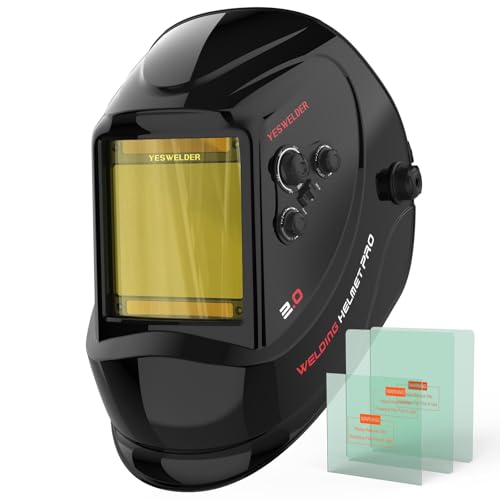
The YESWELDER LYG-M800H is the easiest recommendation for a new welder who wants useful features without jumping into premium pricing. Its 3.93 × 3.66-inch viewing area is unusually large for the price, giving a beginner more room to see the joint, torch or electrode position, and weld puddle.
YESWELDER lists 1/1/1/1 optical clarity, four arc sensors, a light-state DIN 4 setting, variable dark states from DIN 5–9 and 9–13, and weld/cut/grind use. The current manufacturer listing also specifies a response time below 1/30,000 second.
Why it is beginner-friendly
- Large viewing area makes the learning process less frustrating.
- Four sensors provide broad arc detection.
- Variable shade settings work across common welding processes.
- Solar plus replaceable-battery power reduces the chance of being caught with a dead helmet.
- Weld, cut and grind modes give a beginner room to expand.
- Excellent view for the money
- 1/1/1/1 optical clarity
- Four sensors
- Broad process coverage
- Not built like premium professional hoods
- Large shell may feel bulky on smaller users
- More features than someone doing only one simple process needs
Amazon ASIN: B07M5WKCYX • Model: LYG-M800H
2. TOPDC 3.94-in Auto-Darkening Helmet — Best Simple Value
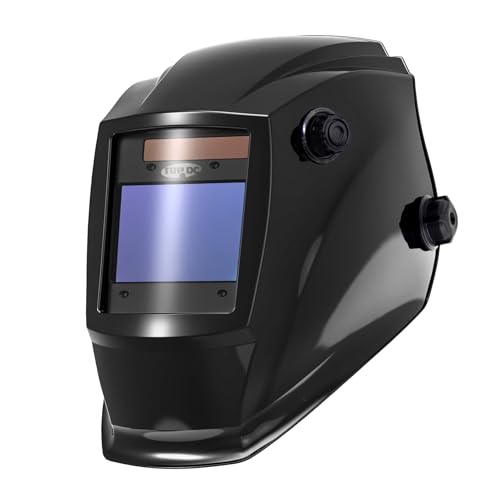
The TOPDC 3.94-inch auto-darkening helmet is a good fit for a beginner who wants the basics without paying for a complicated digital interface. Its 3.94 × 2.64-inch viewing screen, adjustable sensitivity and delay, and solar-plus-battery power cover the functions most first-time welders actually need.
The model listed by WeldHive uses a 1/1/1/2 optical classification, four arc sensors, a 1/10,000-second switching specification, and DIN 5–9/9–13 dark-state settings.
Why it is beginner-friendly
- Controls are relatively straightforward.
- Four sensors are a useful feature for someone still learning helmet positioning.
- Dual power is practical for occasional garage or shop use.
- Its smaller profile can feel less overwhelming than very large helmets.
- Simple to operate
- Four sensors
- Dual power
- Useful shade range
- Optical rating is below 1/1/1/1
- Smaller vertical viewing area
- Less refined than premium helmets
Amazon ASIN: B0FM7YJ68B
3. ARCCAPTAIN 3.94 × 3.66-in Large View — Best for Learning Visibility

Beginners often spend more time trying to find the joint and puddle than experienced welders do. That is why a large viewing area can make a real difference while learning. The ARCCAPTAIN 3.94 × 3.66-inch Large View is designed around that advantage.
The model uses a large vertical viewing area, 1/1/1/1 optical clarity, a listed 1/25,000-second switching speed, and a DIN 4–13 operating range. The WeldHive listing also identifies solar/battery power and four-to-13 shade coverage.
Why it is beginner-friendly
- Large vertical window helps new welders see more of the work.
- 1/1/1/1 optics reduce the visual distortion that can make learning harder.
- Dual power is convenient for home-shop use.
- Simple external controls are easier to understand than a complex digital menu.
- Excellent viewing area
- 1/1/1/1 optics
- Four-to-13 shade coverage
- Good visual awareness
- Basic headgear compared with premium brands
- Large front profile may not suit every user
- More helmet than a casual user may need
Amazon ASIN: B0DDJ482WW
4. MIGVAN H-21 — Best Dual-Power Starter
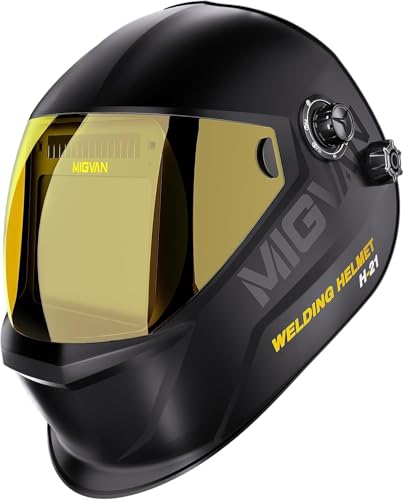
The MIGVAN H-21 is interesting for beginners who want a little more flexibility without immediately moving into premium-brand pricing. Its combination of a large viewing area, True Color lens, four sensors, and solar/rechargeable power gives a new welder a versatile starting point.
The WeldHive product data lists DIN 4/5–13, four arc sensors, solar/rechargeable power, True Color viewing, and a 1/10,000-second switching specification.
Why it is beginner-friendly
- Broad shade range gives a beginner room to try different processes.
- Four sensors are useful as you learn different welding positions.
- Rechargeable backup power is convenient for regular home-shop use.
- True Color viewing can make the puddle easier to interpret than a strongly green-tinted lens.
- Flexible power system
- True Color viewing
- Four sensors
- Broad shade range
- Headgear is less refined than premium models
- Switching speed is not class-leading
- Less established professional ecosystem
Amazon ASIN: B0DT6VGD9Y • Model family: H-21
5. Lincoln Electric VIKING 3350 — Best Long-Term Investment
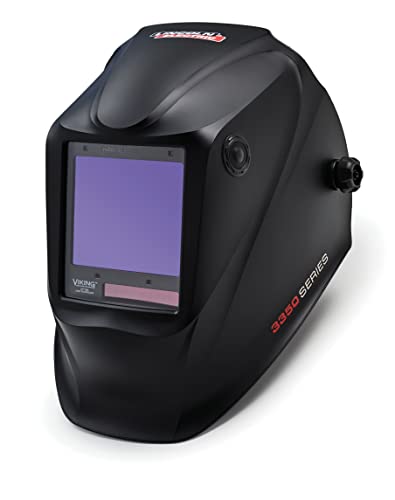
If you already know welding is going to become a serious hobby, trade, or career, it can make sense to skip the starter tier and buy a helmet you will not immediately outgrow. The Lincoln Electric VIKING 3350 is the premium choice in this guide.
The VIKING 3350 K3034-4 is listed with 1/1/1/1 optical clarity, Lincoln’s 4C lens technology, a 12.5-square-inch viewing area, X6 headgear, and a five-year warranty.
Why a beginner might justify the upgrade
- Exceptional viewing area gives plenty of room to learn.
- High optical clarity helps you see the joint and puddle clearly.
- X6 headgear is designed for extended wear.
- Five-year warranty adds long-term value.
- You are less likely to feel the need to upgrade after a few months.
- Excellent 1/1/1/1 optics
- Very large viewing area
- Excellent headgear
- Strong long-term choice
- Much more expensive than necessary for casual experimentation
- Larger and heavier than minimalist helmets
- Premium features may be wasted on occasional users
Amazon ASIN: B07V9G94NK • Model: K3034-4
What Should a Beginner Look for in a Welding Helmet?
1. Choose auto-darkening if you are learning multiple positions
A fixed-shade helmet is simple and can be perfectly useful for some applications. But for a beginner moving between setup, welding, inspection, and different positions, an auto-darkening helmet is usually easier to work with because the lens remains clear before the arc and darkens when welding begins.
2. Do not chase the fastest number on the box
A switching specification such as 1/25,000 or 1/30,000 second sounds impressive, but it should not be the only buying criterion. Viewing area, optical quality, sensor placement, headgear and correct shade selection all matter.
3. A large viewing area is genuinely useful when learning
Experienced welders can work effectively through a relatively small window because they already know how to position their head and workpiece. Beginners are still developing that skill. A larger viewing area can make it easier to see the joint and understand what the puddle is doing.
4. Keep the controls simple
For your first helmet, you normally need to understand only a few controls: shade, sensitivity and delay. Grind mode is also useful if you will grind without changing helmets. You do not need a digital screen, memory profiles or advanced automatic modes unless you actually expect to use them.
5. Fit matters more than beginners expect
A helmet that constantly slips, presses against your forehead or feels front-heavy will become annoying very quickly. Look for adjustable headgear and make sure the helmet works comfortably with the safety glasses and other PPE you actually wear.
Do Beginners Need a 1/1/1/1 Welding Helmet?
No, it is not an absolute requirement. But 1/1/1/1 optical clarity is a useful quality benchmark because it indicates the highest class in the EN 379 optical classification system. For a beginner, clearer and less distorted optics can make it easier to learn joint positioning and read the weld puddle.
Do not, however, assume that a 1/1/1/1 label makes a helmet automatically safer than every helmet with another rating. Safety certification, correct shade selection, physical coverage, fit and proper use remain essential.
What Shade Should a Beginner Use?
There is no single shade that is correct for every welding job. The appropriate shade depends on the welding process and factors such as arc current and electrode size. OSHA guidance says filter selection should be based on the operation and recommends selecting a shade dark enough for the work while staying at or above the applicable minimum protective shade.
For example, OSHA’s construction guidance lists shade 10 for certain SMAW electrode sizes and higher minimum shades for larger electrodes or higher currents. Do not copy a generic “beginner shade” number for every job—use the helmet manufacturer’s instructions and the applicable safety guidance for your process.
Do You Need Safety Glasses Under a Welding Helmet?
A welding helmet should not be treated as your only piece of eye protection. OSHA guidance describes welding helmets as protection against optical radiation, heat and impact and recommends appropriate eye protection underneath the helmet where required by the work environment.
Beginner Mistakes to Avoid
- Buying only by price: the cheapest helmet is not automatically the best starter.
- Buying only by switching speed: optics and fit matter too.
- Ignoring the viewing area: a tiny window can make learning more frustrating.
- Choosing the wrong shade: always select the correct shade for the process and current.
- Skipping the fit adjustment: take time to position the headgear correctly.
- Forgetting cover lenses: scratched or spattered covers reduce visibility.
- Assuming expensive means beginner-friendly: premium helmets can be excellent but may offer features you do not need yet.
Which Type of Beginner Are You?
| If You Are… | Our Pick | Why |
|---|---|---|
| Trying welding for the first time | TOPDC | Simple controls and enough core features without overcomplication |
| Learning MIG, TIG and Stick | YESWELDER M800H | Large view, four sensors and broad shade range |
| Struggling to see the joint | ARCCAPTAIN Large View | Large vertical viewing area |
| Welding regularly at home | MIGVAN H-21 | Flexible power and multi-process coverage |
| Planning a welding career | Lincoln VIKING 3350 | Premium optics, headgear and long-term durability |
Who Should Not Buy a Premium Welding Helmet Yet?
If you are simply testing whether welding is a hobby you will continue, spending several hundred dollars on a premium hood may not be necessary. A solid entry-level auto-darkening helmet can teach you the fundamentals first.
On the other hand, if you are enrolled in a welding program, starting an apprenticeship, or already know that you will be welding frequently, a higher-quality helmet can be a sensible long-term purchase.
FAQs
What is the best welding helmet for a beginner?
For most beginners, the YESWELDER LYG-M800H is the strongest overall starting point in this guide because it combines a very large viewing area, 1/1/1/1 optical clarity, four sensors and broad process coverage without moving into premium pricing.
Should a beginner buy an auto-darkening welding helmet?
Usually, yes—especially if you expect to learn multiple welding processes or positions. It makes setup and arc starting easier because you can see before striking the arc and the lens darkens automatically when welding begins.
Is a cheap welding helmet safe?
Price alone does not determine safety. A lower-cost helmet should still provide the required eye and face protection and meet the applicable safety standard. Check the manufacturer’s certification information instead of relying only on an Amazon listing title.
Is a large viewing area better for beginners?
Often, yes. A larger window can make it easier to see the joint, electrode or torch position, and puddle while you are still learning positioning. It is not the only factor, but it is one of the most useful beginner-friendly features.
How much should a beginner spend on a welding helmet?
There is no universal amount. If you are experimenting, a quality entry-level helmet can make sense. If you expect to weld frequently for years, spending more on better optics, headgear and durability may be more economical than replacing a starter helmet later.
Do I need a welding helmet for grinding?
If your helmet includes a grind mode, it can be useful for switching between welding and grinding. However, grinding creates flying-particle hazards, so use the appropriate eye and face protection for the grinding operation as well.
Final Verdict
The best beginner welding helmet is not necessarily the most advanced one. It is the helmet that gives you reliable protection, enough viewing area to learn, comfortable headgear and controls you can understand.
For most first-time buyers, the YESWELDER LYG-M800H is our best overall starting point. Choose the TOPDC if you want something simpler, the ARCCAPTAIN Large View if visibility is your main concern, and the MIGVAN H-21 if you want flexible power and multi-process capability.
If you already know welding is going to become a serious long-term pursuit, the Lincoln Electric VIKING 3350 is the “buy once, grow into it” option rather than a temporary starter hood.
Related WeldHive Guides
- How to Choose a Welding Helmet
- Best Welding Helmets for Visibility
- Wide-View Welding Helmets
- Solar Auto-Darkening Welding Helmets