
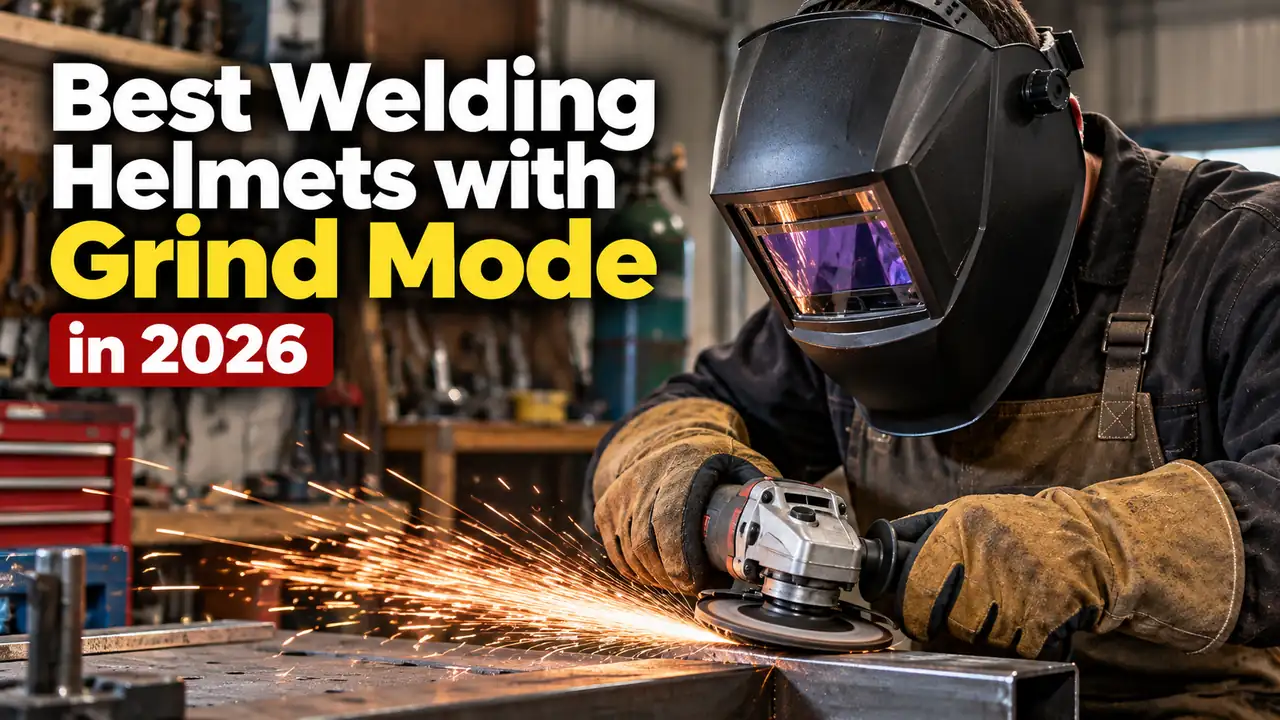
Best Welding Helmets with Grind Mode in 2026
If you weld and grind in the same workflow, a helmet with a dedicated grind mode can save you from repeatedly removing and putting on face protection. The important distinction is not simply whether a helmet has a “grind” setting, but how easily you can switch modes and whether the helmet still gives you the visibility, fit and controls you need for welding.
Quick Picks
Premium optics, very large viewing area and external grind control.
Wide viewing area, four sensors and dedicated grind mode.
Large viewing window and a feature-rich design at a lower tier.
Comparison at a Glance
| Helmet | Best for | Viewing area | Key grind feature | Amazon |
|---|---|---|---|---|
| Lincoln VIKING 3350 | Overall / professional use | 12.5 sq. in. | Low-profile external grind control | Check listing |
| Hobart Inventor 770890 | Value from an established brand | 9.3 sq. in. | Dedicated Grind mode | Check listing |
| YESWELDER LYG-M800H | Large view on a lower budget | 3.93 × 3.66 in. | Grinding application / mode | Check listing |
What Grind Mode Actually Does
In normal auto-darkening welding mode, the filter changes from its light state to a welding shade when it detects an arc. Grind mode is different: it is intended to keep the lens from darkening when you are using a grinder rather than welding.
That makes the feature useful when one job moves repeatedly between welding, grinding, fit-up and inspection. A helmet with an accessible grind control can reduce the friction of switching between those tasks. It does not, however, replace appropriate grinding protection or make a helmet suitable for every grinding situation.
Why the Control Location Matters
A grind mode that technically exists but is awkward to activate is less useful in a busy fabrication workflow. External controls can be particularly convenient when you are moving between tasks while wearing gloves. Internal controls can still work well, but they may require more deliberate handling.
Lincoln specifically highlights a low-profile external grind control on the VIKING 3350. Hobart provides a dedicated Weld/Grind mode on the Inventor 770890. YESWELDER’s LYG-M800H is designed for welding, cutting and grinding applications.
Lincoln Electric VIKING 3350 K3034-4

Why it stands out: The VIKING 3350 is the strongest all-around choice when you want premium optics, a very large viewing area and an easy way to switch between welding and grinding. Lincoln lists 4C optics, 1/1/1/1 optical clarity, a 12.5-square-inch auto-darkening viewing area and external grind control for the series.
Important specifications
| Optical clarity | 1/1/1/1 |
| Viewing area | 12.5 sq. in. |
| Lens technology | 4C Lens Technology |
| Grind control | Low-profile external grind control |
| Processes | Stick, TIG, MIG, flux-cored, gouging and grinding |
- Large 12.5 sq. in. viewing area
- 1/1/1/1 optical clarity
- External grind control
- X6 headgear is designed for balance and comfort
- Premium price tier
- May be more helmet than an occasional hobbyist needs
Amazon listing: ASIN B07V9G94NK. Verify the exact configuration before purchase.
Hobart Inventor 770890

Why it stands out: The Hobart Inventor 770890 is a sensible middle-ground option for welders who want a recognized welding brand, a wide-format viewing area and dedicated grind mode without moving into the most expensive helmet class. Hobart specifies four independent arc sensors, a 1/25,000-second reaction time and a 9.3-square-inch viewing area.
Important specifications
| Optical system | PureColor Lens Technology |
| Viewing area | 9.3 sq. in. |
| Reaction time | 1/25,000 sec |
| Arc sensors | 4 independent sensors |
| Modes | Weld and Grind |
- Dedicated grind mode
- Four independent arc sensors
- 9.3 sq. in. viewing area
- Analog shade, sensitivity and delay controls
- Smaller viewing area than the VIKING 3350
- Analog interface rather than digital controls
Amazon listing: ASIN B07MKRYWMD. Verify the exact configuration before purchase.
YESWELDER LYG-M800H

Why it stands out: The LYG-M800H targets buyers who want a large viewing window and a feature-rich helmet at a lower tier than premium professional models. YESWELDER lists a 3.93 × 3.66-inch viewing area, 1/1/1/1 optical clarity, four arc sensors and a response time below 1/30,000 second.
Important specifications
| Viewing area | 3.93 × 3.66 in. |
| Optical clarity | 1/1/1/1 |
| Response time | <1/30,000 sec |
| Arc sensors | 4 |
| Modes/applications | Weld, TIG, MIG, stick, plasma cutting and grinding |
- Large 3.93 × 3.66 in. viewing window
- 1/1/1/1 optical clarity claimed by manufacturer
- Four sensors
- Weld, cut and grind applications
- Brand/service ecosystem is different from established industrial brands
- Choose the exact Amazon configuration carefully because graphics and variants can differ
Amazon listing: ASIN B07M5WKCYX. Verify the exact configuration before purchase.
How to Choose a Welding Helmet with Grind Mode
1. Check how grind mode is activated
Look for a control you can identify quickly. If your work alternates frequently between welding and grinding, the convenience of the control matters more than simply having the words “grind mode” printed on the specification sheet.
2. Look beyond the grind feature
The helmet still needs to be suitable for your actual welding processes. Consider optical clarity, viewing area, shade range, sensor arrangement, headgear, sensitivity and delay controls, and compatibility with your normal work.
3. Consider viewing area
A larger viewing area can make joint preparation, fit-up and weld-puddle observation easier. But a larger window does not automatically make one helmet better in every other respect.
4. Consider the welding process
TIG users can be especially sensitive to lens behavior and low-amperage arc detection. MIG, stick, flux-core, gouging and other processes may place different demands on the helmet. Match the helmet’s documented capabilities to your work rather than assuming a feature-rich helmet is automatically the best fit.
5. Check the exact Amazon configuration
Welding helmets often appear in several graphics, generations or configurations. Before purchasing, confirm that the Amazon listing matches the exact model discussed here. Do not assume every graphic or variation has identical specifications.
Who Should Buy
- Welders who frequently alternate between welding and grinding.
- Fabricators who want one helmet for a mixed workflow.
- Buyers who value easy access to a grind setting.
- Users who still want to evaluate optics, viewing area and headgear rather than buying on the grind feature alone.
Who Should Not Buy
- Someone who almost never grinds and does not benefit from the extra mode.
- Someone choosing a helmet solely because it says “grind mode” while ignoring optical clarity, fit or welding-process compatibility.
- Anyone intending to use grind mode as a substitute for proper grinding eye and face protection.
Common Mistakes
- Forgetting to switch back to weld mode: always verify the operating mode before striking an arc.
- Confusing viewing area with optical quality: a bigger window does not automatically mean a clearer lens.
- Choosing by response speed alone: response time is only one specification among several.
- Ignoring headgear: a technically excellent lens is less useful if the helmet does not fit securely and comfortably.
- Assuming every variation is identical: verify the exact model and configuration on Amazon.
Frequently Asked Questions
It is a setting intended for grinding that keeps the auto-darkening lens from switching to a dark welding shade.
No. Grind mode is not a welding shade. Return the helmet to the appropriate welding mode and shade before welding.
It can be worthwhile if your workflow regularly alternates between welding and grinding. If you rarely grind, it may be a minor convenience rather than a deciding feature.
The Lincoln VIKING 3350 is particularly notable for its low-profile external grind control. The Hobart Inventor 770890 also provides a dedicated Weld/Grind mode.
It depends on your workflow. If visibility is your main problem, prioritize optics and viewing area. If you repeatedly move between welding and grinding, an accessible grind control becomes more valuable.
Final Verdict
The Lincoln Electric VIKING 3350 is the strongest overall choice if you want premium optical performance, a large viewing area and an external grind control. The Hobart Inventor 770890 is the more balanced value-oriented option for buyers who want a recognized brand and dedicated grind mode without moving to the premium tier. The YESWELDER LYG-M800H is the large-view value choice for buyers who want a feature-rich helmet at a lower price tier.
The main lesson is simple: do not buy a welding helmet just because it has grind mode. Treat grind control as one part of the complete helmet—alongside optical clarity, viewing area, welding-process compatibility, fit, controls and overall usability.
Related WeldHive Guides
- Best Welding Helmets for Visibility
- Wide-View Welding Helmets
- Solar Auto-Darkening Welding Helmets
- How Do Auto-Darkening Welding Helmets Work?
- Auto-Darkening Welding Helmet Filters
Research note: Product specifications were checked against manufacturer information and current web sources available during preparation. Amazon pricing, stock and ratings can change, so this article intentionally avoids fixed current-price claims.