
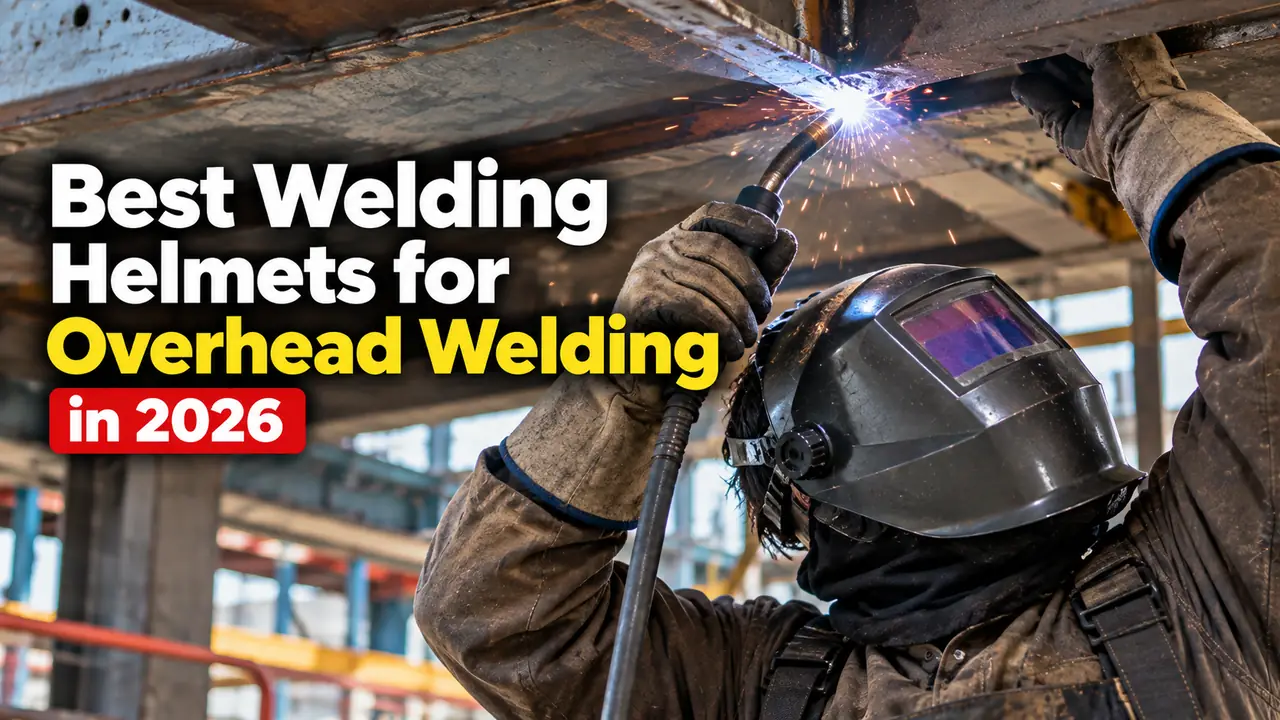
Best Welding Helmets for Overhead Welding in 2026
Overhead welding changes what matters in a welding helmet. Gravity works against you, spatter can fall toward the face and neck, and a helmet that shifts, feels front-heavy or exposes too much of the lower face can become uncomfortable quickly. The best choices for overhead work therefore need a secure fit, sensible weight distribution, useful coverage and dependable lens performance—not simply a large viewing window.
Quick Picks
Purpose-built overhead suitability, rounded front cover lens, strong optical performance and balanced headgear.
Ultra-lightweight narrow-shell design, four sensors, digital controls and weld/grind modes.
Comparison at a Glance
| Helmet | Best for | Overhead advantage | Key lens features |
|---|---|---|---|
| Optrel Crystal 2.0 | Premium overhead welding | Rounded front cover lens designed for overhead welding | Light state 2.0; automatic 4–12; 1/1/1/2 optical classification |
| Jackson Safety Insight HLX 100 | Tight spaces and lower weight | Narrow HLX shell and ultra-lightweight design | Variable 9–13; 1/1/1/1; 4 sensors |
What Makes an Overhead Welding Helmet Different?
For overhead work, the helmet’s physical design matters almost as much as the auto-darkening filter. A helmet that is comfortable in a normal flat welding position can feel very different when your head is tilted upward for long periods.
Look for four things: secure positioning, sensible weight distribution, protection from falling spatter and a lens that gives you dependable visibility without forcing excessive head movement.
Product Picks
Optrel Crystal 2.0

Why it stands out: Optrel explicitly identifies the Crystal 2.0 as suitable for overhead welding because of its rounded front cover lens. The helmet also combines a light state of 2.0 with automatic shade control from 4–12, three sensors, continuously adjustable sensitivity and a heat-reflective silver finish.
| Light state | Shade 2.0 |
| Active shade | Manual 4–12; automatic regulation 4–12 |
| Sensors | 3 |
| Optical classification | EN379: 1/1/1/2 |
| Weight | 460 g / 18.7 oz |
| Overhead feature | Rounded front cover lens |
- Manufacturer specifically lists overhead welding as an application
- Rounded cover lens helps manage overhead spatter exposure
- Very bright shade-2.0 light state
- Strong color and optical performance
- Premium price category
- 18.7 oz is not the lightest option available
- Three sensors rather than four
Amazon listing identified as ASIN B07LHDC74K. Verify the exact configuration before purchase.
Jackson Safety Insight HLX 100

Why it stands out: The Jackson Safety Insight uses a narrow HLX shell intended for tighter working areas, and its lightweight construction can be valuable when overhead positioning makes neck fatigue more noticeable. The current manufacturer listing documents four independent sensors, variable shade 9–13, digital sensitivity/delay controls and weld/grind modes.
| Shade range | 9–13 |
| Viewing area | 3.94 × 2.36 in. |
| Sensors | 4 independent sensors |
| Optical clarity | 1/1/1/1 |
| Shell | HLX lightweight nylon design |
| Modes | Weld and Grind |
- Narrow shell is useful in confined areas
- Ultra-lightweight design reduces helmet bulk
- Four independent sensors
- Digital sensitivity and delay controls
- Smaller viewing area than some premium panoramic helmets
- Less physical coverage than a full-coverage overhead-oriented design
- Exact style/variation should be checked carefully on Amazon
Amazon listing identified as ASIN B01HTMLSIY. Verify the exact style and current configuration before purchase.
How to Choose a Helmet for Overhead Welding
1. Prioritize secure positioning
The helmet should stay where you set it when you tilt your head upward. A ratcheting headgear system with useful adjustment points can be more important than adding another electronic feature.
2. Think about falling spatter
Overhead work changes the direction of falling hot material. A rounded or extended shell can provide a different level of coverage from a compact hood. Check the manufacturer’s intended use rather than assuming any helmet is equally suitable for overhead work.
3. Weight matters more than you might expect
Even a modest difference can become noticeable when the helmet is held in a tilted position for repeated passes. Weight distribution matters too: a helmet that is technically light but poorly balanced can still feel tiring.
4. Four sensors can help with awkward positioning
Sensor count is not a universal quality score, but multiple sensors can reduce the chance that the arc is blocked from all detection points when your head, fixture or workpiece changes position. The Jackson Insight, for example, uses four independent sensors.
5. Do not choose by viewing area alone
A large lens can be useful, but overhead work also demands appropriate shell geometry, fit and protection. The Optrel Crystal 2.0 is an example where the manufacturer specifically connects the rounded cover-lens design with overhead welding.
Who Should Buy
- Structural and fabrication welders who regularly work overhead.
- Pipe and maintenance welders who need a helmet that stays positioned during awkward work.
- Welders who spend long periods looking upward and want to reduce helmet movement.
- Buyers who need a balance of optical performance, physical coverage and fit rather than simply the biggest viewing window.
Who Should Not Buy
- Welders who almost never work overhead and would gain more from a helmet optimized for their dominant process.
- Buyers who choose a helmet solely from its sensor count or viewing-area number.
- Anyone who assumes a welding helmet alone provides complete protection from falling overhead material.
Common Mistakes in Overhead Welding
- Using the same helmet settings without checking fit: head position changes can affect how the helmet sits and how the sensors see the arc.
- Ignoring neck and throat coverage: overhead spatter can travel in directions that are not a concern in flat welding.
- Buying the heaviest premium helmet automatically: premium optics do not remove the physical burden of helmet weight.
- Relying on grind mode as protection: grind mode is a convenience feature, not a substitute for appropriate grinding PPE.
- Ignoring site requirements: construction and industrial sites may impose additional head-protection requirements.
Frequently Asked Questions
Look for a secure, well-balanced helmet with appropriate shell coverage and a lens system suited to your welding process. Purpose-specific overhead features are more useful than simply buying the largest lens.
Usually, lower weight and good balance can reduce the physical burden of holding your head in an upward position. But weight should be considered together with coverage, fit and lens performance.
Yes. Optrel specifically lists overhead welding as an application and says its rounded front cover lens makes the design suitable for overhead welding.
Its narrow HLX shell is designed for tight spaces, and the lightweight design, four sensors and adjustable headgear make it a practical option for awkward positions.
Final Verdict
Choose the Optrel Crystal 2.0 if overhead welding is a serious part of your professional workflow and you want premium optical performance plus a design specifically identified for overhead use. Choose the Jackson Safety Insight HLX 100 if you value a lighter, narrower helmet for tight spaces and want four-sensor detection with digital controls.
Related WeldHive Guides
- Best Lightweight Welding Helmets
- Wide-View Welding Helmets
- Best Welding Helmets for Visibility
- How to Pick a Welding Helmet
Research note: Product information was checked against current manufacturer/product sources and current indexed Amazon listing information during preparation. Prices, availability and Amazon variations can change, so no fixed current price is claimed.